Wednesday, October 24, 2018

Species Spotlight: Easter Amberwing

In Arizona, we often see Mexican Amberwings. These are small, orangish dragonflies that probably gain some protection from predation by looking and acting like wasps. On the east coast, we see another species of amberwing—the Eastern Amberwing. It looks much the same as the Mexican Amberwing, and has similar habits.

We saw several Eastern Amberwings on our trip back east this spring. Here's a male that we saw at our hotel near Boston, MA:


Notice the orangish (waspish) color, and the body that is rather short and stocky for a dragonfly. Notice also the light spot on the side of the thorax.

Male amberwings patrol their territory, looking for suitable egg-laying locations. After mating with a female, males lead her to the chosen egg-laying site, where the males dip—as if they were laying eggs—to induce the female to lay eggs. The female may or may not find the site suitable; if she does, she will begin to lay eggs there.

Here's the female Eastern Amberwing:


Notice the darker, less prominent color of the female, the light spot on the side of the thorax, and the splotchy spots in the wings. Females perch away from the water, where they blend into the vegetation, until they are ready to lay eggs.

P. S. My field guide, Common Dragonflies and Damselflies of the Pacific Coast, has been hard for Amazon to keep in stock—it keeps selling out faster than they can get new books in the inventory. It's back in stock now, and is available for a particularly good price, at the following link:

Field Guide

Friday, October 19, 2018

Mount Baker

We went to Mount Baker yesterday. It was lovely, with temperatures in the mid 60s, beautiful scenery, and some fun birds and dragonflies. First, here's the view at Picture Lake, with Mount Shuksan (just over 9,000 ft in elevation) in the background:


Here's Mount Baker, with Betsy on the trail:


In this area we saw some Pine Siskins and Bohemian Waxwings. Here are a couple views of them:

Bohemian Waxwing (left), and Pine Siskin (right).


Notice the yellow tips on the primaries, and the two white splotches on the side of the wings. I was surprised to see Bohemian Waxwings, as opposed to Cedar Waxwings, and so was eBird—I had to file a rare species form for this sighting.

We also saw some darners, including one that did a series of three splash-dunks followed by a nicely visible spin-dry. We saw a couple different species flying by, but only one landed for us—a Paddle-tailed Darner (Mr. Happy-face).


What a beautiful day.

Saturday, October 13, 2018

Species Spotlight: Desert Whitetail

The Common Whitetail, as its name implies, is a commonly occurring dragonfly. We see it here in Washington, of course, but also in Oregon, California, Arizona, and even back east in Massachusetts. What is not so common, however, is the Desert Whitetail. This is a species that we've seen just one time in one location—Tuba City, Arizona.

Tuba City is a nice little Navajo town north of Flagstaff. You can see its location on the map below:


Just to the east of town is Pasture Canyon Reservoir, where we had been told you could see Desert Whitetails. Here's its location:


We went to Tuba City a couple years ago to see an annular eclipse of the sun, and to look for Desert Whitetails. We went to Pasture Canyon Reservoir, which is quite a good place for birds and dragonflies. We saw all kinds of dragonfly activity at the reservoir, but no Desert Whitetails.

We returned a year later and tried once more. Again no luck at the reservoir, but on our way back we noticed a little stream, more like a trickle in a small ditch, carrying runoff from the reservoir. We stopped just on the off chance there might be some dragonflies there. As soon as we got out of the car we saw Desert Whitetails flitting along the length of the stream, along with some Flame Skimmers and other dragonflies. Very nice!

Here was our first good look at a Desert Whitetail. Notice that it has considerably more pruinosity near the base of the wings than a Common Whitetail. Other than that, the species are quite similar.


Here's a closer look at one perched on the shore of the stream:


Delightful. We always enjoy visiting Tuba City, and plan to do so again this year.

Here's a write up of our eclipse trip to Tuba City. It was our first annular eclipse:


Betsy and I went to Tuba City, where we stayed at a nice, new Inn on the Navajo Reservation run by the Hopi Indians. It was quite a lovely place to stay.

Moenkopi Legacy Inn. We had breakfast out by the pool.

A nice little manmade stream and pool in the courtyard area.


A sample of the Hopi art in the lobby.

Though the Inn was wonderful enough, the real treat for us was the chance to observe the annular eclipse of the Sun. I set up my spotting scope to project an image of the Sun on a poster board, and used the backdoor of the Rav 4 to put the poster board in the shade. The results were quite good.

The beginning phases of the eclipse. Notice the two prominent groups of sunspots.

The top group of sunspots is disappearing behind the Moon.

Deep into the initial phase of the eclipse now, with both groups of sunspots covered.

The beginning of the annular phase of the eclipse.

A nice full ring of fire. About this time we experienced a noticeable chill in the air due to reduction of sunlight.

Annular eclipse of the Sun.

The Moon is moving away from the Sun now, and the top group of sunspots is coming into view again.

Observing an eclipse.

Two weeks before this eclipse we had a "super moon," due to the full moon coinciding with perigee, the closest approach to the Earth. As a result, this new moon is at apogee, the farthest distance from the Earth, which makes it appear smaller. That's why the eclipse is annular as opposed to total – the Moon is too small at apogee to completely cover the Sun.

Oh, one more experience awaited us after the eclipse was over. We went to the Hogan Restaurant here in town and had a delicious Navajo Taco. Definitely a Tuba City Treat!

Monday, October 8, 2018

Wing Beats in Egg-Laying Cardinal Meadowhawks

Cardinal Meadowhawks lay eggs while the males and females hover in tandem—this is how the male guards "his" female in this species. Here's a photo of a pair of Cardinal Meadowhawks hovering in tandem over an egg-laying site:


They hover for a second or two as the female gets an egg ready to be laid, then they dip down and drop off the egg. Here's a short video clip showing an egg-laying dip:


This video was shot at 240 frames per second, and a frame-by-frame analysis reveals a number of details of the tandem flight. First, the wingbeat frequency during this hovering flight is approximately 48 beats per second. That's a blur in real time, but in the slow-motion video you can follow each individual wing beat.

In addition, it's possible to see how the wing beats of the male and female are related to one another. One might think they flap in sync, but that's not the case. Alternatively, one might think they flap independently, but again, this is not the case. What they do is the following:

(1) The female's hindwings flap first.

(2) After 2/5 of a cycle, that is 144˚ of phase later, the female's forewings flap in unison with the
      male's hindwings. This is the key aspect of the hovering flight.

(3) The male's forewings flap 1/5 of a cycle (72˚) later.

(4) Finally, 2/5 of a cycle (144˚) later the female's hindwings flap for the next cycle.

There's a definite relationship between how the male and female flap, it's just not what one might imagine.

Here's a plot that shows the wing positions for both the male and female as a function of time for two cycles:


This same type of phase relationship between the male and female has been seen in Red-veined Meadowhawks. It will be interesting to see how widespread this behavior is among other species.

Wednesday, October 3, 2018

A Hovering Happy Face

One of the delights of the Fall season is that Paddle-tailed Darners are out in numbers. They can be seen patrolling the shoreline of lakes, ponds, and ditches. They also hover frequently, as they keep a close watch on their territory. Here's an example of the hovering behavior:


These dragonflies are beautiful, elegant fliers.

When hovering, they flap their wings out of phase—but not 180˚ out of phase. Recall that 180˚ out of phase means that the wings are moving in opposite directions—one goes down when the other goes up. What is observed in this video, however, is a phase difference between the wings of 100˚. With this phase difference, the wings flap in such a way that when one is at it's maximum downward position, the other is at its horizontal location.

For a specific example, when the hindwings flap downward, the forewings follow a short time later, so that when the hindwings are at the bottom of their stroke, the forewings are at the horizontal position on their way down. When the forewings are at their maximum down position, the hindwings are horizontal on their way up. Flapping out of phase like this improves efficiency, allowing for minimum energy expenditure as they hover.

In contrast, when dragonflies want to accelerate and reach maximum speed they flap their wings together. This is less efficient, and hence requires more energy, but the tradeoff is worth it when the desire is to get moving quickly to chase a rival or a potential mate.

Monday, September 24, 2018

A Real Head Turner

Darners use a variety of means to clean themselves. A particularly "splashy" method is the splash-dunk, followed by a spin-dry to dry off.

They also clean their eyes with their legs. The following video shows a Paddle-tailed Darner (the Happy-face Dragonfly) cleaning its eyes as it rests on its perch. Note the extreme flexibility of the eyes, which can rotate by at least 135˚.


Their eyes are beautiful, almost like small gemstones. Notice that the pseudopupils keep pointing toward the viewer as the head rotates, but that the "eyebrows" move with the eyes themselves. The eyebrows are actually pigment on the surface of the eyes, and are a permanent feature, visible even when the dragonflies dies.

Thursday, September 20, 2018

It's Tule Time!

Betsy and I have been to Cranberry Lake the last several days enjoying the beautiful Fall days. The weather has been lovely, and the dragonfly activity has been interesting. Yesterday there were lots of Paddle-tailed Darners perched in the bushes (6 to 8 at a time), and many pairs of Autumn Meadowhawks flying in tandem.

We also saw lots of bluets, but the funny thing was they were all Tule Bluets, like the ones below:


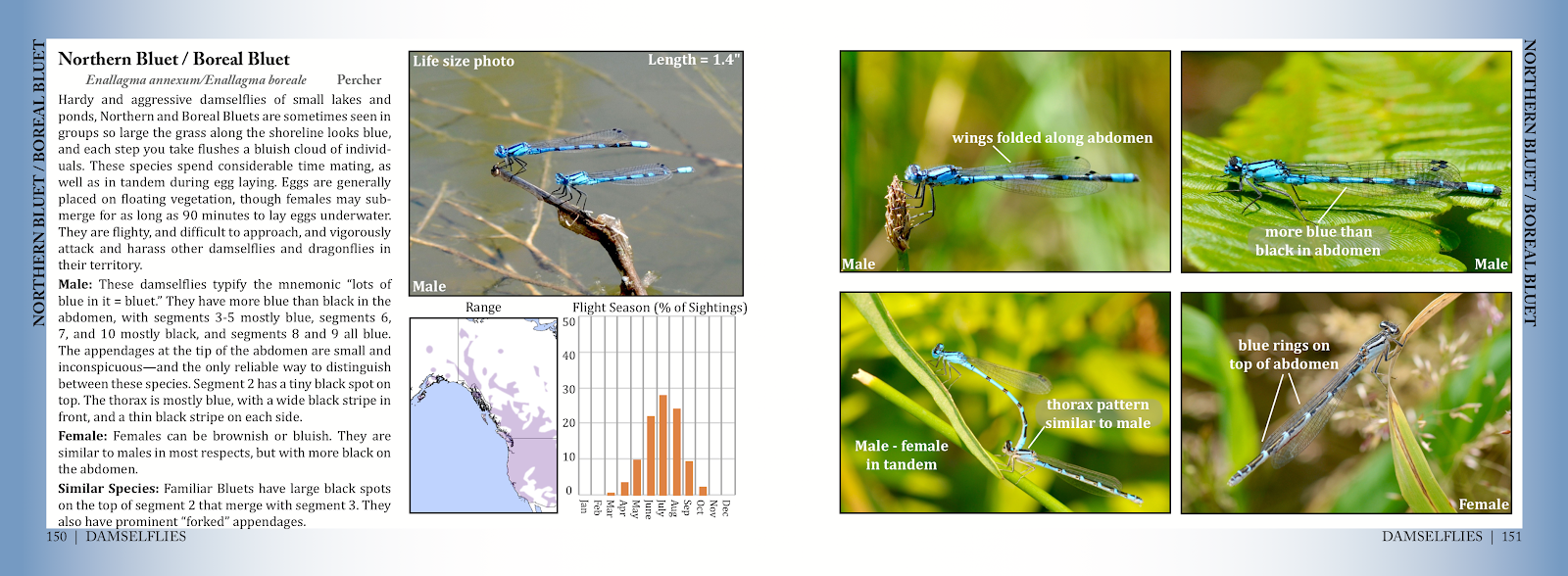
Notice that these bluets have roughly equal amounts of black and blue on the middle segments of the abdomen. In comparison, Northern and Boreal Bluets have mostly blue with small rings of black. You can see this comparison in the pages from my field guide, Common Dragonflies and Damselflies of the Pacific Coast, shown below:


You can find the field guide on Amazon, at the following link:

https://www.amazon.com/Common-Dragonflies-Damselflies-Pacific-Coast/dp/1934199265/ref=sr_1_1?ie=UTF8&qid=1537462425&sr=8-1&keywords=dragonflies+pacific

I was surprised to be seeing only Tules, but on consulting my field guide, I see that it is twice as likely to see Tules in September.

As with all bluets, the Tules are aggressively territorial. Here is one harassing a pair of Blue-eyed Darners:


We filmed a "cloud" of bluets at Cranberry Lake a couple days ago, and noticed that they are very accomplished at flying backwards. Here's a short video clip showing one flying in reverse:


Here's a group of them backing up in unison, like some kind of bluet line dance:


Fascinating creatures, coming or going.