Monday, February 18, 2019

Splash-Dunk/Spin-Dry Analysis for 2011 to 2018

The splash-dunk/spin-dry behavior is an interesting, and previously unreported, aspect of dragonfly behavior. Here's an illustration of the basic features of the behavior:


A dragonfly—often a male Paddle-tailed Darner—plows headfirst into the water (the splash-dunk) a number of times to bathe. When satisfied that it is sufficiently clean, it gains altitude and spins head-over-heels at 1,000 rpm to dry off. This is the spin-dry. The dragonfly spins about a horizontal axis during the spin-dry, like a bicycle wheel, as indicated in the following illustration:


We first started taking data on this behavior in 2011, and since that time we've observed 762 separate splash-dunks events. For each event, we record the number of splash-dunks, which ranges from 1 to 8. The distribution of splash-dunk numbers in an event is shown below:


Notice that roughly 40% of the events consist of a single splash-dunk, many have 2 or 3 splash-dunks, and a couple events have had 8 splash-dunks. The average number of splash-dunks per event is 2.32, which is unchanged to three significant figures over the last three years.

The temporal distribution of splash-dunks has also been stable over the last few years. Here are the results for the number of splash-dunk events seen per month from 2011 to 2018:


The peak of the season is September, which also—not coincidentally—is the peak of the flight season for the Paddle-tailed Darner.

We also keep track of the number of spin-drys seen at the end of an event. Here are the results:


In almost 30% of the events, a spin-dry isn't seen, either because the dragonfly didn't do a spin-dry, or—more likely—because it did a spin-dry out of view. A single spin-dry is seen in about 65% of the events. Sometimes a dragonfly does a spin-dry, and then immediately does another. This is seen in roughly 5% of the events. In addition, a couple events results in 3 spin-drys.

With so many events observed over the last 8 years, the results have become very stable and reproducible from year to year.

Thursday, January 24, 2019

Species Spotlight: Flame Skimmer

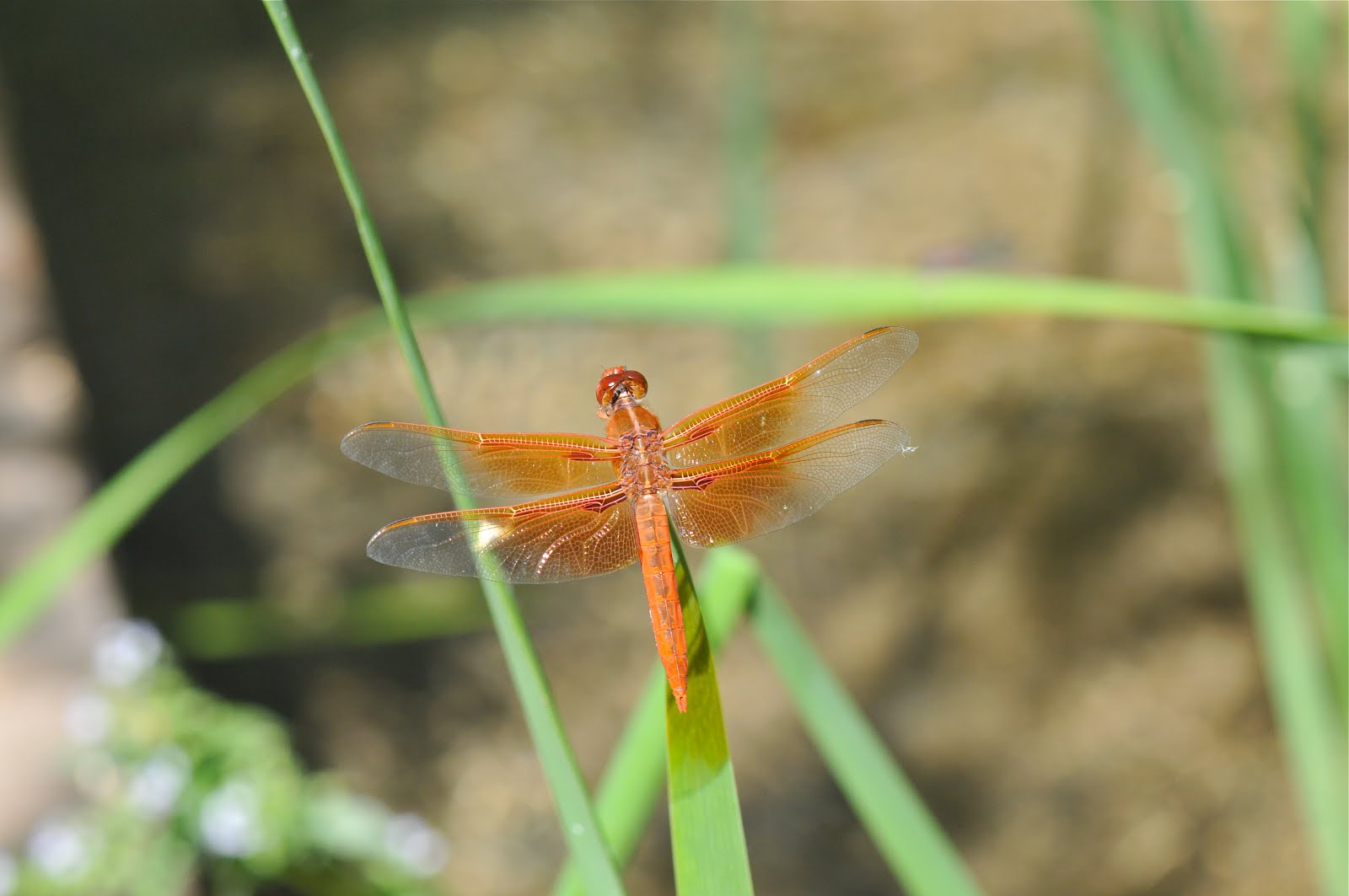
Next up in the spotlight is another striking skimmer—the Flame Skimmer. This flame-colored species is quite common in the southwest, but it is also found in Northern California, Oregon, and just recently a sighting was made in Washington, just across the Columbia River from Oregon.

Here's a look at a male Flame Skimmer:


This species is distinguished from the similar Neon Skimmer by having dark-red rectangular "bars" at the base of the wings, near the leading edge. In addition, the coloration in the wings extends beyond the nodus—the bend in the leading edge of the wing—but stops short of the nodus in the Neon Skimmer.

The female of the species is more lightly colored, as seen below:


Notice the "flange" near the tip of the abdomen, which is the female's "egg scoop".

Here are some additional views of the male:


The next photo shows a common practice of this dragonfly—it often perches with its front two legs tucked up behind the head.


Many dragonflies perch this way, and even fly in this configuration.

Thursday, January 17, 2019

Species Spotlight: Filigree Skimmer

Next up in the species spotlight is a dragonfly with rather striking markings—the Filigree Skimmer. This dragonfly has striped eyes, which is unusual for dragonflies, and complex stripes along the abdomen. In addition, its wings have an intricate, splotchy pattern of dark markings. Here's an example of a male Filigree Skimmer:


We typically see the Filigree Skimmer flying and perching along small streams in Arizona. Good places to find them are on Queen Creek in the Boyce Thompson Arboretum, and on Tortilla Creek at Tortilla Flat.

Here's another view of the individual shown above:


The next photo shows the wing and abdomen patterns more clearly:


Finally, here's a side view of a female Filigree Skimmer:


The "egg scoop" projecting downward near the tip of the abdomen identifies it as a female. Notice that its coloration and markings help it blend into its surroundings.

Tuesday, January 1, 2019

Happy New Year, 2019!

Well, it's here—2019. Here's wishing you and yours a healthy and fulfilling New Year.


And may it be a happy New Year as well!

In today's Rose Parade there was one float that caught my eye. It had a Japanese Garden motif, including dragonflies perched on cattails. Here's the concept drawing for the float:


I hope 2019 provides you with many delightful (and happy) dragonfly experiences.

Tuesday, December 25, 2018

Merry Christmas, 2018!

Merry Christmas 2018, and Happy Holidays!


Special greetings from the Happy-face Dragonfly:


To help us all get in the Christmas spirit, here's a physics problem from Walker Physics involving Santa:


The situation can be visualized as follows:


And now for the calculation:


Here's a bit of insight into the results:


Ah, nothing like a physics calculation to add to the enjoyment of a day.

Merry Christmas!

Wednesday, December 12, 2018

Species Spotlight: Fiery-eyed Dancer

Here's a species of damselfly I don't see very often; the Fiery-eyed Dancer. I've seen it at Lake Patagonia in southern Arizona, near the Mexican border, and at the Hassayampa River, near Wickenburg, Arizona.

For a long time those were the only places I encountered this species—and then, unexpectedly, I found one in late May at the Boyce Thompson Arboretum. It may be more common there later in the year, but we're back in the Pacific Northwest then.

In any case, here it is:


Here's a bit closer look:


The bright red on the eyes makes the origin of the name quite obvious, and the identification very easy. In addition, it's clear this is a dancer by the way it holds its wings well above the abdomen.

I hope I get more opportunities to see this striking damselfly.

Monday, December 3, 2018

Late, Late Season Dragonflies

After the last post about late season dragonflies, I wasn't sure if there would be any additional dragonflies to report on this year—especially since the weather turned gray and wet for several days after our last visit. I thought that might signal the end of the dragonfly season once and for all. Well, it turns out they're still flying.

We went up to Little Cranberry Lake yesterday at noon. Nothing. It was overcast and 44 ˚F. We went back home and had lunch. Then around 1 pm the clouds cleared and the sun came out. We returned to the lake and immediately saw an Autumn Meadowhawk sitting on the bench by the dam. It flew around some, and perched in various places. It seems that we only saw one individual, but one is a lot more than zero. I hadn't brought my camera with me, so I don't have a picture of that one. I thought I might have missed my opportunity for a last photo of a dragonfly this year.

This morning we awoke to a heavy frost outside that looked like snow covering the ground. We thought maybe that was it, for sure. Even so, we went back up to the lake at noon. It was sunny and calm, but only 40 ˚F.

At first, we saw no activity. Then I thought I saw one zip by behind me, but I couldn't be sure. Then, a few minutes later, I saw one perched on the dam. I brought the camera with me this time, so I took some pictures. Here's the male Autumn Meadowhawk we saw today:


This one flew around to various different perches, then Betsy saw another one, and I saw yet another one after that, so there were at least a few flying on this sunny, cold day. The Autumn Meadowhawk is a hardy soul!