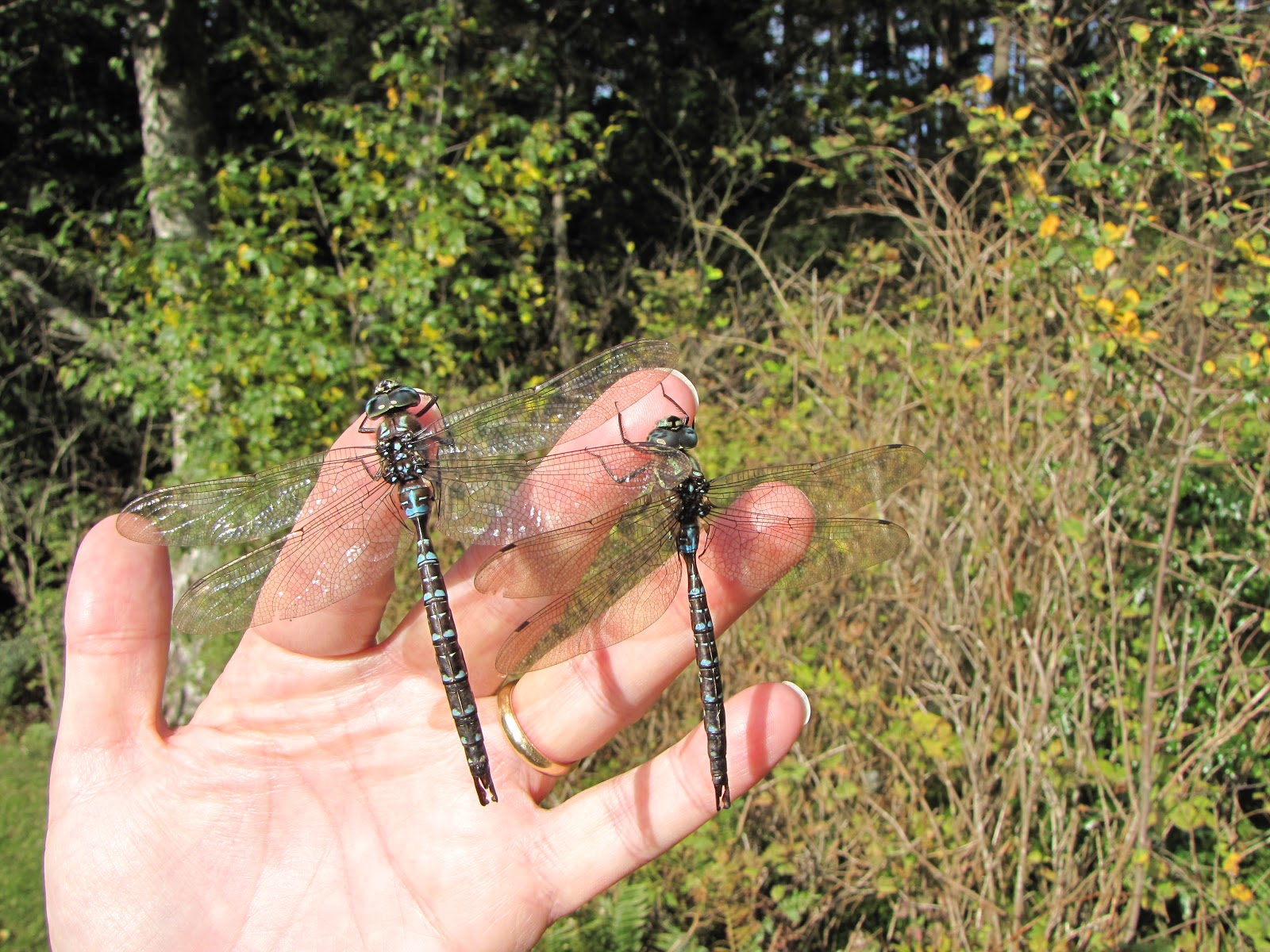
Here's an article I've just submitted to Argia, the journal of the Dragonfly Society of the Americas. The article details my observations of darners interacting more and more aggressively as the end of the flight season nears.
Male-Male Interactions in Darners
James S. Walker
Anacortes, Washington
Cranberry Lake in Anacortes, WA (Figure 1) is a wonderful place to observe dragonflies – especially darners. The first species to start flying is the California Darner (Rhionaeschna californica), followed in short order by the Blue-eyed Darner (Rhionaeschna multicolor). Later in the season, in October and November, the darner population shifts to Paddle-tailed Darners (Aeshna palmata), with a few Shadow Darners (Aeshna umbrosa) tossed in for good measure. As a result, Cranberry Lake is an excellent place to observe darner behavior throughout the flight season.

Figure 1 Cranberry Lake, home to many darners.
Over the years, it has become apparent that the way darners interact with one another evolves as the season progresses. Early in the season, darners fly in mixed flocks – though comprised mostly of males – at convenient hill-topping locations, where the individuals hunt for prey peacefully with little interaction (see the online video links at the end of this article). This is the time when the darners are feeding to attain maturity, after which they return to nearby ponds or lakes to mate.
As the season progresses, and more and more darners are present at local waters, the interactions begin in earnest. In what follows, I describe the types of interactions, and the changes in behavior, observed at Cranberry Lake – both during the peak of the season, and extending well into the final days of flight.
Peak Season Interactions
Interactions during the peak of the season are observed to be rather benign and, one might almost say, gentlemanly. Darners patrol the shoreline of their territory, looking for rivals, mates, and prey. When a second darner flies into the territory of a resident darner, the resident flies toward the intruder. Typically, what happens next is a respectful assessment of the situation, in which the intruder changes course to navigate out of the disputed territory. Once the resident darner observes the change in trajectory of the intruder, it changes course as well, and returns to its territory.
As mentioned, these interactions are usually peaceful affairs, with no physical contact between the competing darners. The darners approach to within a few feet of one another, veer off as they change course, and go their separate ways. As the season progresses, the situation changes.
Late Season Non-Contact Interactions
Late in the season, when the days are growing shorter, the air is getting cooler, and the biological imperative to mate is intensifying, the interactions between darners takes a decidedly aggressive turn. The first signs of change are apparent in the way a resident darner interacts with an intruder. Often we see that instead of veering away from the intruder once the intruder is heading out of the territory, the resident keeps up a prolonged chase – though, again, generally without physical contact.
In such cases, I’ve observed the resident male persist in chasing the intruder to an extent that seems, to a human observer, beyond all reason. Even though the intruder is clearly departing the area, and seems no longer to pose a threat, the resident darner expends a great deal of energy and time in an extended chase.
Sometimes, the intruder is so pressured by the resident that its wings clip the water as it zigs and zags trying to escape. In other occasions, the intruder intentionally plunges into the water in a splash/dunk (Walker 2011-2014, and online video), and then, as the pursuing resident continues on its course, the intruder emerges from the water and takes off in the opposite direction. Clearly, drastic circumstances result in drastic measures.
The aggressive harassment described above still results in no physical contact. Cases that do involve contact become more and more common as the season progresses.
Late Season Contact Interactions: The Final Days of Flight
As the end of the flight season approaches, the interactions between darners become more frequent, and more physical. Males are seen to attempt to attach in tandem with other males, and to grapple with one another in flight for extended periods of time. The whole tenor of their interactions changes.
The first sign of contact interactions is observed in perched darners. Even though darners are flying dragonflies, they do perch from time to time to rest, eat large prey, or sunbathe. They hang vertically in a bush with full exposure to the sun, as shown in Figure 2. It’s common to find 3 or 4 darners perched at a time in the bushes near the shore of Cranberry Lake in peak season, but the number roughly doubles or triples near the end of the season, as more darners seek to warm themselves in the sun.

Figure 2 A perched Paddle-tailed Darner at Cranberry Lake in its usual vertical orientation.
In late season, there may be a dozen darners perched in the bushes, but still with plenty of room to accommodate all of them. Even so, they are often seen perched near one another, as in Figure 3. What’s really odd, though, is that a darner coming in to perch often lands on an already perched darner. Close observation reveals that the incoming darner lands on the thorax of the perched darner, and bends its abdomen downward and forward in an apparent attempt to attach in tandem. At this point the perched darner takes off, and the two darners continue their interaction in flight.

Figure 3 Two darners, a Shadow Darner on the left and a Paddle-tailed Darner on the right, perch near one another.
At the same time, many in-flight interactions can be seen along the shoreline. Competing darners no longer veer off in different directions, or engage in extended pursuits, but aggressively grab one another in flight. In some cases I’ve captured in slow-motion videos (see online videos), the two darners hang on to one another and spin round and round in flight – much as two eagles locked together with their talons. In one particular case, they grapple with one another for 1.9 seconds as they fall toward the water, only releasing their grip just before splashdown. They gain altitude for 0.75 seconds, and then go back at one another, clenching for another 2.3 seconds, before taking off for more interactions.
In another case, the two darners actually landed in the water as they struggled. While floating there, the top male repeated banged the tip of its abdomen against the head of the darner below it for over 4.5 seconds, as it tried mightily to attach in tandem. It finally gave up, flew upward to gain altitude, and 0.9 seconds later the other darner managed to escape the water as well. Interactions like this were common at this time of year.
These observations are only anecdotal, and may not present an accurate picture of darner behavior throughout a season. Additional observations will form a more complete picture, but so far it seems that darner interactions are much more aggressive and physical late in the season, when the darners only have days left to fly.
Conclusion
Darners interact with one another frequently all year long, but their interactions become more intense and physical in the waning days of their flight season. Males land on one another, or grab one another in flight, and appear to attempt attachment in tandem. Late season interactions lead to explosive events at Cranberry Lake in October and November, and likely the same type of behavior can be observed at any location with a healthy darner population.
Acknowledgements
I would like to thank Betsy Walker for her support and help with these observations.
Literature Cited
Walker, J. S. 2011. Spin-Dry Dragonflies. ARGIA 23(3): 29-31.
Walker, J. S. 2011. Splash-Dunk Analysis. ARGIA 23(4): 29-30.
Walker, J. S. 2014. Splash-dunk Analysis for 2011-2013, Including Temporal Distribution. Argia 26(1): 33-34.
Walker, J. S. 2014. Splash-Dunk Analysis for 2011-2014. Argia 26(4): 32-33.
Online Video Links
A number of slow-motion videos showing various aspects of dragonfly behavior can be found on the Dragonfly Whisperer channel on YouTube. Here are a few that are pertinent to this article:
Non-interacting darners in a feeding group.
Soaring Darners with Mount Baker
Gentle, non-contact interaction with zig-zag flight.
Darners interact, by The Dragonfly Whisperer
Non-contact chasing. The pursued darner escapes with a splash-dunk.
Darners interact with splash-dunk escape, by The Dragonfly Whisperer
Contact interaction. Darners hold on to one another until they hit the water.
Darners grab one another and fall in the water, by The Dragonfly Whisperer
Extended contact interaction.
Male darners interact big time, by The Dragonfly Whisperer
Males struggling in the water as one attempts to attach to the other.
Male darners struggle in water, by The Dragonfly Whisperer