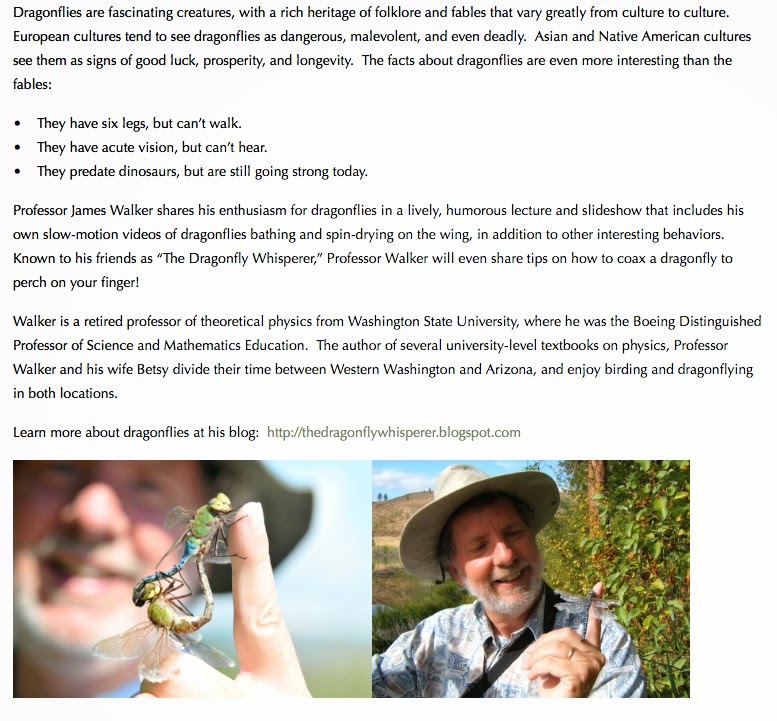
Showing posts with label dragonfly whisperer. Show all posts

Tuesday, March 17, 2015

The Whisperer Speaks!

Greetings Dragonfly Enthusiasts!

The Dragonfly Whisperer will be speaking again tomorrow night (March 18) in Sedona, AZ, and again on Thursday night (March 19) at Flagstaff, AZ.  Here's the ad for talks:


Here's the handout for the talk.  Feel free to download it and print it on your own printer.


I hope to see you there.  Should be a fun evening.  Be sure to come up and say "Hi."

Saturday, February 14, 2015

Happy Valentine's Day!

Happy Valentine's Day from the Dragonfly Whisperer and the Happy-face Dragonfly:


In addition, Happy Valentine's Day wishes from the Calico Pennant, which has a series of heart-shaped spots on its abdomen.  Here it is:


A beautiful dragonfly, and very much in the Valentine's Day spirit.  Perhaps it's name should be changed to the Valentine's Pennant.

Friday, January 2, 2015

January 2015

Here's a calendar for January 2015, featuring various dragonfly photos as a reminder of what we can hope to see this summer:

Thursday, September 11, 2014

Anacortes Field Trip: Saturday, September 13

Greetings Dragonfly Enthusiasts!

I can hardly believe how favorable the forecast is for this Saturday, September 13.  The weather's great, the dragonflies are out, and all systems are go!

Here are some details:

Field Trip Plans

1).  Start around 11:00 am at Heart Lake in Anacortes.  Heart Lake is right next to the road that takes you up to the top of Mt. Erie.  Meet in the southeast corner of the parking lot, which is the area farthest from the boat launch.

2).  Go to Smiley's Bottom around noon for a lunch break and to use the facilities there.  We will carpool at that location and proceed to Cranberry Lake.

3).  Arrive at Cranberry Lake around 1:00 pm.  This is where we hope to see some splash-dunking and spin-drying.  We'll probably finish up and return to Smiley's Bottom around 2:00 or 2:30 pm, depending on the activity level.

Here's a map showing the relevant locations:


To help you prepare for the field trip, here are photos of the damselflies and dragonflies most likely to be seen Saturday:

Clockwise from upper left: Spotted Spreadwing, Tule Bluet, Northern/Boreal Bluet, Pacific Forktail.

Clockwise from upper left: Paddle-tailed Darner, Paddle-tailed Darner (Mr. Happy-face), Shadow Darner, Blue-eyed Darner.

Clockwise from upper left: Cardinal Meadowhawk, Autumn Meadowhawk, Four-spotted Skimmer, Eight-spotted Skimmer.

Clockwise from upper left: Blue Dasher (male), Blue Dasher (female), Western Pondhawk (female), Western Pondhawk (male).

We look forward to seeing you this Saturday!

Monday, September 8, 2014

The Whisperer Speaks Tomorrow!

Greetings Dragonfly Enthusiasts!

Just a reminder of the presentation "Adventures With Dragonflies" to be given tomorrow evening at the Skagit Audubon general meeting.  Details, including time and location, can be found at the following links:

http://www.skagitaudubon.org

http://thedragonflywhisperer.blogspot.com/2014/09/the-whisperer-speaks-next-week.html

We look forward to seeing you there!

Below you will find a "Dragonflies 101" handout for tomorrow's talk.  It includes some of the key concepts to be covered.  Feel free to print a copy and bring it with you to take additional notes.


Field Trip
Don't forget about the field trip we've been planning for Saturday, September 13.  The weather forecast looks favorable, and the dragonfly activity is quite high, so all indications are go.  Here are the basic plans for the field trip:

1).  Start around 11:00 am at Heart Lake in Anacortes.  Good dragonfly activity here, including lots of perching, so bring a spotting scope if you have one.  Binoculars and cameras are great, too.  For recent adventures at Heart Lake check the following links:

http://thedragonflywhisperer.blogspot.com/2014/08/pondhawks-plenty.html

http://thedragonflywhisperer.blogspot.com/2014/09/i-heart-heart-lake.html

2).  Go to Smiley's Bottom around noon for a lunch break and to use the facilities there.  We will carpool at that location and proceed to Cranberry Lake.

3).  Arrive at Cranberry Lake around 1:00 pm.  The splash-dunk/spin-dry activity is quite high right now (this is the peak of the season), and we should have no problem seeing a number of events.  Also a good location to see perching Happy-face Dragonflies.  We'll probably finish up around 2:00 or 2:30 pm.

More details, including maps to the various locations, will be provided in a follow-up notice on Wednesday.  It should be fun to take some of information provided in the talk and apply it in the field!

Wednesday, September 3, 2014

The Whisperer Speaks Next Week!

Greetings Dragonfly Enthusiasts!

Betsy and I are looking forward to seeing you at the next meeting of Skagit Audubon, on Tuesday, September 9, where we will give a presentation entitled "Adventures With Dragonflies."  We also plan to lead a dragonfly field trip the following Saturday, September 13, weather permitting.

More information on the presentation is given below:


Stay tuned for additional information, including handouts and updated information about the planned field trip, and be sure to visit Skagit Audubon for more information about birding in Skagit County at http://www.skagitaudubon.org.

Feel free to bring your dragonfly photos, questions, or stories to share with the whisperer.

Monday, September 1, 2014

I Heart Heart Lake

We had a great time at Heart Lake a few days ago.  The lake gets its name from its very rough heart shape, as can be seen in the following map:

Heart Lake (center, bottom) in relation to downtown Anacortes.

In addition to the numerous Western Pondhawks that were there a couple days ago (see this post), we also observed a number of other dragonflies, including Blue Dashers and Eight-spotted Skimmers.

Perhaps most striking was the Cardinal Meadowhawk, with its intense red colors showing off nicely in the bright sun.  Here's an example of one of the males:

Male Cardinal Meadowhawk at Heart Lake.

In this next view you can see what I regard as its best field mark, the intense concentration of red color near the wing bases.

Male cardinal Meadowhawk.  Notice the dark red, opaque regions in the wings near the base.  An excellent field mark.

This field mark is completely diagnostic, and visible from almost any angle.  I'm always surprised field guides don't make a bigger deal of it.

Notice also the intense red color on the abdomen.  It almost over saturates the eyes.

The Cardinal Meadowhawks were also laying eggs, which they do while attached in tandem.  Here's an example:

Cardinal Meadowhawks laying eggs in tandem.  The female dips the tip of her abdomen in the water to deposit her eggs.

While this pair was laying eggs, a lone male was trying to break them apart so he could replace the current male, as can be seen below.  It didn't work, though he was pretty persistent.

A lone male Cardinal Meadowhawk unsuccessfully attempting to break apart an egg-laying pair.

Tuesday, August 26, 2014

Pondhawks A-Plenty

Western Pondhawks are not that common in Anacortes.  Typically, we'll see maybe one a year, if that, and usually a female.  We saw a female on our field trip recently, and it was a bit of a surprise.

Yesterday, Betsy and I went to Heart Lake in Anacortes, which is near the road to the top of Mount Erie.  We've been there in the past, but hadn't seen a lot of activity.  That certainly wasn't the case yesterday – dragonflies were all over the place, and one of the most common was the Western Pondhawk.

The body of the adult male Western Pondhawk is solid blue, it's eyes are blue to green, and its face is green, with a nice Groucho Marx mustache.  Here are a couple pictures of adult males from yesterday:

Male Western Pondhawk.  Notice the Grouch Marx mustache.


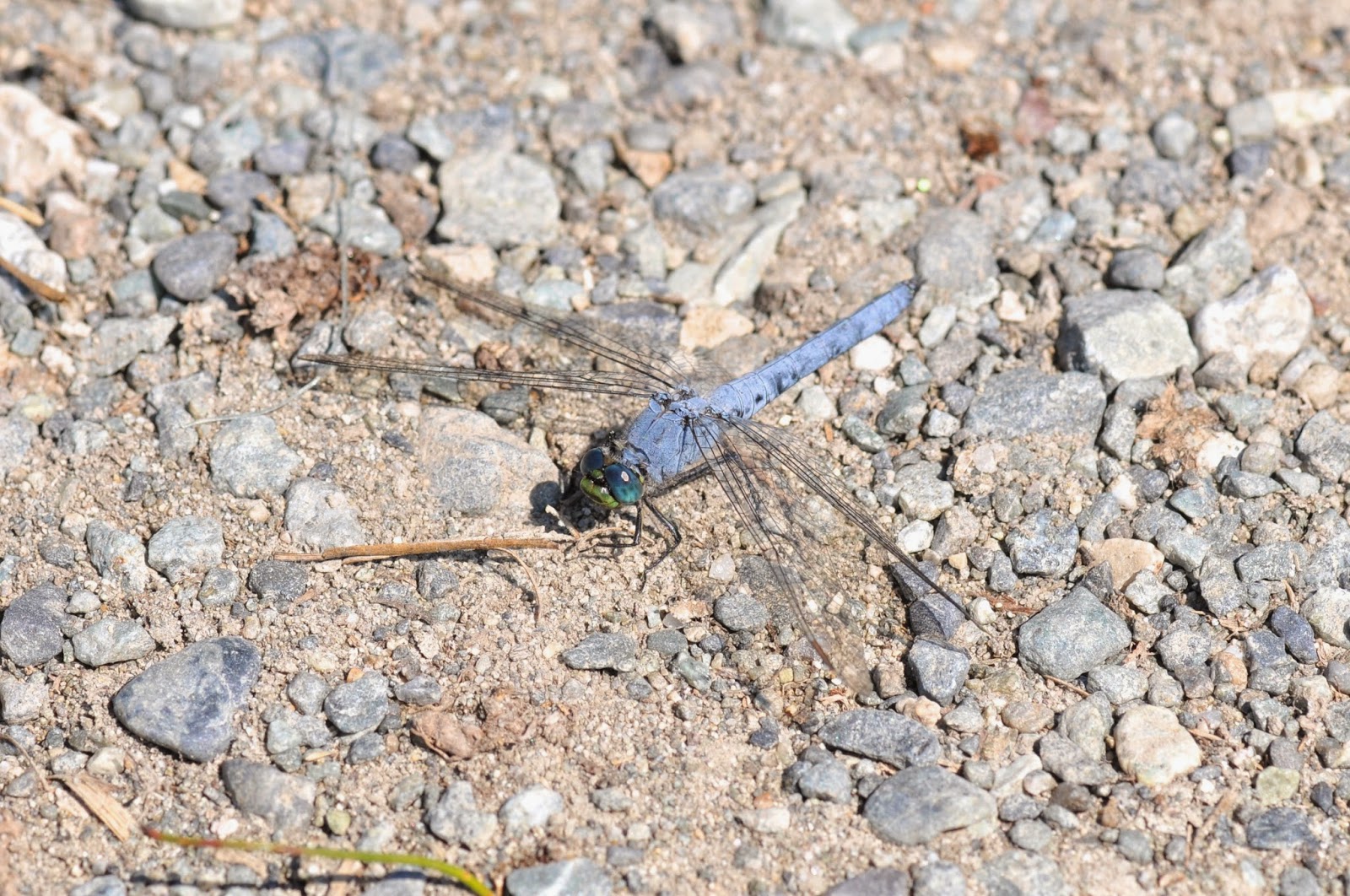
Notice that these photos show the male perched on the ground.  That's where they prefer to perch, and in fact a good rule of thumb is "blue dragonfly on the ground = Western Pondhawk."  Our other blue dragonfly is the Blue Dasher.  It looks a lot like a Western Pondhawk, but I've never yet seen one of them land on the ground.

The female Western Pondhawks are all green.  In fact, Western Pondhawks are our only green dragonflies.  Here's a photo of one of the many females we saw at Heart Lake:

Female Western Pondhawk.

Male Western Pondhawks start off green, like females, not unlike many bird species where the young look like females.  As the male matures it turns blue from the tip of the abdomen forward, with everything becoming blue except the face, which retains its green color.  We saw many "transitional" males at Heart Lake, like the one shown below:

A "transitional" male Western Pondhawk about half way through its changeover from green to blue.

Look for more about our Heart Lake observations to come.

Wednesday, May 21, 2014

The Whisperer Speaks Tomorrow!

Here's sort of an engraved invitation to tomorrow's dragonfly talk, by way of the Vitruvian Darner:


This dragonfly (the Happy-face Dragonfly) shows the nice proportions of da Vinci's Vitruvian Man.

I was curious how these proportions would compare with other dragonflies, so I tried a Vitruvian Glider, based on a Wandering Glider:


Not surprisingly, the broad, wide wings of the glider give it distinctly different proportions.

Both of these sketches were taken from photographs, so the proportions are true to life.

Off to Prescott tomorrow.

Monday, May 19, 2014

The Whisperer Speaks: Dragonfly 101 Handout

I've prepared a handout to go along with my upcoming talk for Prescott Audubon.  Unfortunately, I don't know how many to expect at the meeting, so it's probably best to post the handout here where everyone can have a copy if they like.


This should make the handout available to a wider audience, and also provide a color version suitable for printing at home.  Please feel free to print out a copy.  No need to bring it with you, unless you want to use it to take notes.

See you there, Thursday.

Thursday, May 15, 2014

The Whisperer Speaks in One Week!

In just one week, on Thursday, May 22, 2014, The Dragonfly Whisperer speaks at the general meeting of the Prescott Audubon Society.  They've been kind enough to invite me, and I'm looking forward to a fun evening.  We also plan to conduct a dragonfly walk the following day.

They have a very active organization, with lots of different programs, and they've produced some excellent promotional materials to advertise the talk.  Here's an example:


That should attract some attention.  Even the Vitruvian Dragonfly is getting into the act:


Prescott Audubon's website contains more specific information:


Be sure to say "Hi" if you can make it to the presentation.  Betsy and I will be looking onward to seeing you..

You can find more information about Prescott Audubon at their website:

http://prescottaudubon.org

Friday, January 31, 2014

The Whisperer Speaks: Intriguing Aspects of Dragonfly Behavior

On Saturday, I had the pleasure of giving two dragonfly talks for the Sound Waters Conference.  Thanks so much for attending, and making it an enjoyable experience for all.

Here's a brief description of the talk I gave on dragonfly behavior:


My background, which is mainly in theoretical physics, is described below.  I've been studying dragonflies with increasing interest for the last 6 years or so.


Here's the handout for the dragonfly behavior talk.


After the talk, I was asked about the camera that was used to take the slow-motion videos.  They were taken with a simple point-and-shoot camera called the Casio EX-FH25, shown below.  I shoot the videos at 240 frames per second, which gives good time resolution for observing dragonfly behavior.


I was also asked about the Dragonfly Society of the Americas, and their scientific publication, Argia.  You can find more information about the DSA at the website for Odonata Central, as shown below.


The link to this page is


Here's an example of Argia, showing the first paper I published describing the spin-dry behavior of dragonflies:


The Whisperer Speaks: Identifying Dragonflies in Puget Sound

On Saturday, February 1, I gave a pair of dragonfly talks for the Sound Waters environmental conference in Oak Harbor.  These talks were a little more detailed and technical than the ones I've given in the past.  The first talk was on identifying common Puget Sound dragonflies, and the second one dealt with interesting aspects of dragonfly behavior.

Here's a description of the ID talk:


Here's page 1 of the handout I gave out for the identification talk.  It deals with identifying common non-darner dragonflies by color:


Here's page 2 of the handout, which deals with identification of common Puget Sound darners:


Thanks for attending, and participating with many interesting and insightful questions.  You helped make it an enjoyable experience for all of us.

Happy dragonflying!

Monday, May 6, 2013

The Whisperer Spoke!

Thanks to all who attended the Dragonfly Whisperer talk at the Boyce Thompson Arboretum on Saturday.  We had a great time, and we hope you did too!

After the talk we did a short dragonfly walk with Roger and Gale Racut.  We looked at a number of dragonflies and damselflies through a spotting scope, and had wonderful views of their colors, patterns, and wings.

Here's a list of the odonates we saw on Saturday, both at Ayer Lake and the Mini Oasis in the Demonstration Garden:

Damselflies
Familiar Bluet
Rambur's Forktail
Desert Firetail
Blue-ringed Dancer
Springwater Dancer

Dragonflies
Blue-eyed Darner
Flame Skimmer
Mexican Amberwing
Blue Dasher

Also, during the talk I mentioned that I would post information about some of the field guides and cameras I use.  Here's a link to this information, from a talk I gave earlier this year:

http://thedragonflywhisperer.blogspot.com/2013/04/the-whisperer-spoke.html

Thanks again for attending and asking lots of great questions.

Happy Dragonflying

Tuesday, April 30, 2013

The Whisperer Speaks, Again!

I hope you can join us this Saturday, May 4, for a Dragonfly Whisperer presentation at the Boyce Thompson Arboretum.  The talk starts at 10 a.m., and will include a number of interesting dragonfly anecdotes, some basic dragonfly biology, an introduction to the Happy-face Dragonfly, and slow-motion videos showing dragonflies bathing and spin-drying (at 1,000 rpm!) on the wing.

Here's an ad from the Boyce Thompson Arboretum newsletter.  The homepage for the arboretum can be found at the following link: http://arboretum.ag.arizona.edu.


I know I usually "whisper," but I'll limber up my vocal chords for the talk.  I'll also give tips on how you too can do some dragonfly whispering!  We look forward to seeing you there.

Sunday, April 21, 2013

You Can Be A Dragonfly Whisperer Too!

Yes, the dragonfly whisperer will be speaking again in the near future.  This is your opportunity to hear about some of the fascinating experiences the dragonfly whisperer has had with dragonflies, and to learn how to do some dragonfly whispering on your own.

The upcoming talk will be at the Boyce Thompson Arboretum on the morning of May 4 (probably at 10 am in the Smith Building, but specific time and place still to be set).  A brief description from last year's talk is given below:


Here's a link to the arboretum website, where you can get the latest details on the time and location of the Dragonfly Whisperer talk, and also find out about the many great events offered by the arboretum:

http://arboretum.ag.arizona.edu

I hope to see you there!

Wednesday, April 3, 2013

The Whisperer Spoke!

Many thanks to the Maricopa Audubon Society for sponsoring my talk on dragonflies last night.  I had a great time, and met a lot of wonderful people.  I hope you enjoyed learning a bit about these fascinating creatures.


I mentioned during the talk that I would put some technical information on my blog, including the field guides, the camera equipment I use, and websites.  I'll start with the field guides.

A good beginners field guide to southwest dragonflies and damselflies is the following book by Kathy Biggs:


A more advanced, and comprehensive guide to dragonflies and damselflies of western North America is this field guide by Dennis Paulson:


As for cameras, I use a point-and-shoot for general pictures, occasional macro shots, and dragonflies that are at a distance.  My camera is a Canon Powershot SX30:


There are many fine digital cameras on the market today, and they are all very good.  Canon is now making the SX50 and I'll probably get it soon.

For micro-type shots, I use a Nikon D300 with a 105mm micro lens.  It's a nice lens, and I'm very happy with the results it gives.


Finally, the slow-motion videos are taken with a point-and-shoot camera called the Casio EX-FH25, shown below.  I shoot my videos at 240 frames per second, which gives good time resolution for observing dragonfly behavior.


As far as websites go, the one for Arizona dragonflies is at the following link.  It's a great resource, with many pictures of each species, a comparison of similar species, and a list of good dragonfly locations in the state.

http://www.azdragonfly.net/welcome

Happy Dragonflying!