Tuba City is a nice little Navajo town north of Flagstaff. You can see its location on the map below:

Just to the east of town is Pasture Canyon Reservoir, where we had been told you could see Desert Whitetails. Here's its location:

We went to Tuba City a couple years ago to see an annular eclipse of the sun, and to look for Desert Whitetails. We went to Pasture Canyon Reservoir, which is quite a good place for birds and dragonflies. We saw all kinds of dragonfly activity at the reservoir, but no Desert Whitetails.
We returned a year later and tried once more. Again no luck at the reservoir, but on our way back we noticed a little stream, more like a trickle in a small ditch, carrying runoff from the reservoir. We stopped just on the off chance there might be some dragonflies there. As soon as we got out of the car we saw Desert Whitetails flitting along the length of the stream, along with some Flame Skimmers and other dragonflies. Very nice!
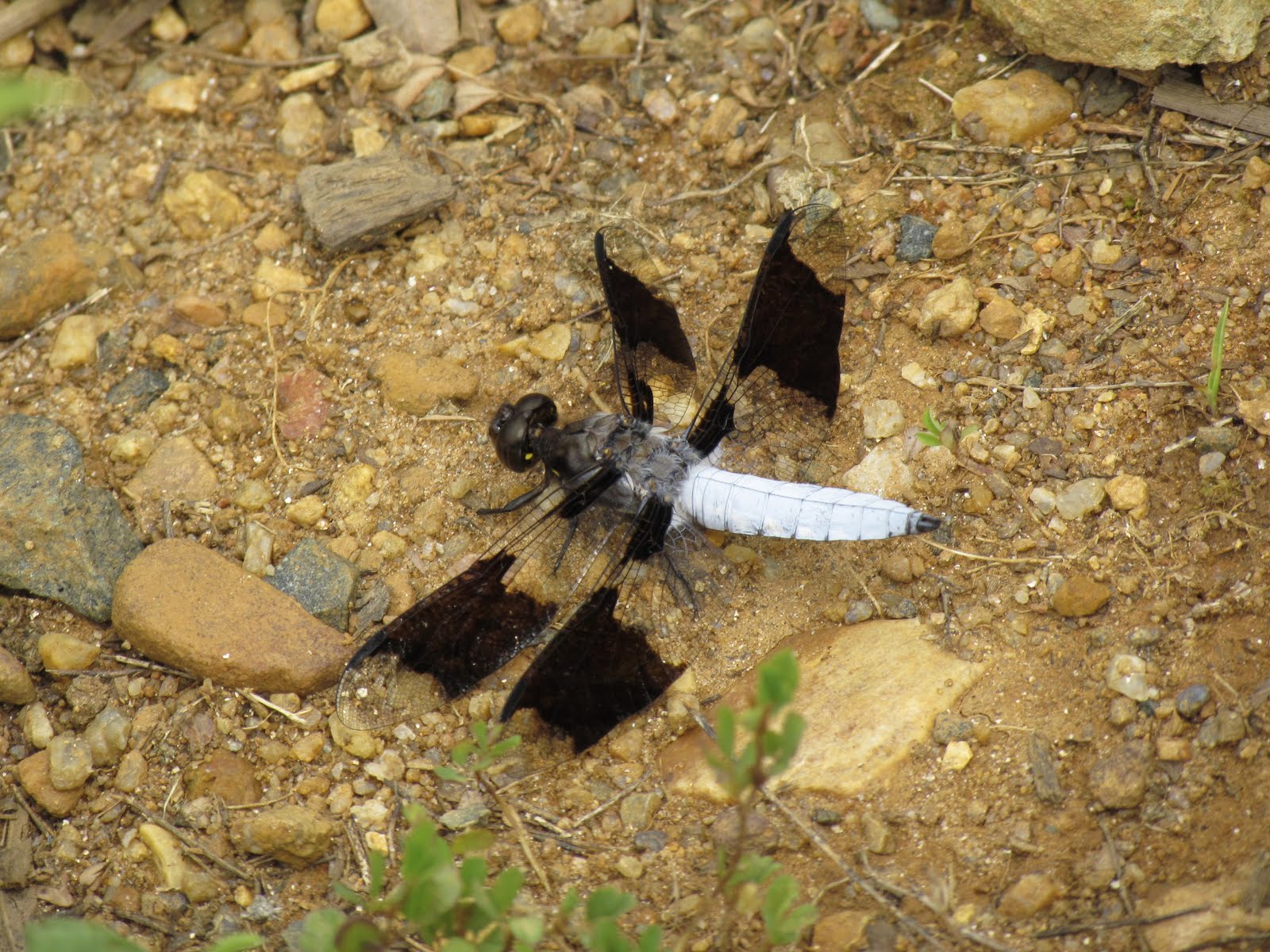
Here was our first good look at a Desert Whitetail. Notice that it has considerably more pruinosity near the base of the wings than a Common Whitetail. Other than that, the species are quite similar.

Here's a closer look at one perched on the shore of the stream:

Delightful. We always enjoy visiting Tuba City, and plan to do so again this year.
Here's a write up of our eclipse trip to Tuba City. It was our first annular eclipse:
Betsy and I went to Tuba City, where we stayed at a nice, new Inn on the Navajo Reservation run by the Hopi Indians. It was quite a lovely place to stay.
 |
| Moenkopi Legacy Inn. We had breakfast out by the pool. |
 |
| A nice little manmade stream and pool in the courtyard area. |

 |
| A sample of the Hopi art in the lobby. |
Though the Inn was wonderful enough, the real treat for us was the chance to observe the annular eclipse of the Sun. I set up my spotting scope to project an image of the Sun on a poster board, and used the backdoor of the Rav 4 to put the poster board in the shade. The results were quite good.
 |
| The beginning phases of the eclipse. Notice the two prominent groups of sunspots. |
 |
| The top group of sunspots is disappearing behind the Moon. |
 |
| Deep into the initial phase of the eclipse now, with both groups of sunspots covered. |
 |
| The beginning of the annular phase of the eclipse. |
 |
| A nice full ring of fire. About this time we experienced a noticeable chill in the air due to reduction of sunlight. |
 |
| Annular eclipse of the Sun. |
 |
| The Moon is moving away from the Sun now, and the top group of sunspots is coming into view again. |
 |
| Observing an eclipse. |
Two weeks before this eclipse we had a "super moon," due to the full moon coinciding with perigee, the closest approach to the Earth. As a result, this new moon is at apogee, the farthest distance from the Earth, which makes it appear smaller. That's why the eclipse is annular as opposed to total – the Moon is too small at apogee to completely cover the Sun.
Oh, one more experience awaited us after the eclipse was over. We went to the Hogan Restaurant here in town and had a delicious Navajo Taco. Definitely a Tuba City Treat!