Showing posts with label Tule Bluet. Show all posts

Saturday, November 17, 2018

Late Dragonflies

Well, it's still dragonfly season!

Yesterday we went to Little Cranberry Lake here in Anacortes. We weren't expecting much, since it had been rainy the last couple days. But the clouds cleared off by mid morning, and at noon it was a nice sunny day, with a temperature of 52 ˚F, so we decided to check out the lake just in case. I'm glad we did.

First, we saw a Tule Bluet, the first damselfly we've seen at the lake since October 9. Here it is:


Next, we saw Autumn Meadowhawks all over the place, with several tandem pairs laying eggs:


They would lay eggs for a bit, in their typical Autumn Meadowhawk way (see my field guide for more details), then they would land on the shore to rest in the sun. Often, this meant that they would land on me, which is always a treat!


Darners were also present—specifically, Shadow Darners. A female was laying eggs on the shoreline for quite some time, and then a male came along and attached to her. He tried to takeoff with her to mate, but she resisted. You can see the male attaching and attempting to takeoff in the pictures below:


Eventually the male gave up, and they separated. The female then landed on the shore to rest:


All in all, quite an active day, especially for so late in the year.

Thursday, September 20, 2018

It's Tule Time!

Betsy and I have been to Cranberry Lake the last several days enjoying the beautiful Fall days. The weather has been lovely, and the dragonfly activity has been interesting. Yesterday there were lots of Paddle-tailed Darners perched in the bushes (6 to 8 at a time), and many pairs of Autumn Meadowhawks flying in tandem.

We also saw lots of bluets, but the funny thing was they were all Tule Bluets, like the ones below:


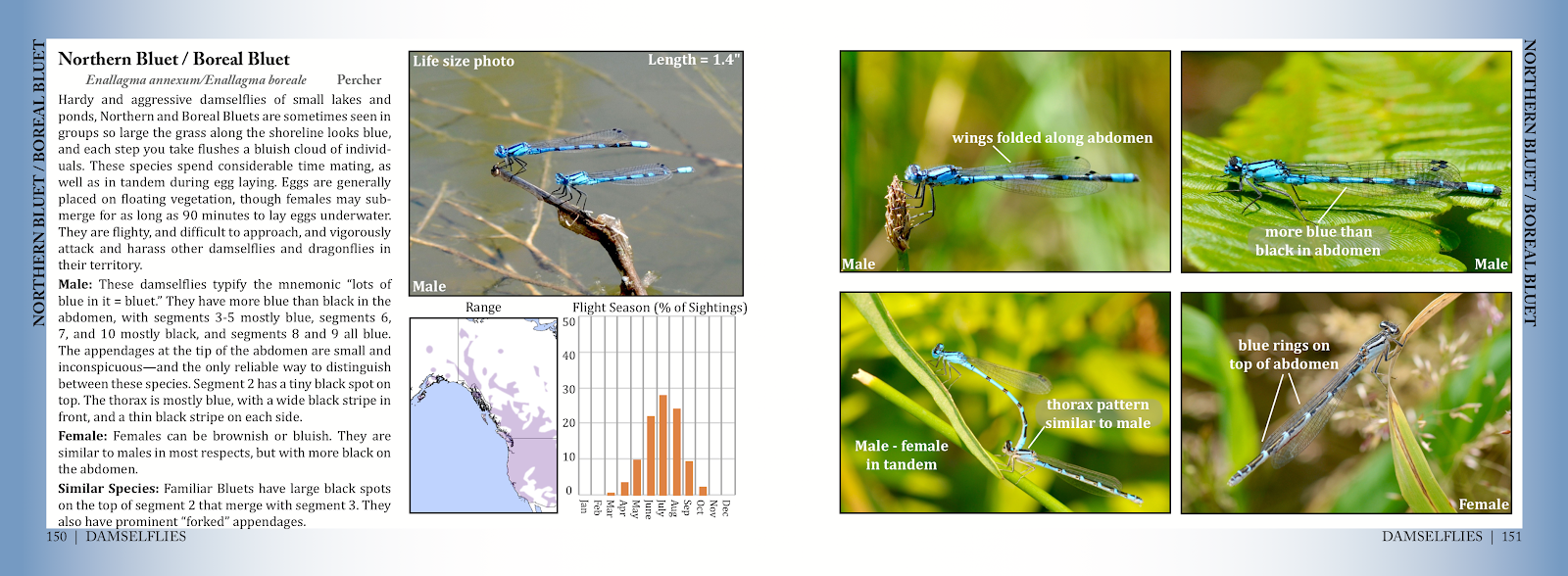
Notice that these bluets have roughly equal amounts of black and blue on the middle segments of the abdomen. In comparison, Northern and Boreal Bluets have mostly blue with small rings of black. You can see this comparison in the pages from my field guide, Common Dragonflies and Damselflies of the Pacific Coast, shown below:


You can find the field guide on Amazon, at the following link:

https://www.amazon.com/Common-Dragonflies-Damselflies-Pacific-Coast/dp/1934199265/ref=sr_1_1?ie=UTF8&qid=1537462425&sr=8-1&keywords=dragonflies+pacific

I was surprised to be seeing only Tules, but on consulting my field guide, I see that it is twice as likely to see Tules in September.

As with all bluets, the Tules are aggressively territorial. Here is one harassing a pair of Blue-eyed Darners:


We filmed a "cloud" of bluets at Cranberry Lake a couple days ago, and noticed that they are very accomplished at flying backwards. Here's a short video clip showing one flying in reverse:


Here's a group of them backing up in unison, like some kind of bluet line dance:


Fascinating creatures, coming or going.

Monday, July 25, 2016

Butchart Gardens

A couple days ago, Betsy and I visited Butchart Gardens on the way back from our cruise to Alaska.


It's a lovely place, and the weather was perfect.  Flowers everywhere, of course.


Many darners were flying over the open grassy lawns, but no other odonates were seen for a while – until we came to the "Star Fountain," shown above.  There we saw lots of Tule Bluets, including one that liked to perch on the begonias:


Notice the almost equal-width bands of black and blue on the abdomen, with the black bands actually a bit wider than the blue ones.  The Northern and Boreal Bluets differ in having mostly blue on the abdomen, with small black rings separating them.

In addition, we saw a darner fly in and land on one of the "frogs" that shoots out streams of water.  Here it is:


It's clear that this is a female, due to its overall brownish and greenish color, and the expanded tip of the abdomen that holds the ovipositor.  Females are generally a bit more difficult to identify than males, but in this case the identification was easy.  Notice the small "bump" – or tubercle – below segment 1 of the abdomen.  Here's a better view of the bump:


The interesting thing about this bump is that it's a distinctive field mark for the female Blue-eyed Darner.  None of the other mosaic darners in our area have this bump.  It's a good field mark to look for, though it's not always as easily seen as it is in this view.

Thursday, January 14, 2016

Species Spotlight: Tule Bluet


As with other bluets, the Tule Bluet is distinguished from forktails by having lots of blue in the abdomen.  This gives rise to the useful mnemonic: 

lots of blue in it = bluet

The Tule Bluet is separated from other bluets by the almost equal-width bands of black and blue on the middle segments of the abdomen.  This is the key field mark for this species.  In many cases, Tule Bluets are numerous at a given location, even when no other bluets are seen.  Perched Tule Bluets fold their wings like a tent over the abdomen.


Here's another view:


Tule Bluets are often numerous in the vegetation along the shore of a lake or pond.  They are frequently seen flying in tandem.  Females use their ovipositor to cut a slit in a stem of vegetation and deposit eggs inside.  Sometimes, the tandem pair lands on a stem emerging from the water, and descends on it until the female is completely submerged.  The male stays attached and goes underwater with the female in some cases, but more often releases his grip when partly submerged, and hovers until the female reemerges.  

It is not uncommon to see a female in the bushes with the abdomen of a male still attached to her thorax.  This strange situation occurs as the result of an attack by a darner, who grabs a tandem pair and snips off the thorax of the male for a snack, dropping the rest into the bushes.  Here's an example:


The Tule Bluet is widespread in North America, especially in the northern part.  Here's the range map: