Showing posts with label four-spotted skimmer. Show all posts

Saturday, April 8, 2023

Four-spotted Skimmer emerging


A Four-spotted Skimmer just emerging from its larval skin, last year on June 10.


Another view.


Fully emerged now, resting and pumping up its body and wings.

Wednesday, July 3, 2019

Painted Skimmer

We just returned from a trip back east, where we attended a wedding and saw some interesting birds and odonates. On the ode side of the ledger, we spotted a particularly striking species in a retention pond across the street from our hotel outside of Boston. Here's the pond:


It's interesting how even the most ordinary little pond can be full of life, with turtles, snakes, frogs, dragonflies, damselflies, birds, and many other creatures calling these waters home.

The first dragonfly we saw at the pond was an eastern species that we would never see on the west coast, the Painted Skimmer. Here's a look at this handsome fellow:


I was struck by how similar the abdomen of this species is to the abdomen of the Four-spotted Skimmer we have in the west. Here's the Four-spotted Skimmer for comparison:


Notice especially the similarity in the coloration of the abdomen, and in the shape and white wing veins of the basal wing patches.

Once we got back home we saw many Four-spotted Skimmers, a reminder of our trip back east.

Sunday, May 27, 2018

A Flurry of Forktails

Betsy and I went to Cranberry Lake here in Anacortes for our first visit of the 2018 dragonfly season. The activity was intense, with lots of Four-spotted Skimmers zipping around, landing on the path, mating, and laying eggs. Here's an example of a Four-spotted Skimmer:


Notice the four dark spots on the center of the leading edges of the wings—these are the four spots in the name. The dark spots near the tip of the wing are the stigma, which all dragonflies possess, and hence are not distinguishing features. Finally, note the dark wings patches near the base of the hindwings with the white veins, a distinctive feature of this species.

Four-spotted Skimmers are also quite friendly and approachable dragonflies; they can be whispered for a closer look:


We also saw California Darners, American Emeralds and Spiny Baskettails—more about the baskettails in another post to follow.

There were lots of Pacific Forktails out and about today as well. In fact, there was one rock where they liked to congregate—forktail flats. Here's a look at seven of them enjoying the sunny day.


Here's a little closer look:


Notice the mix of males and females in this photo.

All in all, a lovely day at the lake.

Friday, July 21, 2017

Beaver Pond

Yesterday, Betsy and I drove over the mountains to Beaver Pond in Winthrop, WA for an afternoon of birding and dragonflying. We had a wonderful time—as usual—and even saw a moose at Rainy Pass on the way there.

Here's the location of Beaver Pond:


You park at the Chickadee Trailhead.

This is one of our favorite spots to visit each year. In fact, it's the location of one of my favorite photos of myself, which Betsy took along the shore of the pond! You can see some of the pond, the countryside, and a ponderosa pine in the background. BTW—The dragonfly on my finger is a Happy-face Dragonfly, aka Paddle-tailed Darner.


We saw lots of activity there. Here's a link to our eBird report:

http://ebird.org/ebird/view/checklist/S38218723

One of the first dragonflies we saw there was a beautiful Four-spotted Skimmer. It was so fresh and vibrant—much more colorful that you usually expect when thinking of this dragonfly.


We saw them mating—and you have to look quick to see it! They stay in the wheel position for only a couple seconds, and then the female immediately starts dipping and laying eggs. The male hovers overhead to guard her from intruders, which are usually other male Four-spotted Skimmers, but in this case also included male Paddle-tailed Darners. Why they were harassing the female skimmer I don't know.

Here's our list of odonates for the day:

Damselflies -- Northern/Boreal Bluet, Pacific Forktail, Northern Spreadwing

Dragonflies -- Blue-eyed Darner, Paddle-tailed Darner, Four-spotted Skimmer, Crimson-ringed Whiteface, Striped Meadowhawk

We also saw lots of fish jumping clear out of the water, apparently going after the damselflies that were skimming along just above the surface of the pond.

I hadn't expected to see splash-dunking and spin-drying, but was pleasantly surprised to see the behavior right from the moment we got there. Here's a list of the splash-dunk events we saw, in the order in which they occurred:

Splash-Dunks
1
2
2
3
2
2
6
2

We were watching this activity from the footbridge, and so many of the spin-drys occurred at eye level.

All in all, quite an interesting day.

Tuesday, June 20, 2017

Species Spotlight: Four-spotted Skimmer

We saw our first Four-spotted Skimmers of the year a few days ago at Cranberry Lake. Curiously, we have never seen one at Heart Lake, even though it is only a few miles away and is very similar to Cranberry Lake. Eight-spotted Skimmers haven't been seen yet.

Heart Lake and Cranberry Lake are very similar, but have distinctly different dragonfly populations.

Here's a male Four-spotted Skimmer:

Four-spotted Skimmer, male.  Notice the dark spots at the nodus (center of leading edge) that give this dragonfly its name.  The dark spots near the wing tips (the stigma) don't count, since all dragonflies have them.  Also, note how the front two legs are folded up and tucked behind the head, just as they are in flight.

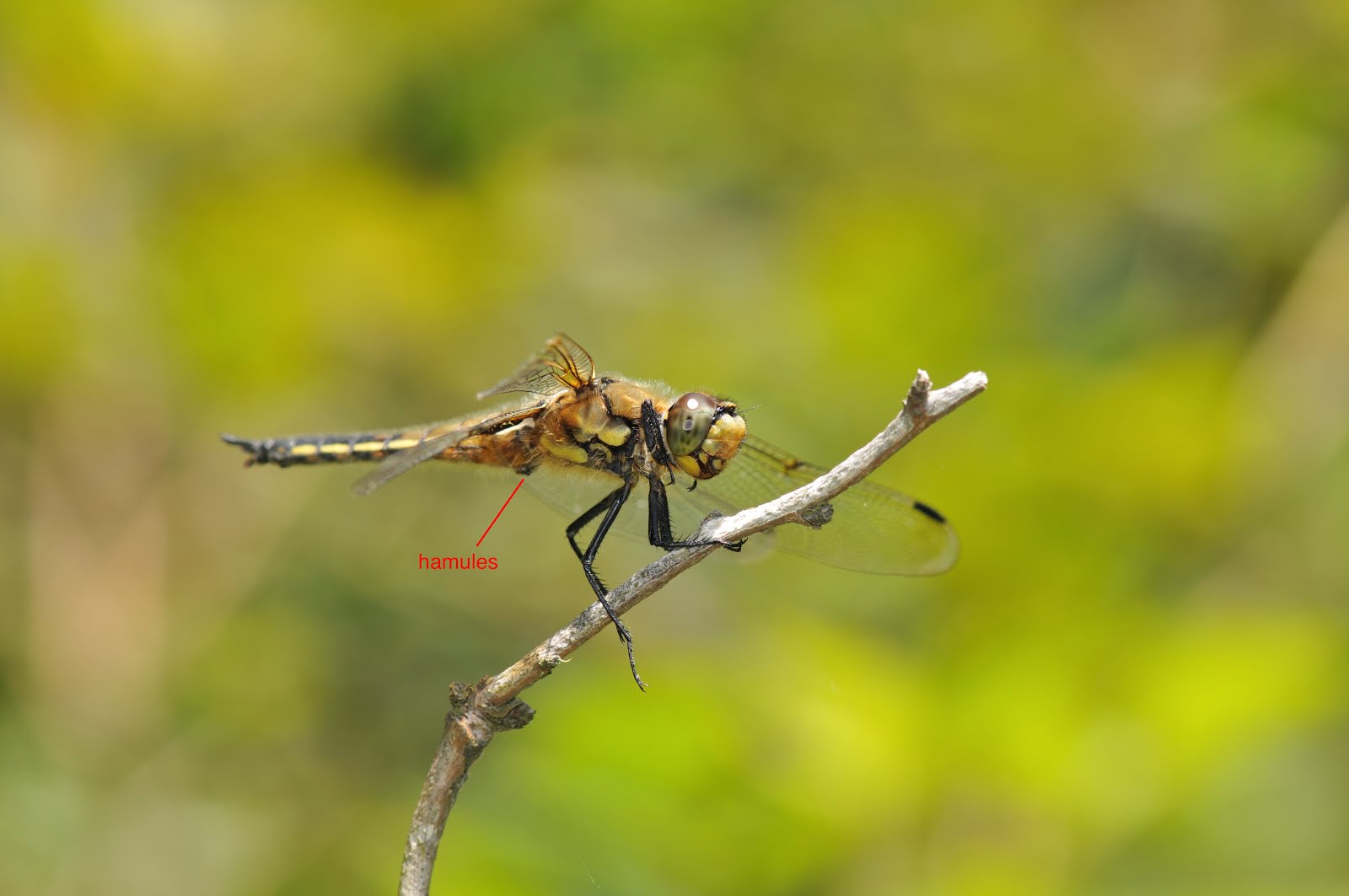
Males and females are practically identical in this species. The best way to distinguish them is by behavior—males patrol the shoreline looking for mates; females perch on vegetation when not dipping the tip of their abdomens in the water to lay eggs—and by the presence (males) or absence (females) of hamules under segment 2 of the abdomen.

Here's a female Four-spotted Skimmer, showing the lack of hamules, and the presence of a small egg scoop:


Here's a male Four-spotted Skimmer, clearly showing the hamules under segment 2 of the abdomen:


The hamules are like latches that hold the abdomen of the males and females together in the wheel position.

Four-spotted Skimmers have a high perching index (about 80 – 90%), and hence are easy to observe and photograph.  If you see a golden brown dragonfly in our area it's almost certainly a Four-spotted Skimmer, so the ID is fairly easy as well.

Mating is a rapid affair with these dragonflies.  Their short, pudgy abdomens aren't particularly flexible, and hence they stay in the wheel position for only about 10 to 15 seconds.  After mating, the female dips the tip of her abdomen repeatedly into the water to lay eggs while the male hovers above for protection.  They don't stay attached in tandem during egg laying, as do many meadowhawks, because their inflexible abdomens aren't well suited for that kind of maneuver.

Sunday, October 11, 2015

Four-spot Capture

One of the slow-motion videos I took this summer showed a Four-spotted Skimmer chasing and catching a small fly.  The way he did it was a bit surprising, though.  He waited until the fly passed him, turned and flew ahead of the fly, and then approached it head-on for the capture.  Here are some frames from the video that document the event.

In this frame, we see the small fly (red dot) ahead and to the right of the skimmer.  A blue dotted line goes from the head of the dragonfly to the prey.  The fly is traveling in a straight line at uniform speed – apparently oblivious to the potential danger in its vicinity.


In this frame the dragonfly is basically in its same position, soaring motionless in a headwind, as the fly gets closer.


Here the fly is passing the dragonfly, while the dragonfly continues to hold its position.


As the fly continues on its path, past the position of the soaring predator, the dragonfly suddenly initiates a turn to go toward the potential prey.


Now you might think the dragonfly would overtake its prey from behind and make the capture that way, but instead it zips ahead of the prey and turns to face it, as we see in this frame.


The dragonfly now drops below the prey, and puts itself in a position to rise and capture the prey head-on, which it does just a split second after this frame.


Of course, in real time this happened so quickly that no details could be made out.  I knew a capture had occurred, but that was about all.  Fortunately, the slow-motion video allowed for a detailed look at just how the dragonfly effected its capture.  Cool!

Saturday, June 9, 2012

Four-spotted Skimmer

One of the dragonflies seen a couple days ago at Cranberry Lake was the Four-spotted Skimmer.  Here's a photo of one from that day:

Four-spotted Skimmer, male.  Notice the dark spots at the nodus (center of leading edge) that give this dragonfly its name.  The dark spots near the wing tips (the stigma) don't count, since all dragonflies have them.  Also, note how the front two legs are folded up and tucked behind the head, just as they are during flight.

Four-spotted Skimmers have a high perching index (about 80 – 90%), and hence are easy to observe and photograph.  If you see a golden brown dragonfly in our area it's almost certainly a Four-spotted Skimmer, so the ID is fairly easy as well.  Females look the same as males, except a bit duller in color.

Mating is a rapid affair with these dragonflies.  Their short, pudgy abdomens aren't particularly flexible, and hence they stay in the wheel position for only about 10 to 15 seconds.  After mating, the female dips the tip of her abdomen repeatedly into the water to lay eggs while the male hovers above for protection.  They don't stay attached in tandem during egg laying, as do many meadowhawks, because their inflexible abdomens aren't well suited for that kind of maneuver.