Betsy and I went to the Boyce Thompson Arboretum yesterday. It's one of our favorite places, and we always have a great time there. Below is where we have our lunch after a full morning hiking the trails.
 |
| The place where we have lunch at the Boyce Thompson Arboretum. Hummingbirds constantly flit back and forth, feeding from the many flowers, and Lesser Goldfinches come regularly to the bubbling pool of water. |
One of the fun things about the arboretum are the many hummingbird nests you can find there. Yesterday, we found four nests, and weren't even looking for them. Below is one where we could watch the mother feeding her young, and at the same time admire the construction of her nest.
 |
| A female hummingbird with some sort of a small bug, which she fed to her young. |
Another nest with feeding going on was built right on top a pine cone. You can see the location in the photo below. The lowest pine cone in the tree, the one against blue sky just above a distant mountain peak, is the one with the nest. Betsy and I found it a week or so ago by "
looking for it," and we were just checking up to see how things were going.
 |
| A hummingbird built its nest on top the lowest pine cone visible here, the one just above a distant mountain peak. |
The mother using this nest was quite attentive. In the sequence of photos below you can see her feeding one baby, taking a breather, then feeding the other baby.
There weren't many odonates at the arboretum, but we went primarily for the birding in any case. We did find a few, though. The first one was a female Springwater Dancer at the mini-oasis. In the past we saw numerous Desert Firetails at this location, but after they cleaned out the pool only a few have been seen. We usually encounter the Springwater Dancer on Queen Creek, so we were a bit surprised to find it here.
It's clear right away that this damselfly is a dancer, by the way it holds its wings high above the abdomen. This is a characteristic pose for dancers. Bluets use their wings to make a "tent" enclosing the abdomen. Notice, in addition, the "arrowhead"-shaped dark markings on the side of the abdomen. This is a good field mark for the Springwater Dancer in this part of the country. Back in the northwest, though, markings like that indicate a Vivid Dancer.
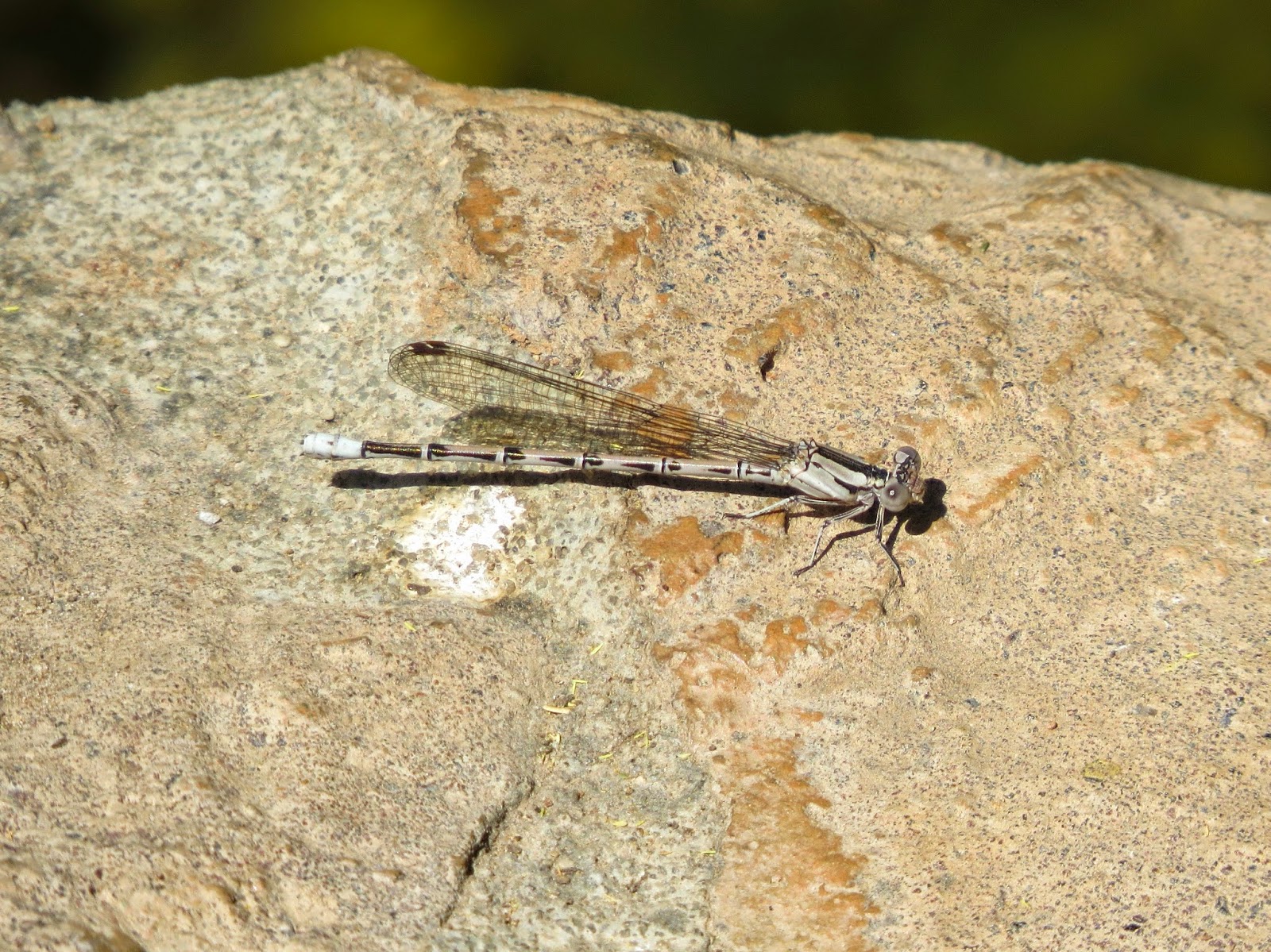 |
| A female Springwater Dancer at the mini-oasis. |
The next odonate we encountered was a Filigree Skimmer on Queen Creek. It was perched on the ground, as is usual for this species. The filigree name comes from the intricate pattern in the wings, but there are intricate patterns all over this dragonfly. The abdomen, for example, has fine markings for most of its length. In addition, the eyes are covered with alternating light and dark lines. One has to wonder what the world looks like to the Filigree Skimmer.
 |
| A Filigree Skimmer on a gravel bar in Queen Creek, near the pump house. |
As we continued on the trail, we soon came to Ayer Lake, shown below. Here we saw three male Blue-eyed Darners actively searching the shoreline for females. Betsy also saw one perch in the bushes.
In addition to the darners, there were a couple birds of note on the lake. You can probably just make them out below, near the center of the picture. They are a pair of Hooded Mergansers, enjoying the day.
 |
| Ayer Lake, at the Boyce Thompson Arboretum. Notice a pair of birds near the center of the picture. |
When I got home I posted a checklist to eBird, and to my surprise the Hooded Mergansers were questioned – in fact, I had to add them to the checklist by hand. I knew they were unusual there, but didn't think of them as being rare. I was more intrigued by our observation – with a tip from naturalist Paul Wolterbeek – of a Common Ground-Dove.
In any case, I described the mergansers for eBird, and included the photo below.
 |
| A pair of Hooded Mergansers on Ayer Lake. eBird regarded them as rare for that location. |
I'm glad they posed for a nice shot to verify the identification.
All in all, a wonderful day at the Arboretum.


