Showing posts with label darner. Show all posts

Wednesday, January 8, 2014

A Hovering Darner, Part III

The previous two installments on this topic focussed on the vertical motion of the darner as it hovers.  We've seen that it bobs up and down with a frequency of about 4.5 bobs per second, with roughly 4 strong wingbeats alternating with 4 weak wingbeats for each cycle of the bobbing motion.  These installments can be found at the following links:

http://thedragonflywhisperer.blogspot.com/2014/01/a-hovering-darner-part-i.html

http://thedragonflywhisperer.blogspot.com/2014/01/a-hovering-darner-part-ii.html

We now include the horizontal motion in our analysis.  I didn't know what to expect when I started, but it turns out that the darner is making a series of "orbits" as it hovers.  Here's an example of an orbital cycle:


The orbits are traversed in the counterclockwise direction, but this is not significant because the orbits would be clockwise if viewed from the other side of the darner.  What is significant is that the darner moves forward as it drops in altitude, and moves backward as it rises.  This is the same regardless of the side from which it is viewed.

Here's another example of an orbital cycle.


The series of bobbing cycles shown below is interesting in terms of the corresponding orbits.  You can see that cycle 2 rises higher, and takes more time to complete, than the other cycles.  Is this difference reflected in the orbits?  Let's see.


First, for comparison, let's look at the orbits for cycles 1, 3, and 4.  As we can see below, these orbits are quite typical in shape.


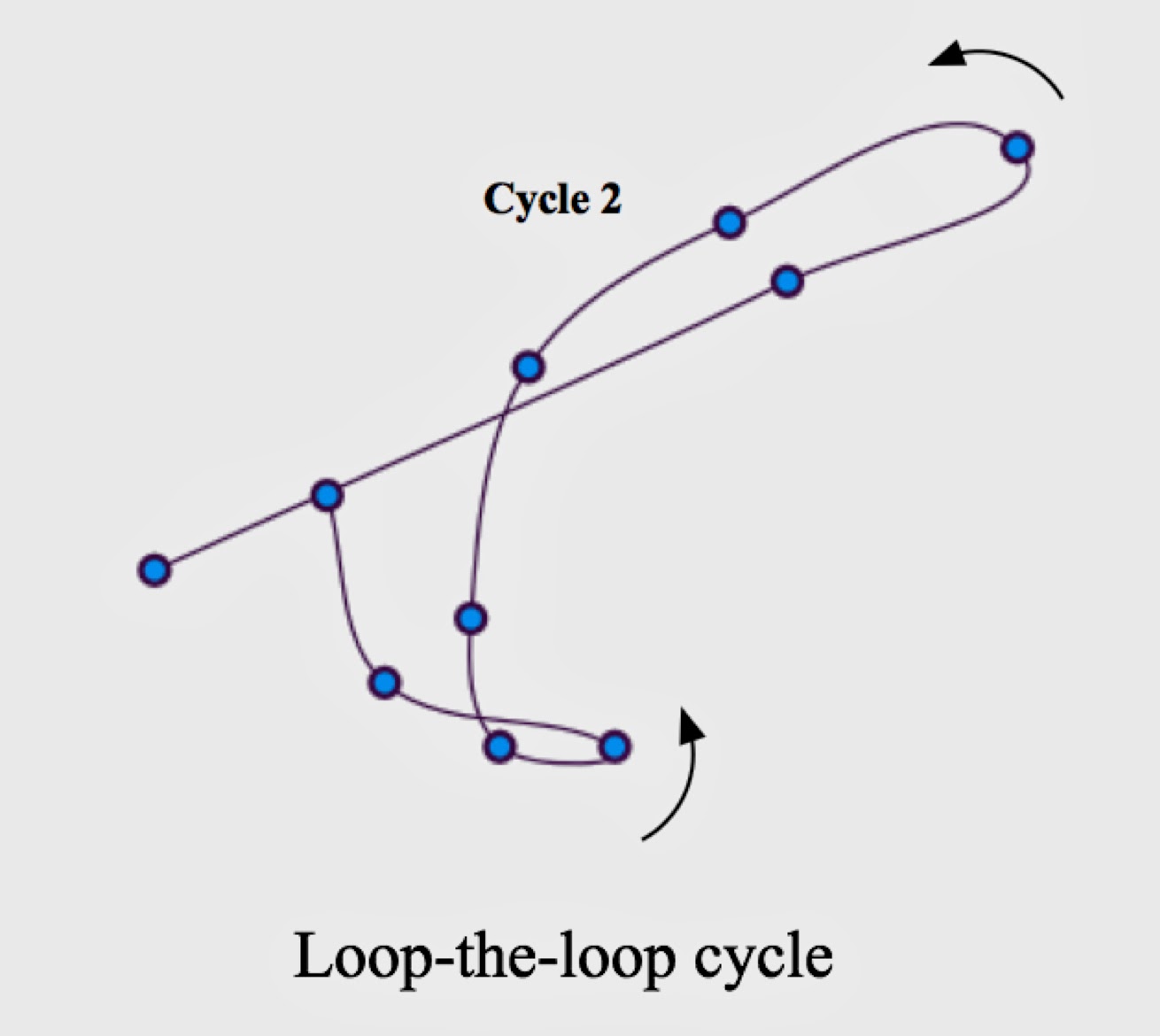
When we look at the orbit for cycle 2, however, we see something quite different.  As shown below, the cycle 2 "orbit" consists of two loops – a sort of loop-the-loop orbit – with both loops orbited in the counterclockwise direction.  Thus, cycle 2 does have a different type of orbit, after which normal bobbing cycles continue as before.


Finally, I've collected below a number of orbits in a 3x3 grid.  The center square shows the takeoff of the darner, and the surrounding squares show a variety of different orbits, including the loop-the-loop in the lower right square.


What's particularly interesting to me about this figure is that it was drawn by the dragonfly itself.  Each orbit was traced out by the darner during one of its up-and-down bobs.  Nice work, Mr. Happy-face!

Tuesday, January 7, 2014

A Hovering Darner, Part II

The analysis of a hovering darner continues in this post.  Part I can be found at the following link:

http://thedragonflywhisperer.blogspot.com/2014/01/a-hovering-darner-part-i.html

Last time, we saw that a hovering darner was actually "bobbing" up and down several times per second as it hovered, a frequency much slower than the rate of its wingbeats.  We also produced a plot showing all twenty up-and-down "bobs" that the darner made in a five-second video clip.

To see the vertical motion in greater detail, we expand the plot and show the flight level of the darner for a period of 1.6 s.  Notice that the bobbing motion is remarkably regular in both frequency and amplitude.  I really hadn't expected to find such a nicely sinusoidal behavior.


The sinusoidal motion of the darner is well represented by the mathematical relation y(t) = A sin(wt), where y is the flight level relative to the average height, w is the angular frequency, t is the time in seconds, and A is the amplitude of motion.  From the above figure, we can see that the amplitude is approximately A = 0.40 cm, and the period of motion is about T = 0.22 s.  From the period of motion, we can obtain the angular frequency w as follows: w = 2π/T = 29 rad/s.

The result for the angular frequency becomes important when we calculate the vertical acceleration of the darner.  To begin, we note that the acceleration a(t) is obtained by taking two time derivates of the position; that is, a(t) = d^2y/dt^2 = –Aw^2sin(wt).  It follows that the maximum upward or downward acceleration of the darner is Aw^2 = 3.4 m/s^2.  This is roughly 1/3 the acceleration due to gravity.

It follows, then, that the darner flaps weakly for about 4 flaps, resulting in a downward acceleration, followed by 4 strong flaps, resulting in an upward acceleration.  This is illustrated in the next figure.


One explanation for the bobbing motion during hovering is that the alternating spurts of strong and weak wingbeats gives the darner a chance to rest on the wing – a little like wind sprints in humans.  Another possibility is that the bobbing motion is a display mechanism – bobbing up and down may increase a darner's visibility to his rivals, letting them know where his territory is, and that he is on guard and ready to attack any intruders.

The last installment in the hover analysis will be posted tomorrow.

Monday, January 6, 2014

A Hovering Darner, Part I

Last summer, Betsy and I spent a delightful afternoon at Beaver Pond, near Winthrop, WA.  It's a medium-sized pond with a tall snag topped by an Osprey nest, and surrounded by a wide flat trail lined with towering Ponderosa Pines and ghostly Quaking Aspen.  The day was sunny and warm, and buzzing with activity of all types.

At one point we sat on a bench to relax, and a friendly male Happy-face Darner (shown below) began to hover at eye level, just inches away from us.  After a few seconds of hovering, he would dart off after a rival, and then return to continue guarding his territory.  He did this time after time, repeatedly giving us a great view.

A male Happy-face Darner (aka, the Paddle-tailed Darner) hovers in front of us, keeping us company.

At first, I wasn't going to take a video of his hovering – after all, I have plenty of good hovering videos from previous years.  But then I noticed something that I had noticed before, but hadn't given much thought.  As the darner hovered, it was "bobbing" up and down.  This doesn't seem too surprising, given that the hovering is produced by wings that are flapping up and down.  What was surprising, though, was that the bobbing was at a much lower frequency than the wingbeats.  Why such a difference, and just what is the bobbing frequency?

With these questions in mind, I decided to go ahead and take a video of the hovering.  The total 5 second video can be found at the following link:

http://www.youtube.com/watch?v=r8oLKmfMLBc

The video was shot at 30 frames per second, and so I made screen captures of each of the 150 frames in the total clip.  I digitized each frame by measuring the distance from a prominent point in the background (a crossing of two branches) to a fixed point on the body of the darner.  This removed effects of the camera moving slightly during the clip.  I measured to the head of the darner, to his thorax, and to the tip of his tail – all three cases gave essentially the same results.  The results given here were recorded for distances measured to the darner's head.

The graph below shows a plot of all 150 data points for the 5 seconds of hovering.  The "cluster" of points is the hover itself, and the points going off to the right show the darner's takeoff to challenge a rival.  Notice that this is a plot of vertical position versus horizontal position.


To see what's happening during the hover, we expand the cluster of points, and plot them as vertical position versus time.  The result is shown below:


The first thing we notice in this plot is that the darner is indeed bobbing up and down as it hovers, and in a fairly regular way.  In fact, it's clear there are about 4 - 5 "bobs" per second, as compared with the wingbeats, which are at the rate of 35 - 40 per second.  The second thing we notice is that the average height of the hover is decreasing with time at a steady rate of about 0.2 cm per second.  This is something I hadn't noticed in real time as I observed the hover.

The analysis of the hover will continue in a subsequent post.

Friday, September 27, 2013

Darner Hovering: Bobbing With Bursts

Hovering is an energy-intensive activity.  It's not surprising, then, that dragonflies might employ strategies to reduce the effort – or at least rest the muscles a bit.  Here's an example.

I was observing a Happy-face Darner (Paddle-tailed Darner) hovering at Beaver Pond in Winthrop, WA.  As it hovered, I noticed it was bobbing up-and-down in a regular manner.  This might not seem surprising, considering that its wingbeats don't provide constant lift.  The frequency of the "bobbing" motion was much smaller than the frequency of the wingbeats, however.  The wings beat at about 35-40 beats per second, whereas the bobbing motion was clearly only a fraction of that frequency.  I decided to record a video to study the hovering in more detail.

Here's one of the videos I recorded.  It's recorded in "real time"; that is, normal speed.


A better view can be had at the following link to the Dragonfly Whisperer Channel on YouTube:

http://www.youtube.com/watch?v=r8oLKmfMLBc

As you can see, the wings are beating so fast they're just a blur.  In contrast, the body bobs up-and-down at a much slower rate.

I made frame-by-frame measurements of the flight level of the darner from the video and have plotted the results below.

Data from a video showing the up-and-down bobbing motion of a hovering darner.

The data show a clear periodicity to the flight level.  The darner is indeed bobbing up-and-down with quite a well-defined frequency.

The bobbing motion has a period of about 0.2 s, which corresponds to 5 bobs per second – or roughly one bobbing cycle for every 8 wingbeats.  The angular frequency of this motion, w, is about 31 radians per second, and the amplitude, A, is about 0.4 cm.  It follows that the maximum upward and downward acceleration is roughly Aw^2 = 3.8 m/s^2, which is just under 40% of the acceleration due to gravity.  Thus, the darner is never in free fall; it's always getting lift from the wings, but the lift varies with a period of 0.2 s.

It seems, then, that the darner alternates weaker and stronger wingbeats as it hovers, a little like the flight of finches and woodpeckers.  This is indicated in the plot below.  With this strategy, the darner can give a burst of 4 strong wingbeats, rest for 4 wingbeats, give another burst of 4 strong wingbeats, rest for 4 wingbeats, and so on.  Perhaps the intermittent rest helps it hover for long periods of time without getting fatigued.

Same plot as above, but with times of weak and strong wingbeats indicated.

Monday, September 23, 2013

Darner Mating Behavior: Attaching In Tandem

All dragonflies and damselflies mate in the so-called "wheel" or "heart-shaped" position.  In this position, the tip of the male's abdomen grabs the female behind the head in dragonflies, or on the front of her thorax in damselflies, and the tip of the female's abdomen attaches to the base of segment 2 of the male's abdomen.  A good example in the Common Green Darner is shown below:

Common Green Darners in the wheel position during mating.

The first step in attaining this position is for the male to grab the female and attach his abdomen to her, forming a tandem pair.  The following is a slow-motion video (1/4 speed) showing this attachment process in the Happy-face Darner (Paddle-tailed Darner):


A better quality video can be seen on the Dragonfly Whisperer YouTube Channel at the following link:

http://www.youtube.com/watch?v=p_ap7Aex9Y4

What's particularly interesting about this process is the way the male grips the female tightly as he makes the attachment.  Notice how the rear legs of the male slip down behind the female's forewings and pull them forward, folding them tightly against her thorax.  The male holds her like this for a moment as he shudders rapidly – apparently acquiring the desired connection – and then releases her wings and tries to take off.  In this case the female doesn't cooperate, and the male eventually gives up and departs alone.

I hadn't known before that the male folds the wings forward like that when it attaches in tandem.  It seems like quite an extreme maneuver.  You often see females with large tears in the forewings, and I wonder how often the tears are the result of this behavior.  This particular female had a large tear on the left forewing, as you can see in the photos below:


Notice the large tear just behind the nodus (bend) in the left forewing.

When the male pulls the forewings forward you can see that his leg fits nicely into that tear.  Before this video I might have considered the tear to be the result of a bird attack, but I think another possibility must be considered.

The other interesting feature of this video is the male's rapid oscillation of his abdomen (about 60 oscillations per second) just before he tries to take off.  Is he making sure he's got a good attachment?  I found one reference to something like this in Corbet, Dragonflies: Behavior and Ecology of Odonata.  On page 276 he describes a male Common Green Darner that is in tandem when it's attacked by another male.  According to Corbet, "the tandem male shakes its abdomen in a convulsive movement detectable to the human observer only when portrayed in slow motion."  I wonder if this is the same basic behavior.

Wednesday, September 18, 2013

Autumn Has Arrived!

Well, not according to the calendar – for a few days yet – but as far as the dragonflies are concerned it has.   Recall the following haiku:

Red dragonfly on my shoulder,
calls me his friend.
Autumn has arrived.

The Autumn Meadowhawks are out in numbers at Cranberry Lake, and they are landing on your shoulders, arms, legs, shoes, etc.  In fact, you have to be careful where you step to make sure you don't step on one or more of them.  Here are a few pictures from Cranberry Lake last year to give you an idea of what it's like there now:

A pair of Autumn Meadowhawks in the wheel position on my finger.

The Autumn Meadowhawks are fairly numerous, and they seek out perching sites with good exposure to the sun.

Dragonfly on the shoulder – and the hat, too!

The Autumn Meadowhawk has been named the world's friendliest dragonfly by DASA, the Dragonfly Appreciation Society of America (membership consists so far of Jim and Betsy Walker).

The darners are also present in numbers right now.  The sunlit bushes at the lake were hosts to 6 to 8 perched darners at any given time, mostly Paddle-tailed Darners, but also a couple Shadow Darners and a Variable Darner.

Update:

The next day we made our first observation of a Dark-eyed Junco in our backyard.  This is another species whose occurrence is linked with the seasons – we see them on or close to the first day of Fall, they stay with us all winter, then disappear again around the first day of Spring.  They are extremely accurate, usually to within a day or two, as they were again this year.

Here's a little haiku to commemorate their appearance:

Dark-eyed Junco in my yard,
hopping to and fro.
Autumn has arrived.

Friday, February 8, 2013

Aggressive Darners I

Late in the season last year (late October/early November) the male Shadow Darners and Happy-face Darners outnumbered the females at Cranberry Lake by quite a ratio.  In fact, we seldom saw females, and in locations where we would normally see 2 - 4 male darners perched we now saw 15 or more.  In addition, the males seemed to be particularly aggressive toward one another – certainly more so than we had seen earlier in the season.  Rather than simply fly toward a rival until it turned and left the territory, the males would come into physical contact, and grab at one another with their legs.

The following video from the Dragonfly Whisperer channel on YouTube shows two male darners grabbing one another and spinning round and round like two Bald Eagles with locked talons.  They almost fall into the water, but separate just in time.  They then gain some altitude and go at it again.  This is quite different from the interactions earlier in the season, which generally don't result in any direct contact.  Here's the link to the video:

https://www.youtube.com/watch?v=9UVUxjbhYA0

Monday, November 26, 2012

The Case Of The Constipated Darner

The story of the Constipated Darner is an interesting one for a number of reasons, not least of which is how it illustrates the deep connection I've developed over the years with the Happy-face Darner (Paddle-tailed Darner).  I first interacted with this dragonfly as a child, when I brought a live one into the house.  More recently, at Cranberry Lake, I discovered its delightful happy-face, and its method of cleaning by splash-dunking into the water and then spin-drying at 1,000 rpm in mid flight.  I've rescued a  number of them that got stuck when they splash-dunked, and have also gotten good at lifting them up from a perch onto my finger for a little visit.  I've even had a Happy-face come to my deck for a house call.  They've brought out the "dragonfly whisperer" within me.

This story begins at Cranberry Lake.  Betsy and I were observing male Happy-face Darners as they flew about the lake searching for mates and interacting with one another.  Suddenly, we saw one begin a series of splash-dunks.  We counted them out as they progressed:  "1, 2, 3, 4, 5, 6, 7, 8".  Wow, eight in a row.  That was a record!  Below is a table of the number of splash-dunks per event versus the number of events for the last two years – including this new observation.  We've seen a total of 265 splash-dunk events, with an average number of 2.31 splash-dunks/event.

Splash-Dunks per Event               Number of Events
1                                                        94
2                                                        65
3                                                        60
4                                                        28
5                                                        13
6                                                        4
7                                                        0
8                                                        1


After completing its 8 splash-dunks, and a nice spin-dry, the darner flew to a cedar tree near the shore to perch.  We could see it clearly, though it was fairly high up.  We noticed something attached to its abdomen, trailing off the back end.  Was something stuck to the darner?  Apparently so.  It was about the length and color of a pine needle.  Did this account for its record number of splash-dunks, as the darner attempted to dislodge whatever this was?  In fact, as we watched, it flexed its abdomen and tried to remove the material by rubbing it against a leaf, but was unsuccessful.

I reached up and grabbed the lowest branch of the cedar tree, and was able to pull down enough to bring the darner closer for better observation.  We saw that it was distressed over this attachment to its abdomen, and that flies were attracted to it.  We began to realize it might be a string of excrement still attached to the unfortunate creature.

At this point I realized that I could now reach up and grab the next higher cedar branch, and bring the darner even closer.  I did so, and got it close enough that I was able to reach up and lift it onto my finger.  Now we could examine it in detail.  Indeed, it had a long string of excrement attached to its abdomen that it was trying to remove.  I took hold of the far end of the string, which was dry and a light tan color, and pulled.  The string separated cleanly from the darner, and it seemed relieved.  I took a few pictures of it on my finger, and then placed it back on a cedar branch where it rested for several more minutes before flying off.

I wonder how the problem developed in the first place?  Or perhaps the better question is: Why doesn't this sort of thing happen more often, given that dragonflies have no fiber in their diet?  Whatever the case, I never imagined my connection with the Happy-face Darner would extend to a situation like this.  I was happy to help, though, and I hope it was able to continue its dragonfly pursuits in a more regular fashion.

Here are a couple photos from this adventure:

The darner perched in the cedar tree with the attachment to its abdomen.  Notice the fly, whose presence is not a coincident.

After pulling the cedar branch down I was able to reach the darner and lift it onto my finger.

So is this why he splash-dunked eight times in a row?  It seems quite likely.

I was able to pull off the attachment and make a clean break.

My friend the Happy-face Darner seemed pleased with the result.

Tuesday, November 6, 2012

Splashdance

You've heard of Flashdance and splash-dunk.  Well, here's a combination of the two I call splashdance.

In the following video a male darner is chasing another male out of its territory.  Males usually do this by approaching their opponent from below and behind.  They swoop down low, then rise up for the attack.

In this case, however, both dragonflies are speeding along close to the surface of the lake.  As the attacking dragonfly gets closer, the intruder begins to take evasive action.  The attacking dragonfly mirrors these moves, as it continues flying at high speed, but its wing tips hit the surface of the water.  The graceful little dance it does to avoid an unintentional splash-dunk or cartwheel is what I call the splashdance.

Monday, November 5, 2012

Intense Interactions And A Split-S Maneuver

The darners at Cranberry Lake are still active on nice days.  Today many were flying over the water, and at one point at least 15 were perched in the bushes.  It was 50 ˚F, calm, with filtered sun.

Both Shadow Darners and Happy-face Darners (Paddle-tailed Darner) were present, but only males were seen.  The interaction between the males seems more intense than in the middle of the season, when females are numerous.  This time of year the males seem desperate to find a female, and as a result are more aggressive with one another.  I also get the impression that sometimes one male grabs another male hoping it might be an andromorphic female.  In any case, the males are grabbing hold of one another this time of year much more than is seen earlier in the year.

Here's a video showing two males that grab one another, spin around, then fall into the water.  They both get out and fly upward.


A third male observing the interaction flies upward too, and then does a wonderful aerobatic move where it rolls 180˚ and pitches in the dorsal (positive) direction.  What a nice maneuver.  In aerobatics, this is referred to as a split-s – basically, an Immelmann turn in reverse.

Sunday, June 24, 2012

Virginia Dragonflies: The Comet Darner

Betsy and I were in Virginia last week for a family get together.  Of course, we were also hoping to see some interesting birds and dragonflies while there – and we weren't disappointed.  As luck would have it, our hotel was located next to some nice wildlife areas, including a pond and some woods.

The morning after arriving we visited the pond, and immediately saw lots of dragonfly activity – many individuals and many species as well.  One of the first dragonflies we saw was the strikingly-colored Comet Darner.  This darner has a reddish-orange abdomen and a green thorax and head.  It's unmistakable, which certainly makes the identification a breeze.  Here are a couple shots of it, first in flight, and then perched in a tree:

A Comet Darner (male) patrols its pond.
Comet Darner perched high in a tree.
Notice the long, orange legs.  No wonder the species name for this dragonfly is longipes, meaning long-legged.

The Comet Darner is larger than the Common Green Darner, which was also seen at the same pond.  In fact, the Comet Darner is the second largest dragonfly in North America – exceeded in total length only by the Giant Darner of the southwest.

The Common Green Darner and Comet Darner are closely related, both belonging to the genus Anax (king, ruler).  The Common Green Darner's scientific name is Anax junius (king of June), while the Comet Darner's scientific name is Anax longipes (long-legged ruler).  The robust legs seen in the last photo above show how this darner got its name.

Sunday, June 10, 2012

California Darner

The earliest, and smallest, darner in our area is the California Darner.  Here's a shot from my recent trip to Cranberry Lake:

California Darner, male.  You can clearly see the "egg tooth" on the front of its thorax, which it uses to break through the larval skin when it emerges as an adult.

Notice the lack of a front stripe on the thorax, the cream-colored spots on the tenth segment of the abdomen, and the simple (blade shaped) appendages – all key features of California Darners.  Also notice that it is perched on the ground, another characteristic of these darners.  The other common darners in our area – Blue-eyed Darner, Paddle-tailed Darner, Shadow Darner – almost always perch in a bush at hip to shoulder height.  In our area, a darner on the ground is quite likely to be a California Darner, especially early in the season.

There were a dozen or more California Darners flying over the meadow and landing on the ground at Cranberry Lake.  When you walk through the grass you flush another darner every few steps.  At one point I saw a pair in tandem being chased by a single  male.  The lone male grabbed the male in tandem and they crashed to the ground.  The photos below show the pair in tandem and the lone male sitting on top.  After a few moments the male in tandem took off, displacing the lone male, and the pair flew high up into the trees.

A male California Darner on top of a pair in tandem.  Apparently it was trying to break up the pair so it could replace the original male.

The pair stays attached and takes off, displacing the lone male.

Monday, April 30, 2012

Splash-Dunk (x2) + Spin-Dry Video

Here's one of my favorite splash-dunk/spin-dry videos.  It was taken at Cranberry Lake in Anacortes, WA.


The dragonfly in this video, most probably a male Paddle-tailed Darner, makes two nice splash-dunks.  It then takes a long, smooth glide toward the water as if it might dunk again.  At the last moment it changes its mind (apparently) and decides to head upward for a spin-dry.  The resulting spin sheds a large number of water droplets.

Check out the post "How Slow Is Slow" to get a feeling for how slowed down this video really is.
http://thedragonflywhisperer.blogspot.com/2012/02/how-slow-is-slow.html

Also, recall the following overview that gives a good idea of what's going on in splash-dunk/spin-dry behavior:


Thursday, April 12, 2012

Extreme Maneuver

Dragonflies are well know for their acrobatic abilities in flight.  Here's an extreme example:


This dragonfly, as you might have guessed, is a male Happy-face (Paddle-tailed Darner).  It was patrolling back and forth along its territory, a walking path in front of some bushes near a water-filled ditch.  Most of my shots show him in normal flight, but in this shot he is apparently making an extreme turn to the right.  I think fighter jets would have a hard time keeping up with this guy.

Here's what he looks like most of the time.  Notice the heavy eyebrows of the "happy face," and the fact that the front two legs are tucked up behind his head.

Tuesday, April 10, 2012

Splash-Dunking Gone Bad: The Sticking Frequency

(This post is a version of an article I published in Argia 24(1): 19-22, the official journal of the Dragonfly Society of the Americas.)

There are many aspects of the recently described splash-dunk/spin-dry behavior in dragonflies (Walker, 2011) that are of interest. In this paper I concentrate on what happens when splash-dunking goes awry and a dragonfly gets stuck in the water. To put this phenomenon in context, I start with a brief overview of some of the general features of splash-dunking and spin-drying.

The Frequency of Splash-Dunking

Splash-dunking is a fairly common event at Cranberry Lake in Anacortes, WA, where my wife Betsy and I do most of our observing. Though the rate of splash-dunking varies from day to day, as one might expect, on a typical day a splash-dunk event is observed every 5 to 10 minutes.

Figure 1 shows data recorded at Cranberry Lake during the 2011 dragonfly season. The upper set of data points shows the clear decrease in temperature during the season. The lower set of data points show the splash-dunk rate in dunks per hour. The average dunk rate is 6 dunks per hour, and the maximum rate is 12 dunks per hour. Though the temperature drops about 20 ˚F during the observation period, the average dunk rate is essentially unchanged.


Figure 1  Temperature (upper data) and dunk rate (lower data) versus date of observation. The straight lines show the trends in the data; namely, a clear decrease for the temperature and no significant change for the dunk rate.


The Dragon Splash

When people see one of my slow-motion videos of darners slamming into the water during a splash-dunk (Walker, YouTube), they invariably remark on the intensity of the splash, and wonder how the wings survive such an impact. The fact that the wings hit the water with some force is illustrated by the shape and size of the splash that is produced.

Figure 2 shows a head-on view of a splash produced by a splash-dunking darner. The darners flying when this picture was taken were primarily Paddle-tailed Darners (Aeshna palmata), though a few Shadow Darners (A. umbrosa) were seen as well. When viewed from this angle the shape and symmetry of the splash becomes apparent. The image shown here is a frame capture from a slow-motion video, and hence of low resolution. Still, it shows the key features of what I like to call the “dragon splash.” Notice the tri-lobed structure of the dragon splash, with a central component produced by the impact of the body, and symmetric side splashes from the wings impacting the water.


Figure 2  The tri-lobed “dragon splash” produced by a darner impacting the water.  Dragonflies typically splash-dunk 1 to 6 times in succession, each time producing an impressive splash.


Dunk Time

When darners perform a splash-dunk, they don’t dillydally in the water. They generally pop right back out in less than half a second. The number of dunks observed for a variety of time intervals is shown in Figure 3. The bar labeled “0.325” corresponds to times between 0.325 s and 0.349 s, the bar labeled “0.350” corresponds to times between 0.350 s and 0.374 s, and so on for the other bars. The average time it takes for a dragonfly to emerge from the water after a splash-dunk is 0.383 s.


Figure 3  Number of dunks versus time spent in the water.  The first bar is for times from 0.325 s to 0.349 s, the second bar for times between 0.350 s and 0.374 s, and so on.


Spin-Dry Parameters

After doing 1 to 6 splash-dunks, a dragonfly rises well above the water and does a spin-dry, which usually consists of 5 rotations and lasts about 0.44 s. Rotation rates have been observed as low as 760 rpm and as high as 1,600 rpm. The average rotation rate for our observations is 1,014 rpm.

There’s a good reason extended spins with many more than 5 rotations are not observed. A complex object in three dimensions – like the body of a dragonfly – has three independent axes of rotation, each of which has its own moment of inertia. Rotation about the axes with the maximum and minimum moments of inertia is stable, but rotation about the axis with the intermediate moment of inertia is not stable. In the case of a dragonfly, the axis of rotation through the wings – which is the axis of the spin-dry motion – is the one with the intermediate moment of inertia. As a result, the spin-dry motion is inherently unstable. In fact, dragonflies pulling out of their spin-dry are often observed to be “wobbling” as they complete their last spin, a sign that the instability is affecting their rotation.

When Splash-Dunking Goes Wrong

Life doesn’t always work out as planned. For splash-dunking dragonflies, this means that sometimes they don’t make it back out of the water. If they can’t become airborne again in half a second or less, they just aren’t going to make it at all. The result is generally death by drowning, though predation may play a small role as well.

Figure 4 shows a male Paddle-tailed Darner (A. palmata) that hit the water about 50 yards from shore and promptly became stuck. We refer to this as a “sticking event.” All sticking events we observed occurred on the first splash-dunk, all happened with air temperatures below 65 ˚F, and all were irreversible.


Figure 4  A male Paddle-tailed Darner (A. palmata) struggling to escape the water after a splash-dunk that didn’t go well.  At this point the darner is close to shore, after struggling for several minutes, and its wing beats are weak.  Just after getting stuck its struggles were much more vigorous, several times getting the dragonfly to the verge of escape.


It’s difficult to watch these gutsy animals struggling to free themselves from the water after getting stuck. They try so hard, come so close to escaping, and continue to struggle for such a long time. The individual shown in Figure 4 struggled for several minutes until – surprisingly – it “paddled” its way to shore right in front of me. I took the opportunity to rescue it and place it on a bush in the sun. After several minutes of drying out it took wing, apparently no worse for wear. I couldn’t help wondering if it would splash-dunk again.

We observed the first sticking event on September 19, 2011, after having observed 90 successful splash-dunks starting back on the 4th of July. As the season progressed, and the temperature dropped, the sticking frequency increased to higher and higher levels. At the end of the season, when the temperature had dropped into the upper 40s, the sticking frequency was a full 25% – one in four splash-dunks resulted in death. The close inverse correlation between temperature and sticking frequency is shown in Figure 5.


Figure 5  Temperature (upper data) and sticking frequency (lower data) as a function of the date of observation.  The inverse correlation between temperature and sticking frequency is evident.


The same kind of behavior was seen in the fall of 2010, before we started collecting data. I remember going to Cranberry Lake one day in late October 2010 when the temperature was below 50 ˚F. I would say as many as 10 darners were stuck in the water and trying to escape at any one time. It was depressing to see them struggling, knowing their efforts were futile.

In Figure 6 we plot sticking frequency as a function of temperature. Notice the nice fit to an exponential decay with increasing temperature. Another way to state this is that as temperature is decreased, the rate of increase in the sticking frequency is roughly proportional to the value of the sticking frequency. In this sense, the sharp rise in sticking frequency seen in Figure 5 is an indication of the dragonflies “hitting the wall” when it comes to their low-temperature flight capabilities.


Figure 6  Sticking frequency as a function of temperature.  The drop-off with increasing temperature is roughly exponential.


Minimum Flight Temperature

Our observations at Cranberry Lake show that dragonflies like the Paddle-tailed Darner (A. palmata) can fly at ambient temperatures as low as 44 ˚F. This is in sharp contrast to a minimum flight temperature of 57.2 ˚F reported for aeshnids (including A. palmata) in Alaska (Sformo and Doak, 2006). In any case, it’s clear that flight at such low temperatures is pushing the envelope when it comes to a dragonfly maintaining the elevated thoracic temperature necessary for the flight muscles to operate efficiently. Sformo and Doak report thoracic operating temperatures in A. palmata of about 97 ˚F.

It’s difficult enough for a dragonfly to maintain the necessary high thoracic temperature when the surrounding air temperature is below 50 ˚F, but the situation becomes much worse when the dragonfly splash-dunks into water. Even though the water temperature was the same as the air temperature at Cranberry Lake (within ±1 ˚F), water drains thermal energy away from a dragonfly at a much higher rate than air. Specifically, Newton’s law of cooling states that the rate of transfer of thermal energy is proportional to both the temperature difference and the thermal conductivity (Walker, 2010). Noting that the thermal conductivity of water is about 23 times greater than that of air, it’s clear that a dragonfly will lose thermal energy rapidly when it is in contact with cool water. Though a number of studies have addressed thermoregulation in dragonflies at high-temperature extremes (May, 1976; May, 1995), less attention has been paid to low-temperature performance, and so far none seem to consider cooling due to contact with water.

Finally, one might wonder whether the increase in sticking frequency with decreasing temperature could be caused by an increase in the surface tension of water, making it harder for the dragonfly to escape (Kuntz, 2012). While this may be a contributing factor, the surface tension increases uniformly by only about 2% over the same temperature range where the sticking frequency increases sharply by over 20%. It seems the most important factor determining the sticking frequency is maintaining the thorax at operating temperature.

Summary

The sticking frequency of splash-dunking dragonflies shows a strong inverse correlation to ambient temperature. In fact, dragonflies engaging in the splash-dunk/spin-dry behavior when temperatures are less than 50 ˚F are at significant risk of becoming stuck in the water – which is lethal.

Literature Cited

Sformo, T. and Doak, P. 2006, Thermal ecology of Interior Alaska dragonflies (Odonata: Anisoptera). Functional Ecology 20: 114-123.

Kuntz, R. 2012. Private communication.

May, M. L. 1976. Thermoregulation and adaptation in dragonflies (Odonata: Anisoptera). Ecological Monographs, 46(1): 1–32.

May, M. L. 1995. Dependence of flight behavior and heat production on air temperature in the green darner dragonfly Anax junis (Odonata: Aeshnidae). Experimental Biology 198: 2385-2392.

Walker, J. S. 2010. Physics. Addison-Wesley, 4th edition, pg 555-559.

Walker, J. S. 2011. Spin-Dry Dragonflies. Argia 23(3): 29-31.

Walker, J. S. 2011. Splash-Dunk Analysis, 2011. Argia 23(4): 29-30.

Walker, J. S. Slow-motion videos of splash-dunking and spin-drying can be found on the YouTube channel "thedragonflyguy".

Friday, February 17, 2012

The Happy-face Dragonfly


This is the first picture I took of a Happy-face Dragonfly.  When I took the picture, on October 22, 2006, I had no idea its face looked like this – it wasn't until I got home and viewed the picture on the computer that I realized what I had discovered.  This picture is what really "hooked" me on dragonflies.

The official common name of this dragonfly is the Paddle-tailed Darner.

Monday, January 23, 2012

Interacting With Dragonflies


Autumn Meadowhawks in the wheel position.

Interacting with dragonflies is part of the fun of dragonflying.  In the photo above a pair of Autumn Meadowhawks in the wheel position rests on my finger.  These are the latest flying dragonflies in our area, and they are very comfortable with landing on people or sitting on your finger.  Betsy and I have given them the title of "Friendliest Dragonfly."

The pleasures of interacting with dragonflies.

Nature is a delight.

One day while taking pictures of dragonflies I had a Blue-eyed Darner on my finger.  A father and his daughter stopped and asked what I was doing.  When I told them, the girl said, "Can I hold it?"  I said sure, and transferred the cooperative dragonfly from my finger to her hand.  As you can see, she was delighted with the experience.  It was a beautiful dragonfly, with incredible blue colors.  The dragonfly sat on her hand for about five minutes.  We eventually walked closer to the shore, she held her hand out, and the dragonfly took off.  She said, "Will it come back?"  "No," I said, "it has a busy life and lots of things to do."

The dragonfly had not been caught with a net or manipulated in anyway – it was a "free range" dragonfly.  I simply lifted it up from the bushes on my fingertip.  It was free to fly away any time it wanted.