Showing posts with label tondo. Show all posts

Tuesday, June 20, 2017

Species Spotlight: Four-spotted Skimmer

We saw our first Four-spotted Skimmers of the year a few days ago at Cranberry Lake. Curiously, we have never seen one at Heart Lake, even though it is only a few miles away and is very similar to Cranberry Lake. Eight-spotted Skimmers haven't been seen yet.

Heart Lake and Cranberry Lake are very similar, but have distinctly different dragonfly populations.

Here's a male Four-spotted Skimmer:

Four-spotted Skimmer, male.  Notice the dark spots at the nodus (center of leading edge) that give this dragonfly its name.  The dark spots near the wing tips (the stigma) don't count, since all dragonflies have them.  Also, note how the front two legs are folded up and tucked behind the head, just as they are in flight.

Males and females are practically identical in this species. The best way to distinguish them is by behavior—males patrol the shoreline looking for mates; females perch on vegetation when not dipping the tip of their abdomens in the water to lay eggs—and by the presence (males) or absence (females) of hamules under segment 2 of the abdomen.

Here's a female Four-spotted Skimmer, showing the lack of hamules, and the presence of a small egg scoop:


Here's a male Four-spotted Skimmer, clearly showing the hamules under segment 2 of the abdomen:

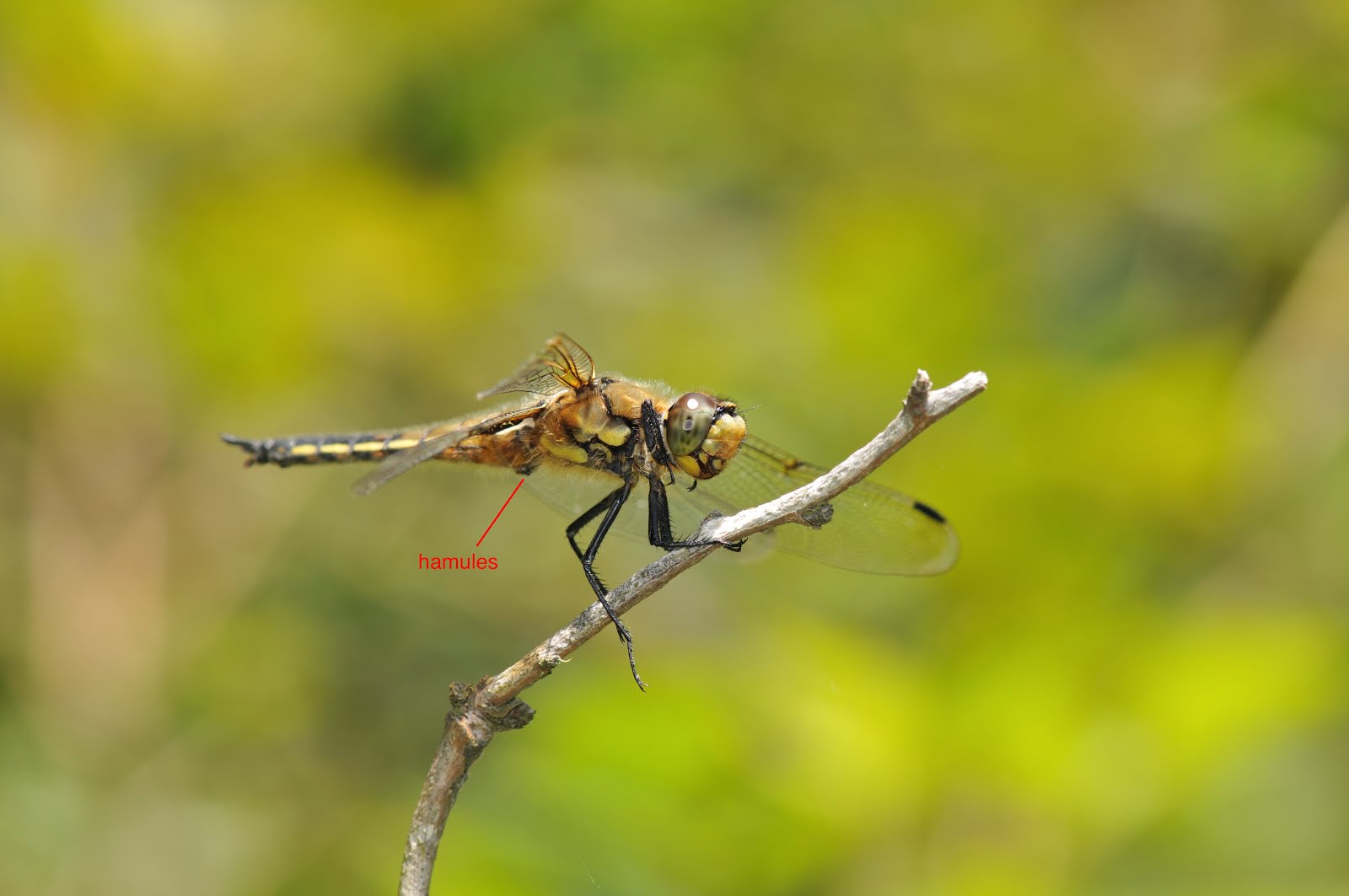


The hamules are like latches that hold the abdomen of the males and females together in the wheel position.

Four-spotted Skimmers have a high perching index (about 80 – 90%), and hence are easy to observe and photograph.  If you see a golden brown dragonfly in our area it's almost certainly a Four-spotted Skimmer, so the ID is fairly easy as well.

Mating is a rapid affair with these dragonflies.  Their short, pudgy abdomens aren't particularly flexible, and hence they stay in the wheel position for only about 10 to 15 seconds.  After mating, the female dips the tip of her abdomen repeatedly into the water to lay eggs while the male hovers above for protection.  They don't stay attached in tandem during egg laying, as do many meadowhawks, because their inflexible abdomens aren't well suited for that kind of maneuver.

Monday, March 30, 2015

Early-Season Report: Red-tailed Pennant

The Red-tailed Pennant is a common red dragonfly of the desert southwest.  In Arizona, where I am now, its flight season is said to begin in June.  Even so, I've been seeing them regularly in April the last couple years, and this year I saw one in my backyard just a few days ago.  It seems their early flight date should be moved up to March.

Here's a look at the Red-tailed Pennant, along with some of its more prominent field marks indicated with white text and arrows. The blue annotations indicate other features of interest.

A male Red-tailed Pennant, observed at the Gilbert Water Ranch.
Field marks for the Red-tailed Pennant.

Here's a slightly different view:


It seems a lot of animals are showing up at different times than usual these days – apparently the Red-tailed Pennant falls into that group.

The best thing about this observation is that this was the first time I've seen a Red-tailed Pennant in my backyard.  That's cool.  I hope I continue to see them!

Friday, January 9, 2015

U-Haul Dragonfly

I've seen lots of U-Haul trucks with interesting graphics on their sides highlighting animals, events, landmarks, etc., from different states and Canadian provinces.  They call it their SuperGraphics program, and I think it's a great idea.

Here's a SuperGraphics I'm suggesting for the state of Washington, which highlights animals seen on Fidalgo Island in Puget Sound.  After all, the Happy-face Dragonfly was discovered right here on Fidalgo Island, at Cranberry Lake.


I think this would make for a great U-Haul SuperGraphics.

Friday, January 2, 2015

January 2015

Here's a calendar for January 2015, featuring various dragonfly photos as a reminder of what we can hope to see this summer:

Thursday, January 1, 2015

Happy New Year, 2015!

Happy New Year from the Happy-face Dragonfly!


We've been enjoying Christmas here, as you can see:


Now that the Christmas season is winding down, we've started off the New Year with a great day.


A Cooper's Hawk visited the backyard to add a touch of excitement.


Happy New Year everyone!

Thursday, December 18, 2014

Late-Season Dragonfly

Betsy and I visited Cranberry Lake every sunny day this Fall to see if any dragonflies were flying.  The last day we saw a dragonfly at Cranberry Lake was Thanksgiving, November 27.  On that day we saw two male Autumn Meadowhawks, which set a new record for a late flight date by one day.  They were perched in the sun, low to the ground, and the temperature was 55 ˚F.  Nice conditions, overall, though it was a bit breezy.  One of the meadowhawks flew upward, grabbed a flying insect, and landed to consume it, so they were still quite active.

Here's a photo of a male Autumn Meadowhawk:


This one is perched on the fence near the parking area, a favorite perching spot due to its exposure to the sun.

The weather has been so variable lately.  One day when we visited Cranberry Lake there was a fog bank around the shoreline of the island.  We decided to go out to Washington Park to see what it was like there.  Here's the view at Green Point:


At the top of the loop drive we were above the fog bank, and it was sunny and warm.  Here's the view:


Cranberry Lake is in the hills in the distance, above the fog on this day.  Birds were active at this lookout point, including a flock of 30 American Robins, 4 Varied Thrushes, and a single (naturally) Townsend's Solitaire.

Thursday, September 11, 2014

Anacortes Field Trip: Saturday, September 13

Greetings Dragonfly Enthusiasts!

I can hardly believe how favorable the forecast is for this Saturday, September 13.  The weather's great, the dragonflies are out, and all systems are go!

Here are some details:

Field Trip Plans

1).  Start around 11:00 am at Heart Lake in Anacortes.  Heart Lake is right next to the road that takes you up to the top of Mt. Erie.  Meet in the southeast corner of the parking lot, which is the area farthest from the boat launch.

2).  Go to Smiley's Bottom around noon for a lunch break and to use the facilities there.  We will carpool at that location and proceed to Cranberry Lake.

3).  Arrive at Cranberry Lake around 1:00 pm.  This is where we hope to see some splash-dunking and spin-drying.  We'll probably finish up and return to Smiley's Bottom around 2:00 or 2:30 pm, depending on the activity level.

Here's a map showing the relevant locations:


To help you prepare for the field trip, here are photos of the damselflies and dragonflies most likely to be seen Saturday:

Clockwise from upper left: Spotted Spreadwing, Tule Bluet, Northern/Boreal Bluet, Pacific Forktail.

Clockwise from upper left: Paddle-tailed Darner, Paddle-tailed Darner (Mr. Happy-face), Shadow Darner, Blue-eyed Darner.

Clockwise from upper left: Cardinal Meadowhawk, Autumn Meadowhawk, Four-spotted Skimmer, Eight-spotted Skimmer.

Clockwise from upper left: Blue Dasher (male), Blue Dasher (female), Western Pondhawk (female), Western Pondhawk (male).

We look forward to seeing you this Saturday!

Wednesday, September 3, 2014

The Whisperer Speaks Next Week!

Greetings Dragonfly Enthusiasts!

Betsy and I are looking forward to seeing you at the next meeting of Skagit Audubon, on Tuesday, September 9, where we will give a presentation entitled "Adventures With Dragonflies."  We also plan to lead a dragonfly field trip the following Saturday, September 13, weather permitting.

More information on the presentation is given below:


Stay tuned for additional information, including handouts and updated information about the planned field trip, and be sure to visit Skagit Audubon for more information about birding in Skagit County at http://www.skagitaudubon.org.

Feel free to bring your dragonfly photos, questions, or stories to share with the whisperer.

Monday, May 19, 2014

The Whisperer Speaks: Dragonfly 101 Handout

I've prepared a handout to go along with my upcoming talk for Prescott Audubon.  Unfortunately, I don't know how many to expect at the meeting, so it's probably best to post the handout here where everyone can have a copy if they like.


This should make the handout available to a wider audience, and also provide a color version suitable for printing at home.  Please feel free to print out a copy.  No need to bring it with you, unless you want to use it to take notes.

See you there, Thursday.

Thursday, April 10, 2014

Roseate Bay at the Gilbert Water Ranch

Another place we like at the Gilbert Water Ranch is what we call Roseate Bay, so named because Roseate Skimmers are so abundant there.  It's located at the northern end of Pond #5 in an area that stays wet all the time, while most of the pond dries up.  Its location is indicated on the map below:


There's also a nice shaded viewing blind at Roseate Bay.  It's a great place to see 3 or 4 Roseate Skimmers perched at a time, while in the background all sorts of ducks and shorebirds are feeding.

Here are a couple shots of a Roseate Skimmer at Roseate Bay.  They're very active right now, and often just perch for a few seconds before taking off again, but every now and then one rests for long enough to get some good shots.

Roseate Skimmer, at Roseate Bay, Gilbert Water Ranch.

The same individual.  Notice how the front two legs are tucked up nicely behind its head.  This is where they hold the front legs during flight as well.  Once the rear four legs capture an insect, the front two legs come into play as they manipulate the prey item for processing.


Also observed at Roseate Bay were a couple Variegated Meadowhawks.  Here's one on a stem, watching for something to take off and chase.

Variegated Meadowhawk, Roseate Bay, Gilbert Water Ranch.

The same individual from a different angle.  Notice the two yellow spots on the thorax.  When it was younger, there would have been two white stripes on the thorax, with yellow spots at the bottom.  With age, the white fades away, leaving just the yellow spots.  Notice also the intricate pattern on the abdomen, the reason for its name.