Showing posts with label Dot-tailed Whiteface. Show all posts

Wednesday, August 1, 2018

The Dot-tailed Whiteface Does A Body Slam

On a recent trip to Heart Lake here in Anacortes, I observed a new behavior exhibited by the Dot-tailed Whiteface. Here's a picture of an individual of this species from Heart Lake:


Notice the chalk-white face, black eyes, clear wings, and black body with a yellow dot near the tip of the abdomen. This is surely one of the easiest IDs to make in dragonflying.

Getting back to the behavior, I was taking a video of general dragonfly activity at the lake. When I got home and viewed the video on the computer I noticed some unusual movement in the lower right corner. On closer inspection, I saw that a bluet was harassing a Dot-tailed Whiteface, eventually grabbing its abdomen. The whiteface immediately did a spin move—similar to what dragonflies do in a spin-dry, only in this case it was "shedding" the damselfly rather than water.

Here's a video clip showing the body slam. It's grainy because it's an enlargement of the lower right corner of the full video:


You can see the full video at the following link:

https://www.youtube.com/watch?v=QuY34erRHpY

Fascinating behavior, where the dragonfly adapts one behavior—spin-dry to shed water—to another ver different situation—spin-dry to shed a damselfly.

Find out more about the splash-dunk/spin-dry behavior, as well as about the Dot-tailed Whiteface, in my new field guide, Common dragonflies and Damselflies of the Pacific Coast. You can find the book at the following link:

https://www.amazon.com/gp/product/1934199265/ref=s9u_simh_gw_i1?ie=UTF8&fpl=fresh&pd_rd_i=1934199265&pd_rd_r=4Q8FNWQMZKPZ7GYWQB31&pd_rd_w=c79uB&pd_rd_wg=lb3xg&pf_rd_m=ATVPDKIKX0DER&pf_rd_s=&pf_rd_r=038QHD1N13Z2D7NWAP1Q&pf_rd_t=36701&pf_rd_p=1cf9d009-399c-49e1-901a-7b8786e59436&pf_rd_i=desktop

You never know when a trip to the field will result in new behavior.

Friday, June 8, 2018

Heart Lake

I went to Heart Lake in Anacortes a couple days ago, and the dragonfly activity was at a high level—dragonflies everywhere, with lots of egg-laying behavior on display. There were also some newcomers for the year, including the Cardinal Meadowhawk and the Eight-spotted Skimmer.

Here's a Cardinal Meadowhawk perched near the egg-laying area:


This guy's is looking up, checking out his surroundings. Notice that his abdomen is broad and flat, as is typical of this species. Here's another individual on his favorite leaf:


You can just barely see one of the white spots on the side of the thorax, one of the field marks for this species. Also, notice that the abdomen is fringed with yellow, indicating this is a young male. The abdomen starts off yellow, and turns bright red with age. This individual is just at the end of this transition.

Most of the egg laying was being done by the Cardinal Meadowhawks. Here is a couple dipping into the water to deposit a small mass of eggs:


This is a frame capture from a video, and in the video itself you can see the egg mass dropped off by the female, which then slowly sinks to the bottom.  Sometimes there were a couple pairs laying eggs at the same time:


Another common species along the shore was the Dot-tailed Whiteface. A number of pairs were seen in the wheel position, though I didn't see any egg laying. Here's a male perched on the ground:


This was also the first day I've seen the Eight-spotted Skimmer in Anacortes. Here's a young male on his favorite perch in the bushes:


It's clear this is a male from the white spots in the wings. Notice, however, that it's a young male because the abdomen still looks like the abdomen of a female, with straight yellow side stripes. As it matures, the abdomen will turn a lovely pruinose blue.

Sunday, July 2, 2017

A Visit To Heart Lake

Yesterday, Betsy and I went to Heart Lake after lunch. It was a beautiful day, temperatures in the 70s and not a cloud in the sky. Nice and calm too. We were glad we went because the dragonfly activity was high.

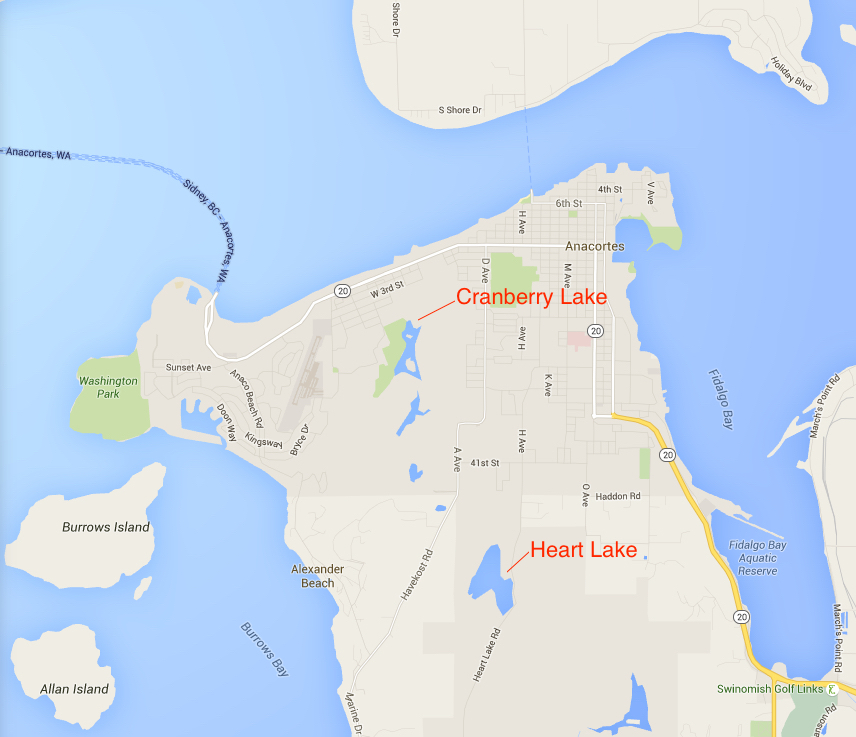
Here's the location of Heart Lake. It's within the city limits of Anacortes, and also a part of the Anacortes Community Forest Lands.


The first thing we noticed as we got out of the car was an abundance of Pacific Forktails. They were all over the place. Every step you took in the grass flushed a small cloud of them. Most were immatures, and many were females.

The females are quite striking in this species. Here are a couple examples:


Notice the single blue segment at the tip of the abdomen (males have two) and the stripes on the top of the thorax (males have spots).

Here's a look at the ovipositor of this species—the "bulge" at the tip of the abdomen. The female uses this to cut a slit in a stem in which to deposit her eggs.


Here's the male Pacific Forktail for comparison:


As mentioned above, he has two blue segments at the tip of the abdomen, and blue spots on top of the thorax.

We also saw lots of Dot-tailed Whitefaces. They love lily pads, but there were so many of them that they were perching all over the place.


Notice the chalk-white face, and the yellow "dot" on the abdomen.

Western Pondhawks were also numerous. Many were quite young and fresh in appearance, like the female shown below.


Here's a male showing off his blue color, and his "Groucho Marx" mustache.


Cardinal Meadowhawks were common, as well. Notice the red wing patches near the base of the wings, the bright red face, and the intense red dorsal fovea on the top of the eyes. In contrast, you can see one of the white dots on the side of the thorax.


We also saw Variegated Meadowhawks, which seemed to prefer perching on the ground near the shore of the lake. Notice the complex pattern on the abdomen. Just barely visible is one of the yellow dots this species has on the sides of the thorax.


Of particular interest was a single Four-spotted Skimmer. It was the first of its species to be observed at Heart Lake (though they are common at Cranberry Lake).


All in all, it was a beautiful day at Heart Lake, and a sure indication that dragonfly season is well underway.

Thursday, June 15, 2017

Species Spotlight: Dot-tailed Whiteface

Just a few days ago Betsy and I went to Heart Lake in Anacortes on a nice sunny, warm day. The dragonfly activity is picking up there now. We saw Common Green Darners, California Darners, a Variegated Meadowhawk. We also saw several Dot-tailed Whitefaces, our first of the year.

Here's the location of Heart Lake:


The Dot-tailed Whiteface is a mostly black, small dragonfly that loves to perch on lily pads. It's key field marks include a yellow dot on the abdomen (tail), and a chalk white face.


Not often noted, but also an interesting field mark, are the white wing tips, which are formed by light-colored wing veins that extend beyond the stigmas. You can see the white tips on three of the wings in the photo above, but the fourth wing tip is hidden in the shadows.

Here's another look at the Dot-tailed Whiteface:


Females look much like males, though more brownish in overall color.

The eyes of the Dot-tailed Whiteface are so black, and so shiny, that they show interesting reflections. The next photo shows a Dot-tailed Whiteface looking at the camera:


The two bright, almost circular, spots are reflections of the sun, much as you would see in a football helmet, as indicated below:


The broader, paler white patches in the eye are reflections of the bright white face.

Take a look for this interesting dragonfly on a lily pad near you!

Wednesday, June 22, 2016

Heart Lake Dragonflies

We had a great time dragonflying at Heart Lake a few days ago.  Lots of individuals, and several species, were seen – including species we never see at nearby Cranberry Lake.

Heart Lake gets its name from its roughly heart-shaped outline, as can be seen in the following map:

Heart Lake (center, bottom) in relation to downtown Anacortes.  Cranberry Lake is just above center.

Perhaps most striking dragonfly at Heart Lake was the Cardinal Meadowhawk, with its intense red colors showing off nicely in the bright sun.  Here's an example of one of the males:

Male Cardinal Meadowhawk at Heart Lake.

In this next view you can see what I regard as its best field mark, the intense concentration of red color near the wing bases.

Male cardinal Meadowhawk.  Notice the dark red, opaque regions in the wings near the base.  An excellent field mark.

This field mark is completely diagnostic, and visible from almost any angle.  It will be featured prominently in my forthcoming field guide.

Notice also the intense red color on the abdomen.  It almost over saturates the eyes.

The Cardinal Meadowhawks were also laying eggs, which they do while attached in tandem.  Here's an example:

Cardinal Meadowhawks laying eggs in tandem.  The female dips the tip of her abdomen in the water to deposit her eggs.

While this pair was laying eggs, a lone male was trying to break them apart so he could replace the current male, as can be seen below.  It didn't work, though he was pretty persistent.

A lone male Cardinal Meadowhawk unsuccessfully attempting to break apart an egg-laying pair.

We also saw numerous Dot-tailed Whitefaces – more than I've ever seen before.  They were everywhere, flushing from the ground or grass with every step, and also sitting on their favored perches – lily pads.  Here are a couple photos:

A male Dot-tailed Whiteface showing off its yellow dot.

In this photo you can see the chalk white face reflecting from the jet black eyes.

Notice the cute little yellow spot, or "dot," on the abdomen, the reason for its common name.