Showing posts with label dorsal fovea. Show all posts

Wednesday, October 18, 2017

What Big Eyes You Have!

Dragonfly eyes are beautiful and impressive. As an example, take a look at the eyes of a young Blue Dasher, shown below.


Notice the large reddish areas on the top of the eyes. These areas are referred to as the dorsal foveae—so named because they are on the top (dorsal) surface of the eyes, and are the parts of the eyes with the sharpest vision (analogous to the vertebrate fovea). The name is ironic because the word fovea is Latin for "pit," and indeed the fovea (area of sharpest vision) of a vertebrate's eye is a pit on the surface of the retina. In the case of a dragonfly, the fovea is not a pit, but it is the area of sharpest vision.

Here's another view of dorsal foveae in dragonflies, this time on a Cardinal Meadowhawk.


One of the interesting aspects of dorsal foveae is that the ommatidia (individual eyes) in them are rather large, and point primarily in one direction. This gives the sharp vision mentioned above. It also means that when you look directly at the dorsal foveae, you see an exceptionally large pseudopupil, as shown below.


My, what big eyes you have!

This effect is perhaps best seen in Blue Dashers. Take a look for the "big eyes" next time you get a good look at a Blue Dasher. You can read more about the eyes of dragonflies in my new field guide: Common Dragonflies and Damselflies of the Pacific Coast.

Tuesday, January 24, 2017

Species Spotlight: Band-winged Meadowhawk

Our next species is another meadowhawk—the Band-winged Meadowhawk. This is a species that is distinguished by extensive amber wing patches.

Here's a male Band-winged Meadowhawk, giving a good view of the wing patches:


Notice that the patches are darker on the hindwings than the forewings, but even there they are transparent. The patches extend out to the nodus of the wing—the little "bend" on the leading edge. Here's another view of this individual:


Other distinctive field marks of this species are the black side stripe on the abdomen, the yellow at the base of the abdomen, and additional yellow on the sides of the thorax.

The female is generally yellowish in color, which is typical in females and young males:


The female also has amber wing patches, like the male, which makes for easy identification.

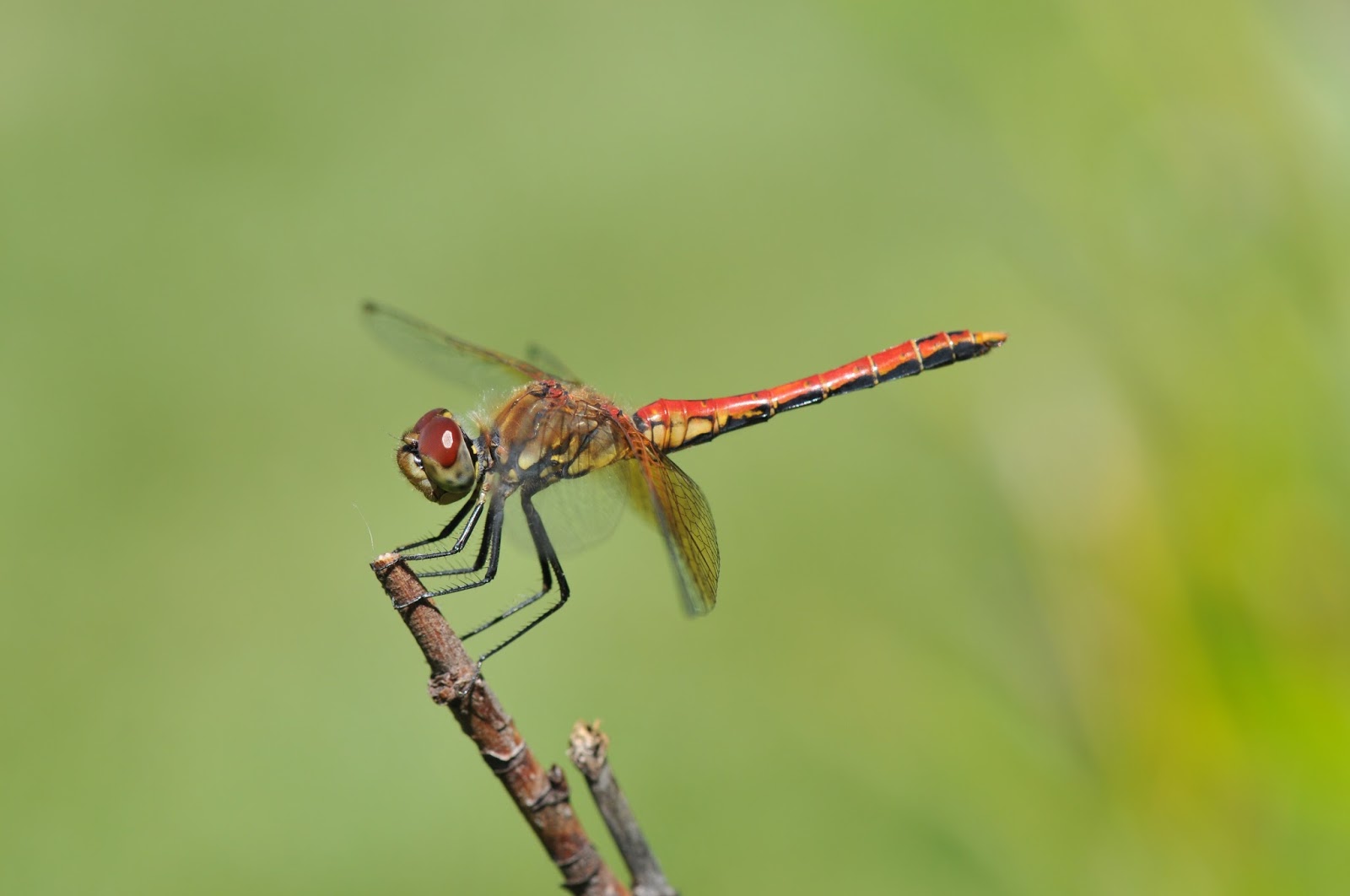
Band-winged Meadowhawks have noticeable dorsal fovea—the red areas on the top of the eyes.


As can be seen, the eyes are red on top, and yellowish below. The red dorsal fovea are the areas of best vision. When the meadowhawk wants a good view of a prey item or a potential mate flying by, it points the dorsal fovea in that direction.