Showing posts with label Magnuson Park. Show all posts

Tuesday, July 25, 2017

Magnuson Park

This weekend we went to Magnuson Park in Seattle for the first time this summer. It was hot, and we were looking for shade most of the time. Still, the dragonflies were happy, and lots of them could be be seen at the various ponds.

Here's the location of Magnuson Park:


In the old days—when I was a kid—this area was known as Sandpoint. In those days, it was the location of Sandpoint Naval Airbase. Now, it's a lovely park with lots of different areas for different activities.

Our main interest is in the wildlife area, which consists of a smooth gravel path that winds around a number of small ponds, each slightly different in character. Some ponds dry up completely in the summer, some are much reduced, and some have a water supply that keeps them full all year round. We find a different distribution of odonate species at the various ponds, which makes Magnuson Park an interesting place to do some dragonflying.

On this trip, we saw lots of Western Pondhawks. Most were males, which are out and about defending their territory almost all of the time. Some were young, and still showed some of their adolescent green color on the thorax and near the base of the abdomen:


When possible, Western Pondhawks like to perch on the ground, or on a mat of algae. When a flat surface is not available, they may resort to perching on stems.

Notice that the males have a uniform blue color when fully mature. Specifically, the blue color  on the thorax is the same as the blue on the abdomen, unlike Blue Dashers whose thorax is a darker blue. Western Pondhawks also lack white stripes on the sides of the thorax that are present in Blue Dashers, and they have completely clear wings—Blue Dasher's wings have a bit of amber near the base. Finally, the face of the Western Pondhawk is green, as compared with the white face in the Blue Dasher.

Only a couple female Western Pondhawks were seen. They stay back from the water when not laying eggs, and their green color helps them blend in with the vegetation.


What a wonderful green color, especially on the thorax. Notice the small "egg scoop" projecting downward near the tip of the abdomen.

The next most numerous species at Magnuson Park was the Blue Dasher. These dragonflies are lively and beautiful. They perch frequently and give many good photo opportunities.


Here you can see that the thorax is darker blue, and has light-colored side stripes. Also, note the amber at the wing bases, and the white face.

Other species at the park included Spotted Spreadwing, Tule Bluet, Pacific Forktail, Blue-eyed Darner, Common Green Darner, Cardinal Meadowhawk, Common Whitetail, and Black Saddlebags.

Thursday, September 17, 2015

Double Seams

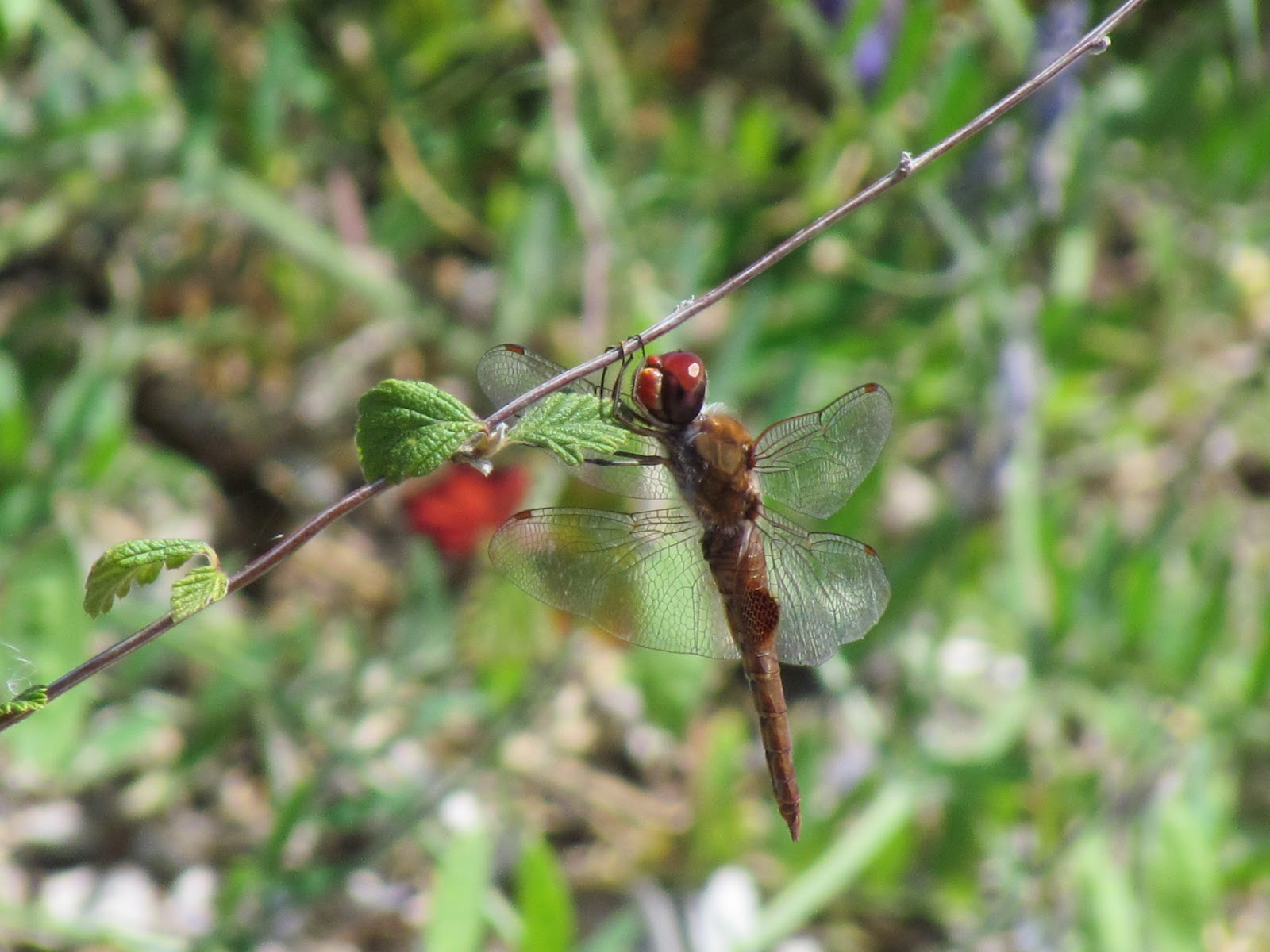
On a recent trip to Magnuson Park in Seattle, I took a few pictures of a young Cardinal Meadowhawk.  When I looked at the photos later it seemed like I was seeing double.  Here's an example of what I mean:


Notice the double images along the abdomen, specifically at the seams between the segments.  I wondered if I had jiggled the camera somehow, or had a smudge on the lens, but the double images were in all the photos.

I had never noticed before that the seams are doubled, but it turns out that it's easier to see the effect in young individuals, when the abdomen is light colored.  The double seams are still present in a mature adult, but they're not as prominent, as can be seen in the following photo:


I decided to check other meadowhawks, and have found that Striped Meadowhawks also have these unusual double seams.  Here's an example:


I haven't found this effect in other meadowhawks yet, like the Autumn Meadowhawk in the next photo.  I'll keep checking, though.

Monday, November 11, 2013

A Late Meadowhawk

On October 6, Betsy and I went to Magnuson Park in Seattle for a little dragonflying.  We weren't expecting too much that time of year, but it was a nice day, and we thought we might as well give it a try.  We found quite a few darners and spreadwings, as we expected, so it was a fun outing.

To our surprise, we also found some Cardinal Meadowhawks out and about.  They are one of our first meadowhawks to appear.  In fact, they show up in early May, well before most of the other common meadowhawks in our area.  We hadn't expected to see them this late in the season, and a check with the calendar of flight dates showed that the latest date previously reported for the Cardinal Meadowhawk was October 2.  Here's a look at the flight season for Cardinal Meadowhawks, including our modest extension to October 6:


Another way to look at the flight season is shown below.  In this graph, we plot the probability a Cardinal Meadowhawk will be seen in a given month.  For example, notice that about 40% of the Cardinal Meadowhawk observations are made in the month of July.  The data for this plot are taken from 3 successive years of observations.


Even though it was late in the season, the Cardinal Meadowhawks were in prime color – which means intense red.  Here are a couple photos from October 6:

A male Cardinal Meadowhawk.  Notice the dark red color at the base of the wings.
Brilliant red on a sparkling, sunny day.  The dark red in the wings is nicely visible, but the wings make it difficult to see the white dots on the side of the thorax.

Cardinal Meadowhawks are primarily a west coast species, as you can see from the following dot map:


Even in our part of the country, they tend to be more common in the west:


When identifying meadowhawks, remember that Cardinal Meadowhawks are our only meadowhawk with a dark red concentration of color near the base of the wings.  This field mark can be seen from virtually any angle, which is often not the case for the white spots on the side of the thorax, and is quite definitive for this species.

Saturday, August 31, 2013

Magnuson Park Field Trip

Greetings Dragonfliers,

Thanks for the wonderful turnout for the dragonfly field trip on Sunday at Magnuson Park.  Your enthusiastic participation really made it a most enjoyable experience for Betsy and me – and the weather cooperated too.

Here's a list of the species we saw:

Damselflies
California Spreadwing
Spotted Spreadwing
Tule Bluet  
Pacific Forktail  
Western Forktail 

Dragonflies
Paddle-tailed Darner
Shadow Darner
Blue-eyed Darner
Common Green Darner
Eight-spotted Skimmer 
Western Pondhawk
Variegated Meadowhawk 
Cardinal Meadowhawk 

A few of the highlights were the intense red of the Cardinal Meadowhawk, the incredible blue of the Spotted Spreadwing's eyes ("you haven't lived …"), and the Groucho Marx mustache of the Western Pondhawk.  We also got to see egg-laying behavior in many of the species, including the Cardinal Meadowhawk, Eight-spotted Skimmer, Western Pondhawk, and California Spreadwing.

Videos
Here are some links to videos on my YouTube Channel (The Dragonfly Whisperer Channel) that illustrate topics that were discussed during the trip.  These videos are slow motion, showing dragonfly behavior at 1/8 normal speed.

1.  Dragonflies do sometimes prey on other dragonflies and damselflies.  Here's an example of a Paddle-tailed Darner going after a pair of Autumn Meadowhawks in tandem.  This pair was lucky and escaped, but many others did not.  Also, notice the egg-laying process in the Autumn Meadowhawk – first they dip the female's abdomen into the water where she collects a droplet, next they hover for a short time while she lays eggs into the drop, finally they swoop down and slam into the vegetation to dislodge the drop.  This video shows the whole egg-laying process, as well as the attack by the darner:


2.  A nice sequence of splash-dunking and spin-drying can be found here, where a darner splash-dunks into the water twice to clean itself, then spin-drys at 1,000 rpm to shed the water:


3.  The Happy-face Dragonfly can be seen in this spoof movie trailer:


Thanks again for sharing the fun of dragonfly watching with us.

Jim and Betsy Walker

Wednesday, August 21, 2013

Magnuson Park Dragonfly Update

Greetings Dragonfliers,

I've been watching the weather forecasts carefully, and I'm a bit concerned about this coming weekend.  At the moment Sunday looks marginally better than Saturday, but neither one looks that great.  We'll keep checking and make a final decision Thursday or Friday.  If the weather looks too iffy we'll just wait a week and try again.

Here are a couple maps showing the location of Magnuson Park.  I like to take the following route, getting off the freeway at exit 172:


You can also get off the freeway at 145th, and then head south along Sand Point Way, as indicated here:


In either case, you arrive at the intersection of Sand Point Way NE and NE 65th St.  Enter the park here, and go several blocks to the first large parking lot on your left:


This is our starting point.

Let's hope the weather shapes up for the weekend.

A Merlin has been feasting on dragonflies at Magnuson Park, primarily on Blue-eyed Darners, and putting on quite a show for dragonfliers and birders alike.  Here are a couple photos taken by Gregg Thompson showing the Merlin with a pair of darners that it probably snagged as they flew in tandem.  Many thanks to Pam Pritzl for sharing the excellent photos.

Saturday, August 17, 2013

Dragonfly Field Trip, August 24 or 25

Greetings Dragonfliers,

Let's try for a dragonfly field trip next weekend.  We'll shoot for Saturday, August 24, or Sunday, August 25, depending on which is predicted to have the better weather.

The trip will be at Magnuson Park in North Seattle, which is a great location for dragonfly activity.

Details will be posted next week, but I just wanted to give everyone an advance heads-up to start thinking about dragonflies.

Last year we saw a couple Spot-winged Gliders at Magnuson Park, which is quite an extraordinary dragonfly to see in this area.  Will they appear again this year?

A male (notice the hamules under segment 2 of the abdomen) Spot-winged Glider at Magnuson Park last year.
The same individual, this time with a better view of the spots on the hindwing that give this dragonfly it's name.

More details on the Spot-winged Glider at Magnuson Park can be found at the following post:

Monday, July 30, 2012

Spot-winged Glider At Magnuson Park

The Spot-winged Glider is one a relatively small number of dragonflies known to migrate, along with the Wandering Glider, Variegated Meadowhawk, and Black Saddlebags, to name a few others.  They are well equipped for long-distance flights with their wide hindwings that stretch for almost half the length of their abdomen.  The key field mark for this dragonfly, as indicated in their common name, is a dark spot on each hindwing near the abdomen.

We've only seen this dragonfly once or twice before, and those observations were in Arizona.  Our first sighting was at the Gilbert Water Ranch in Gilbert, AZ.  We saw an unusual dragonfly flying and flying, but with persistence we finally saw it land.  It stayed put long enough for a few pictures for identification before it took off never to be seen again.  We may have seen another in Cottonwood, AZ, but it never landed and didn't come close enough for a positive ID.

We were quite surprised, then, to see a Spot-winged Glider whizzing past us at Magnuson Park in Seattle, WA late in July.  It had the look of a glider – similar to the more common Wandering Glider, but darker and more reddish – and as we watched it fly by a couple times we finally got a good look at its spots.  Knowing this was an unusual sighting, we wanted to have photographic documentation, so we watched it carefully until it landed for us.  Below are a few pictures I got that show it was a male Spot-winged Glider.  The pictures aren't great, but they document this unusual sighting.

The Spot-winged Glider finally landed for us, though in a fenced off area where we couldn't get very close.  Notice the hamules on segment 2 of the abdomen, indicating that this individual is a male, and the dark spot on the hindwing.

From some angles, the spots on the hindwings can be a bit hard to see since they are so close to the abdomen.

A better look at the spots here.  Notice also the great width of the hindwing, almost half the length of the abdomen.

We saw a Spot-winged Glider land at a different location a few minutes later.  It may have been the same individual.  From this angle you can see the beautiful red of the eyes, which is quite apparent even in flight.

We were curious to see just how unusual it is to see a Spot-winged Glider in this part of the country.  Checking with Dennis Paulson we discovered that he has seen the Spot-winged Glider in King County only once before – he saw a single individual fly by and disappear at Magnuson Park two years ago.  We also checked with the new field guide Dragonflies and Damselflies of Oregon by Kerst and Gordon.  They state the following:

We have one photographic record of this rare dragonfly from 2001, hanging up in a flower garden in the Friendly neighborhood in Eugene.

The only other reported sighting in Oregon was in Medford in 2009.

We're glad we were able to get photos of this individual, and that Dennis also saw and photographed it when he visited the park the next day.  You just never know what you're going to encounter when you go out into the field.