Showing posts with label Flame Skimmer. Show all posts

Wednesday, April 17, 2019

Arizona Heating Up

Well, the dragonfly activity in Arizona is certainly heating up—as are the temperatures. In fact, the dragonflies are much more active here than they were in Costa Rica a week ago. We went to the Gilbert Water Ranch two days ago and were surprised at all the dragonflies and damselflies that were out to greet us. Here's our odonate list:

Blue-ringed Dancer
Familiar Bluet

Mexican Amberwing
Flame Skimmer
Blue Dasher
Roseate Skimmer

We don't remember seeing the Mexican Amberwing at the water ranch before, so that was a pleasant surprise. Here's a look at one of males we saw:


This small dragonfly looks a bit like a wasp, which may provide it some protection. Notice the dark brownish-red areas on top of the eyes. These are the dorsal fovea, the areas that provide the dragonfly with its best vision.

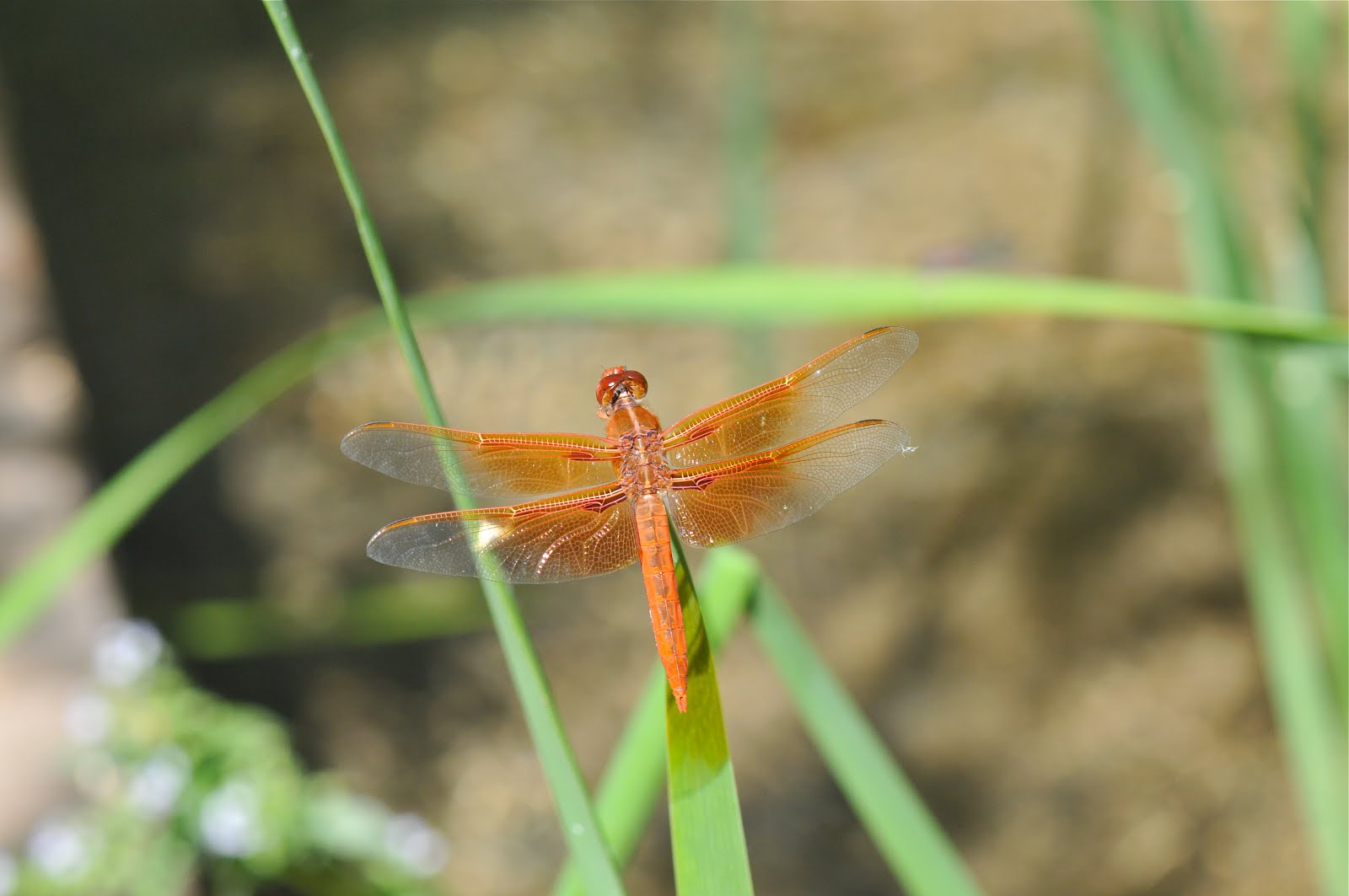
Just after seeing this dragonfly, we commented on how nice it would be to see the much larger and more brilliantly colored Flame Skimmer. Right on cue, a mature male came in and landed directly in front of us. Here it is:


Shortly after that, we saw this Familiar Bluet, just like the one we saw in Costa Rica:


All in all, a nice day at the water ranch, with lots of dragonflies and damselflies—and this was in addition to the 35 species of birds we saw!

Thursday, January 24, 2019

Species Spotlight: Flame Skimmer

Next up in the spotlight is another striking skimmer—the Flame Skimmer. This flame-colored species is quite common in the southwest, but it is also found in Northern California, Oregon, and just recently a sighting was made in Washington, just across the Columbia River from Oregon.

Here's a look at a male Flame Skimmer:


This species is distinguished from the similar Neon Skimmer by having dark-red rectangular "bars" at the base of the wings, near the leading edge. In addition, the coloration in the wings extends beyond the nodus—the bend in the leading edge of the wing—but stops short of the nodus in the Neon Skimmer.

The female of the species is more lightly colored, as seen below:


Notice the "flange" near the tip of the abdomen, which is the female's "egg scoop".

Here are some additional views of the male:


The next photo shows a common practice of this dragonfly—it often perches with its front two legs tucked up behind the head.


Many dragonflies perch this way, and even fly in this configuration.

Tuesday, April 26, 2016

Dragonflying at Tortilla Creek

One of the places we like to dragonfly in Arizona is Tortilla Creek, in the little tourist town of Tortilla Flat.  The town consists of a few small "cowboy"-type businesses along the road.  Here's a picture of the town:


Most of the visitors to Tortilla Flat are probably not even aware of the small creek, Tortilla Creek, just across the street from the town.  Here's a view of the creek:


Everywhere you look when you visit Tortilla Creek you see incredible desert vistas, like the one below.


Dragonflies are out and flying at Tortilla Creek, though not nearly in the numbers that will be seen in about a month.  Even so, we had some good views of Common Green Darners, Flame Skimmers, Roseate Skimmers, Blue Dashers, and a Mexican Forktail.

The Flame Skimmers seemed particularly vibrant.  Here's one that landed right in front of us:


Notice the intense red colors in the wings, including the dark rectangular concentrations (opacities) near the wing bases – an important way to distinguish the Flame Skimmer from the similar Neon Skimmer.  I also like the yellow cross veins near the leading edges of the wings, and the contrast they make with the red colors elsewhere.

A Blue Dasher landed near us, and offered an unusual rear view:


Later, it turned around to give us some more common perspectives:


One other dragonfly gave us some nice close views – a male Roseate Skimmer.  It looked quite young and fresh, with lovely colors, and fairly clean wings.  Here are a few looks at it:


What a treat!

Tortilla Creek may not be well known, and it may be overlooked because of the tourist attractions across the road, but it's a nice place to view birds and dragonflies.

Tuesday, April 19, 2016

Capitol Building in Santa Fe

On a recent trip to New Mexico, we stopped at the state's capitol building in Santa Fe.  It's a very nice building, very inviting.  Here's the senate chamber:


The lobbies are full of beautiful art work, including the following painting that caught my eye:


I love the various Native America motifs in the painting, and especially the three symbolic dragonflies.  The lower one is reminiscent of a Flame Skimmer, the middle one makes me think of a Red Rock Skimmer, and the top one could be a Western Pondhawk.  In any case, it was cool to see these dragonfly representations in the halls of power in Santa Fe.

The bluish dragonfly at the top is near a spiral symbol:


I've looked for the meaning of these spirals, which are quite common in Native American art, but no one really knows what they mean.  Some say they stand for water, others say they signify life, but no one knows for sure.

My thought – a bit biased I must admit – has always been that the spirals could represent the water spraying off a dragonfly as it performs a spin-dry after a series of splash-dunks.  What is particularly interesting in this painting is the association between the dragonfly symbol and the spiral symbol – there might be something to my spin-dry interpretation after all.

Wednesday, April 23, 2014

The Unexpected Pleasures of Dragonflying: A Rattler and a Monster

One of the great things about dragonflying is that it gets you out in the field where you're likely to see many wonders of nature.  A couple weeks ago we went to the Boyce Thompson Arboretum, and though we saw only a couple Blue-eyed Darners and one Flame Skimmer at Ayer Lake, we saw lots of other delights.

One was a beautiful male Broad-billed Hummingbird that perched for us in the sunlight.  This was in the Cactus Garden area, near the boojum tree.  Such a nice contrast between his flame red bill and the iridescent blues and greens in his body.

A Broad-billed Hummingbird at the Boyce Thompson Arboretum.

A little later, on the shady path near the Herb Garden, we saw two baby Anna's Hummingbirds almost spilling out of their tiny nest.  Good thing it's so elastic.  Here are the babies:

Baby Anna's Hummingbirds overflowing their nest.

As we watched, they decided to take a little nap:

Nap time for the babies.

Hummingbirds are a common part of a visit to the arboretum, even babies in the nest.  What was a bit more exciting, however, was the next unexpected pleasure – a Western Diamonback Rattlesnake.  We were heading back toward the picnic area for lunch when we spotted a good-sized rattler under a bush.  I would say it was around 5 feet long.  Here are a couple photos of it:

Western Diamondback Rattlesnake.  Clearly a member of the pit viper family.

He was getting a good look at us.  As he moved on I was able to get a couple shots of his rattles, and also the black and white bands of roughly equal width:


It was interesting having lunch, knowing this guy was just a few feet away.  Oh well, he was staying well under the bush, so we weren't concerned.

After lunch we took a walk through the Demonstration Garden.  We checked out the hummingbird nest on top a pine cone, but discovered that the babies had left.  Just then we stopped dead in our tracks as we saw the guy below lumbering out of the meadow onto the walking path:

A Gila Monster strolling across the walking path.

What a treat to see the Gila Monster.  We've seen them before at the arboretum, but always in the desert area, near the Cactus Garden.  This was the first we'd even heard of one being in the Demonstration Garden.

He sauntered across the path, then disappeared into the brush on the other side.  A nice treat to top off our day of unexpected pleasures.

Friday, April 4, 2014

Flame Skimmer at the Water Ranch

Betsy and I visited the Gilbert Water Ranch today.  Lots of activity, including some nice looks at Flame Skimmers, which are just getting started for the year.

Below is a female Flame Skimmer.  You can tell it's a female by the widened flanges near the tip of the abdomen, which is where the eggs come out.  The female uses the flanges to flip droplets of water as it lays its eggs.  Also, notice the lack of hamules.

Female Flame Skimmer at the Gilbert Water Ranch.

An important field mark for this species are the dark red markings near the base of the wings.  This is the best way to distinguish this skimmer from the similar Neon Skimmer, which lacks those dark marks.