Showing posts with label dancer. Show all posts

Wednesday, April 10, 2019

Costa Rica: Cerulean Dancer

We just returned from a wonderful trip to Costa Rica. It was a first trip to that country for us, and we explored a number of different areas and habitats. Here's a rough look at our itinerary:


We were there during the dry season, which was great for us, but not as conducive to seeing odonates. Even so, we did see a few. Our first was the Cerulean Dancer, which we saw at a small pond on a tour of a coffee plantation. Here's a look at this attractive damselfly:


Notice its "dancer" habit of holding its wings high above the abdomen when perched. Later we saw a pair laying eggs, with the female partially submerged:


Here's a side view:


It would have been interesting to watch to see if the female would eventually go completely underwater, but we had to get back to join the tour. We only had a few minutes to observe this damselfly, and get a few pictures, but it was fun to see a new species for us in a new country.

Wednesday, August 7, 2013

Betsy's Blue-tipped Dancer

On a recent trip to Minnesota, Betsy came across a new damselfly for us – the Blue-tipped Dancer.  She was able to get a picture of it for documentation, which is shown below.

A male Blue-tipped Dancer from Rice County, Minnesota.

She knew right away it was a dancer by the way it "flipped" its wings after landing.  It also tends to hold its wings completely above the abdomen, another dancer trait.

After identifying it, we checked the range maps, and found that it's a bit uncommon where she saw it.  Shown below is the dot map from Odonata Central.

Dot map for the Blue-tipped Dancer, as compiled by Odonata Central.

Zooming in to River Bend Nature Center near Faribault, MN in Rice County, we see that the dots begin to disappear.  This is shown below.
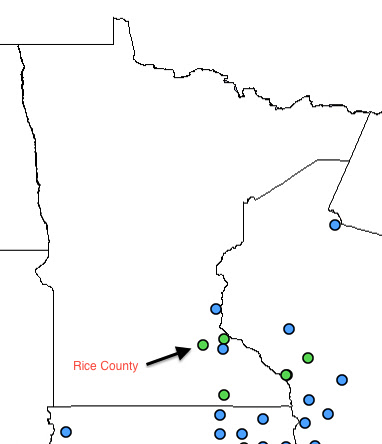
Dot map for the Blue-tipped Dancer for Minnesota.

Betsy's observation was in Rice County, and only a single observation of this species had been made in this county before.  The previous sighting is indicated with the arrow.  Betsy saw the dancer on the other side of Rice County, so we'll add her observation to the dot map so others can know where it can be seen.

Here's a bit more detailed map showing where Rice County is in relation to Minneapolis:

Rice County is the boxed region south of Minneapolis.

A closer look shows Betsy's observation site, and the only other observation in Rice County:

Detailed map showing River Bend Nature Center, where Betsy saw her dancer.  The only other report of this damselfly from Rice County was at the indicated location near Northfield.

Update:

Betsy's observation has been accepted, and now appears on the Odonata Central dot map.  Here it is:

Sunday, April 29, 2012

Getting Into A Spot Of Trouble

Yesterday, Betsy and I explored the Hassayampa River Preserve for the first time.  It's a wonderful place, with a great variety of habitats, ranging from a lake, to a stream, to cottonwood groves, and even open desert.

One of the treats along the stream was a thriving population of damselflies, including American Rubyspots.  The photo below shows a rubyspot (right) fending off an aggressive California Dancer.


Notice how the rubyspot flashes the red patches on his wings, which are usually hidden as it rests with its wings closed.  At the same time, it arches its abdomen and opens its appendages, which look like the pincers on an earwig.  The display generally has the desired effect of warding off the dancer; even so, the dancer usually lands just a short distance away on the same twig to await another chance to get the rubyspot out of his territory.

Here's a closer look at the rubyspot's threat display.  Can he actually do harm with those menacing appendages?  I wonder.


The Blue-ringed Dancer

Blue-ringed Dancer (male) at the Gilbert Water Ranch

One of the most photogenic damselflies is the Blue-ringed Dancer.  This male is perched on a rock in a swiftly flowing stream, the Blue-ringed preferred habitat.  I love the intense colors, especially in the head and thorax.

Notice how the wings are held completely above the abdomen; this is characteristic of dancers as a group.  In contrast, bluets tend to hold their wings folded along their abdomen.