Showing posts with label damselfly. Show all posts

Friday, January 15, 2016

Pop Culture: Curb Your Dragonfly

We've been binging on Curb Your Enthusiasm lately, and enjoying it quite a bit.  It's a fun series, and I like the fact that its shot in real locations, rather than in a sound stage, and that so many interesting people show up from time to time.

In the season 7 episode "Officer Krupke," referring to a character in West Side Story, Larry sits on a couch at the end of the episode.  I noticed that the pillows on the couch had representations of damselflies on them, which I thought was cool.  Here are a few pics of the scene, showing the interesting pillows:


Tuesday, December 29, 2015

Species Spotlight: American Rubyspot

The American Rubyspot is an impressive damselfly.  It is fairly large for a damselfly, and has dazzling "ruby" spots at the base of its wings.  Here is a look at the male of the species:


Here's another view, with a Blue-ringed Dancer in the background:


When an American Rubyspot wants to fend off a rival, it flicks its wings open to flash the ruby spots.  It also bends the tip of its abdomen forward, and opens its appendages, in a "stinging" threat pose. In the next photo we see an American Rubyspot fending off a California Dancer that would like to perch on the same stem:

Wednesday, August 7, 2013

Betsy's Blue-tipped Dancer

On a recent trip to Minnesota, Betsy came across a new damselfly for us – the Blue-tipped Dancer.  She was able to get a picture of it for documentation, which is shown below.

A male Blue-tipped Dancer from Rice County, Minnesota.

She knew right away it was a dancer by the way it "flipped" its wings after landing.  It also tends to hold its wings completely above the abdomen, another dancer trait.

After identifying it, we checked the range maps, and found that it's a bit uncommon where she saw it.  Shown below is the dot map from Odonata Central.

Dot map for the Blue-tipped Dancer, as compiled by Odonata Central.

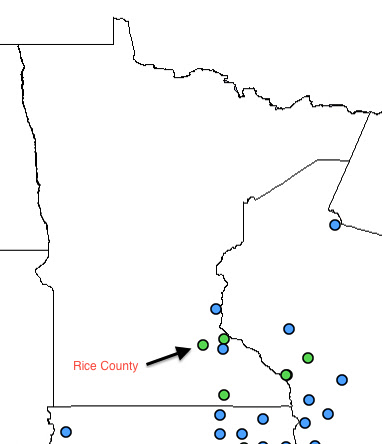
Zooming in to River Bend Nature Center near Faribault, MN in Rice County, we see that the dots begin to disappear.  This is shown below.

Dot map for the Blue-tipped Dancer for Minnesota.

Betsy's observation was in Rice County, and only a single observation of this species had been made in this county before.  The previous sighting is indicated with the arrow.  Betsy saw the dancer on the other side of Rice County, so we'll add her observation to the dot map so others can know where it can be seen.

Here's a bit more detailed map showing where Rice County is in relation to Minneapolis:

Rice County is the boxed region south of Minneapolis.

A closer look shows Betsy's observation site, and the only other observation in Rice County:

Detailed map showing River Bend Nature Center, where Betsy saw her dancer.  The only other report of this damselfly from Rice County was at the indicated location near Northfield.

Update:

Betsy's observation has been accepted, and now appears on the Odonata Central dot map.  Here it is:

Wednesday, September 19, 2012

River Jewelwings

A few weeks ago Betsy and I drove to a location just south of Olympia to look for a striking damselfly known as the River Jewelwing.  We've only seen this odonate twice before, both times a single male at Stossel Creek near Duvall, WA.  According to reports, the River Jewelwing can be seen in numbers where State Route 12 crosses the Black River, so we headed south to check it out.  We had stopped at the same location on our way home from Arizona in May, but that was too early in the season and none were seen.  This trip was during the peak of the season, and several – both males and females – were seen flitting along the shore of the river.

The Black River is beautiful at the location populated by the jewelwings.  Here are a couple shots that show the setting.

Betsy on the shore of the Black River.

The Black River.  Notice the submergent vegetation just below the surface of the river.

Just visiting this location is pleasant enough, but if you look closely in the vegetation along the shore you'll see some flashes of iridescent blue and green.  You'll also see wings flapping with prominent black patches.  These are the River Jewelwings going about their daily activity.

Here are a couple shots of the male River Jewelwing.

A male River Jewelwing with its wings slightly parted.

Side view of a male River Jewelwing on the shore of the Black River.

The beautiful colors of this damselfly are due to iridescence, which is a very different mechanism from colors produced by pigments.  Here's a comparison between the two mechanisms:

Pigment Colors  Pigments absorb certain colors and reflect others, resulting in a specific color when viewed in white light.  The observed color is the same regardless of the viewing angle, since it depends only on which colors are reflected.

Iridescent Colors  Iridescent materials produce colors by interference.  What this means is that all colors of light are reflected, but some colors cancel themselves out due to phase shifts caused by the structure of the material.

One of the key characteristics that distinguish pigment colors from iridescent colors is that iridescent colors change with the viewing angle, because changing the viewing angle changes the phase shift.  This effect can be seen in cases like the head and neck of a male Mallard, which can appear either blue or green.  The same effect is seen in the River Jewelwing, as we can see below:

A male River Jewelwing viewed from one side.  The body is dark blue.

The same individual as above, this time viewed from the other side.  Its body is now brilliant green.

Notice that even the leading edge of the wings (the costa) changes color from blue to green along with the thorax and abdomen.

The males were constantly patrolling along the shore, defending their territories.  Here are a couple males flashing their wings as one tries to displace the other.

Male River Jewelwings competing for space along the shore.

Female River Jewelwings were present as well – our first opportunity to view them.  They share the iridescent body colors of the male, and also have white spots (the stigmas) at the tip of their wings.

A female River Jewelwing.  Notice the iridescent body and the white spots on the wings.

Many female River Jewelwings were seen in the male's territories, but no mating activity was observed.

All in all, it was a beautiful day at a wonderful location full of special damselflies.

Monday, July 23, 2012

A Trip To Fobes

Last Saturday, Betsy and I went to Fobes to do some dragonflying and birdwatching.  Haven't heard of Fobes?  It's a small "town" near Snohomish that is little more than an intersection where five roads meet.  I lived there as a kid, on a seven acre farm.  The old farmhouse is shown below:

Our house in Fobes.  I walked across the street to go to school.

When I was young, Fobes was defined by a small four-room schoolhouse – one room for kindergarten, and three other rooms with two grades each – plus a small grocery store across the road from the school.  The grocery store was the front half of someone's home, but it was big enough to supply the snack needs of the school kids.

One of the five roads that meet in Fobes leads down to the Snohomish River.  That's where we go to view wildlife, along a dike that helps to prevent flooding.  Here's a view of the river from the dike:

The Snohomish River on its way to Puget Sound.

It was wonderful day, with temperatures in the 70s.  Lots of birds and dragonflies, too.  Betsy spotted an Eastern Kingbird, and soon saw that it had a nest and was feeding young.  The nestlings were still covered in down, and were begging to be fed.  Eastern Kingbirds like to feed on flying insects, and much of their diet at this location turns out to be dragonflies.  There were certainly enough to support a growing family of kingbirds.

Young Eastern Kingbirds anticipate a meal – which will probably be a dragonfly or damselfly.

An adult at the nest.

Lots of dragonflies were escaping the various predators and going about their lives.  Here's our species list for the day:

Northern/Boreal Bluet
Tule Bluet
Pacific Forktail
Common Green Darner
Blue-eyed Darner
Four-spotted Skimmer
Eight-spotted Skimmer
Cardinal Meadowhawk
Blue Dasher

The Pacific Forktail is a particularly friendly damselfly.  It likes to land on people, and gives plenty of good photo opportunities.  The male has an interesting face that is black on top and brilliant green below.

Male Pacific Forktail, a friendly damselfly.

The female can take on different forms, as is so common in damselflies.  An andromorphic female looks almost the same as a male.  On the other hand, heteromorphic females have a distinctly different look, as illustrated by the immature female shown below:

An immature, heteromorphic female Pacific Forktail.

Saturday, June 2, 2012

A New Damselfly

On our way home from Arizona, Betsy and I stopped at the Black River outside Olympia to see if there might be any early River Jewelwings out and about.  There weren't.  However, we did see another interesting damselfly.

First, Betsy saw a female, which was deep reddish orange.  It looked like an immature forktail, since they are often an orangish color, but not one that was familiar to me.  A short time later we saw a male, which was clearly a new forktail for us.  It was the Swift Forktail.

Here's the male.  Notice the long blue tip at the end of its abdomen.  Also, this forktail prominently displays the "forked tail" that gives the group its name.

Swift Forktail, male.


The female almost looks red from a distance.  It has the same structure of thorax stripes as the male.

Swift Forktail, female.

Sunday, May 6, 2012

Forktail Interaction

Western Forktails differ from many other damselflies in an interesting way.

If you go to a nice pond in the summer in Washington state, you are quite likely to see female Western Forktails.  They are pruinose blue overall, and quite easy to spot as they move along the shore laying eggs in one location and then another.  You don't see male Western Forktails, however.  It can be quite tough to spot a male.  What's going on?

Apparently, most female Western Forktails mate just once in their lives; after that they fend off other males who attempt to mate with them. A good example is shown in the slow-motion video below.  The video starts with a female Western Forktail minding her own business.  Suddenly a male races in to grab her and attempt to mate – not really much in the way or courtship, I'd say.  The female resists, and eventually the male moves on.  After getting this kind of treatment from the females, the males apparently move off into the bushes to forage and thus are not encountered very often.


According to Dennis Paulson in Dragonflies and Damselflies of the West, female Western Forktails are "very effective at repelling attention of male forktails and bluets by fluttering wings and curling abdomen tip down."  Here's a good example of that.

Sunday, April 29, 2012

Getting Into A Spot Of Trouble

Yesterday, Betsy and I explored the Hassayampa River Preserve for the first time.  It's a wonderful place, with a great variety of habitats, ranging from a lake, to a stream, to cottonwood groves, and even open desert.

One of the treats along the stream was a thriving population of damselflies, including American Rubyspots.  The photo below shows a rubyspot (right) fending off an aggressive California Dancer.


Notice how the rubyspot flashes the red patches on his wings, which are usually hidden as it rests with its wings closed.  At the same time, it arches its abdomen and opens its appendages, which look like the pincers on an earwig.  The display generally has the desired effect of warding off the dancer; even so, the dancer usually lands just a short distance away on the same twig to await another chance to get the rubyspot out of his territory.

Here's a closer look at the rubyspot's threat display.  Can he actually do harm with those menacing appendages?  I wonder.


The Blue-ringed Dancer

Blue-ringed Dancer (male) at the Gilbert Water Ranch

One of the most photogenic damselflies is the Blue-ringed Dancer.  This male is perched on a rock in a swiftly flowing stream, the Blue-ringed preferred habitat.  I love the intense colors, especially in the head and thorax.

Notice how the wings are held completely above the abdomen; this is characteristic of dancers as a group.  In contrast, bluets tend to hold their wings folded along their abdomen.