Showing posts with label Eight-spotted Skimmer. Show all posts

Monday, April 10, 2023

Eight-spotted Skimmer

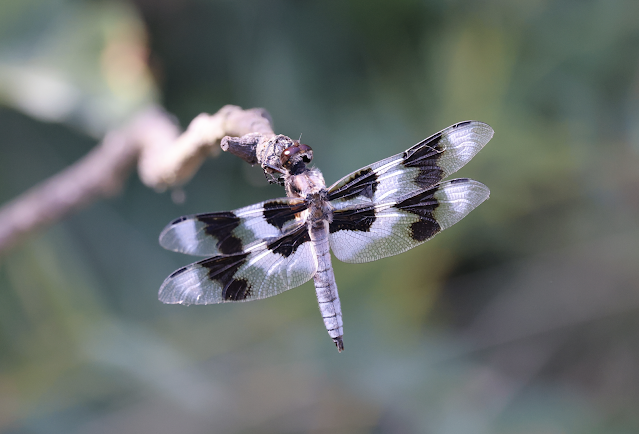
A male Eight-spotted Skimmer, Cranberry Lake, July 30, 2022.


This was a relatively early-in-the-season individual. The body and wings are quite pristine, with just a slight indication that it may have mated—the dark area that can be seen mid abdomen, where a female may have grabbed hold and rubbed off a bit of pruinosity.

Tuesday, October 15, 2019

Immature Eight-spotted Skimmer

Here's a look at an immature male Eight-spotted Skimmer at Heart Lake in Anacortes:


Notice that the abdomen isn't pruinose bluish-white, as it is in adult males. In fact, at this age the male looks like a female, except for the white patches in the wing which are not present in the female.

In addition, the front legs are tucked up behind the head. This is a common way for dragonflies to relax when they are perched, and is also common in flying dragonflies.

Eight-spotted Skimmers are featured in my field guide, Common Dragonflies and Damselflies of the Pacific Coast. Check out the spread devoted to these beautiful dragonflies:


You can find the field guide at the following link:

https://www.amazon.com/gp/product/1934199265/ref=s9u_simh_gw_i1?ie=UTF8&fpl=fresh&pd_rd_i=1934199265&pd_rd_r=4Q8FNWQMZKPZ7GYWQB31&pd_rd_w=c79uB&pd_rd_wg=lb3xg&pf_rd_m=ATVPDKIKX0DER&pf_rd_s=&pf_rd_r=038QHD1N13Z2D7NWAP1Q&pf_rd_t=36701&pf_rd_p=1cf9d009-399c-49e1-901a-7b8786e59436&pf_rd_i=desktop

This species is abundant at Heart Lake, and common at Little Cranberry Lake, as well.

Monday, October 29, 2018

Aging in the Eight-spotted Skimmer

Dragonflies lead active lives, and as a result, they show clear signs of aging. Here are some photos showing the progression of aging in Eight-spotted Skimmers.

First, we see a fresh, clean young male. Notice the sheen on the sparkling-clean wings, and the nice clean body. Also, we see that the pruinosity (or pluminosity if you like) is not yet fully developed, and the yellow side stripes seen in young males are still visible. A beautiful individual in the prime of its live.


Next, we see a middle-aged individual. The pruinosity is fully developed here, and a dark patch is seen in the middle of the abdomen where pruinosity has been rubbed off by females grasping the abdomen at that location during mating. The wings are nice and brilliant, though not quite as "new" looking as in the previous individual.


Finally, we take a look at an individual that is clearly showing the effects of age. The wings are tattered now, with sections missing here and there. The abdomen is faded, though the dark section in the middle of the abdomen can still be seen.


It's amazing that this individual can still function with wings like that, but it was seen flying about seemingly unaffected by the wear and tear.

Thursday, September 6, 2018

Evening Magazine

A few weeks ago, Evening Magazine from King5 TV came to Anacortes to do an interview with the Dragonfly Whisperer. It will be aired on September 11 at 7:30 pm.


They were getting some great shots with their video equipment. They could fill the entire frame with small damselflies, and get really nice close ups of dragonflies. Here's the cameraman getting a video of me taking a picture of him (notice the reflection of my hands holding my camera in the video lens):


We filmed at Cranberry Lake, where we took videos of damselflies, and at Heart Lake, where we concentrated on dragonflies. At Heart Lake we had a nice look at a female Cardinal Meadowhawk. They got great video of the dragonfly, as well as video of me taking pictures of it. They will then intersperse some of my still shots, like this one, in the finished segment:


We also saw several Eight-spotted Skimmers, again with the video camera getting great views, as well as shots of me taking pictures of the dragonflies. Some had quite a bit of wear on their wings, like this one:


One even had an entire wing missing. I've seen ragged wings, and wings with sections missing, but this was the first time I had seen a dragonfly with one wing completely gone.


As the cameraman for Evening Magazine said, "It's amazing it doesn't just fly around in circles." That's right, but in fact it was flying pretty much normally.

I'm sure the segment on King5 will be quite brief, but it will be fun to see some dragonflies on TV.

Friday, June 8, 2018

Heart Lake

I went to Heart Lake in Anacortes a couple days ago, and the dragonfly activity was at a high level—dragonflies everywhere, with lots of egg-laying behavior on display. There were also some newcomers for the year, including the Cardinal Meadowhawk and the Eight-spotted Skimmer.

Here's a Cardinal Meadowhawk perched near the egg-laying area:


This guy's is looking up, checking out his surroundings. Notice that his abdomen is broad and flat, as is typical of this species. Here's another individual on his favorite leaf:


You can just barely see one of the white spots on the side of the thorax, one of the field marks for this species. Also, notice that the abdomen is fringed with yellow, indicating this is a young male. The abdomen starts off yellow, and turns bright red with age. This individual is just at the end of this transition.

Most of the egg laying was being done by the Cardinal Meadowhawks. Here is a couple dipping into the water to deposit a small mass of eggs:


This is a frame capture from a video, and in the video itself you can see the egg mass dropped off by the female, which then slowly sinks to the bottom.  Sometimes there were a couple pairs laying eggs at the same time:


Another common species along the shore was the Dot-tailed Whiteface. A number of pairs were seen in the wheel position, though I didn't see any egg laying. Here's a male perched on the ground:


This was also the first day I've seen the Eight-spotted Skimmer in Anacortes. Here's a young male on his favorite perch in the bushes:


It's clear this is a male from the white spots in the wings. Notice, however, that it's a young male because the abdomen still looks like the abdomen of a female, with straight yellow side stripes. As it matures, the abdomen will turn a lovely pruinose blue.
Monday, June 26, 2017

Species Spotlight: Eight-spotted Skimmer

A couple days ago I went to Cranberry Lake and saw my first Eight-spotted Skimmer of the year. There was just one, but it was patrolling back and forth along the shoreline, sometimes chasing and sometimes being chased by a Four-spotted Skimmer.

A male Eight-spotted Skimmer. The dark area in the middle of the abdomen is where a female has rubbed off the pruinosity while grasping the male in the wheel position.

The Eight-spotted Skimmer is named for the eight black spots, not for the white spots. Only the male has the white wing spots, but both sexes have the black spots. Here are a couple more shots of males.


Here's a female. Notice that the wings are clear between the black spots.


Female Eight-spotted Skimmers look a lot like female Common Whitetails, but they differ in the side stripes on the abdomen. Eight-spotted Skimmers have straight side stripes that are yellow in color; Common Whitetails have white side stripes that curve inward at their forward ends.

The Eight-spotted Skimmer is a showy dragonfly, and can't be missed when it's on the wing. If you see one flying by, take a good look—you'll notice that it glides for extended periods of time, whereas most insects flap their wings constantly while in flight. You can often see Eight-spotted Skimmers rocking back and forth as they glide, almost like a soaring hawk.

Wednesday, September 4, 2013

Cherry Springs Interpretive Sign

Not long ago, I was contacted by naturalist Sheri Covert at the Cherry Springs nature area near Pocatello, Idaho.  She was putting together an interpretive sign to inform visitors about some of the interesting insect life to be found there, and asked if she could use a couple of my dragonfly pictures.  I was happy to help with a project like that, and supplied her with pictures of the species she was looking for.  Here's a rough draft of the sign, which looks very nice.


Here's an enlargement of the dragonfly section:


I look forward to visiting Cherry Springs one of these days.  If any of my intrepid readers gets there first, please take a picture of the sign in place and we'll include it in the blog.