Showing posts with label western pondhawk. Show all posts

Wednesday, February 28, 2018

Species Spotlight: Western Pondhawk

The next species in our spotlight is the Western Pondhawk—a common dragonfly all up and down the Pacific coast. It's range extends eastward into Texas in the southern part of the USA.

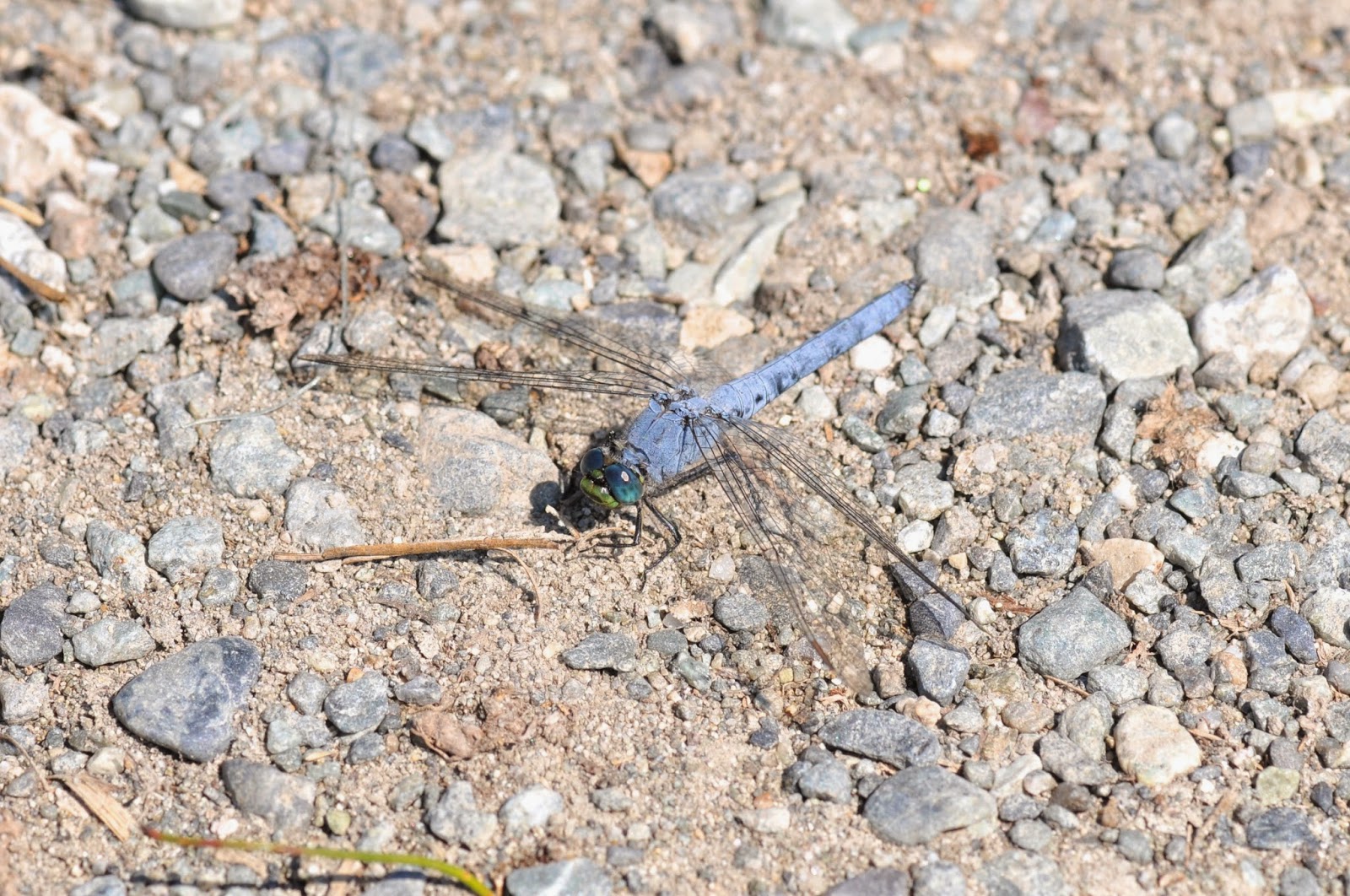
Mature males of this species are a wonderful powder blue color—though they start off life a brilliant green. With age they turn blue from the tip of the abdomen forward. Females also start off green, but they retain their green color for life, making them the only mature green dragonfly on the Pacific coast.


This dragonfly loves to perch on the ground—which it almost always does unless the ground is covered with vegetation. It also seems to specialize in eating damselflies; at least, when I see them eating prey, it's usually a damselfly.


Also, be sure to look for the "Groucho Marx" mustache on the face of this species. It's quite distinctive, and is often seen on females as well!

For more information, see Common Dragonflies and Damselflies of the Pacific Coast:

https://www.amazon.com/gp/product/1934199265/ref=s9u_simh_gw_i1?ie=UTF8&fpl=fresh&pd_rd_i=1934199265&pd_rd_r=4Q8FNWQMZKPZ7GYWQB31&pd_rd_w=c79uB&pd_rd_wg=lb3xg&pf_rd_m=ATVPDKIKX0DER&pf_rd_s=&pf_rd_r=038QHD1N13Z2D7NWAP1Q&pf_rd_t=36701&pf_rd_p=1cf9d009-399c-49e1-901a-7b8786e59436&pf_rd_i=desktop

Tuesday, July 25, 2017

Magnuson Park

This weekend we went to Magnuson Park in Seattle for the first time this summer. It was hot, and we were looking for shade most of the time. Still, the dragonflies were happy, and lots of them could be be seen at the various ponds.

Here's the location of Magnuson Park:


In the old days—when I was a kid—this area was known as Sandpoint. In those days, it was the location of Sandpoint Naval Airbase. Now, it's a lovely park with lots of different areas for different activities.

Our main interest is in the wildlife area, which consists of a smooth gravel path that winds around a number of small ponds, each slightly different in character. Some ponds dry up completely in the summer, some are much reduced, and some have a water supply that keeps them full all year round. We find a different distribution of odonate species at the various ponds, which makes Magnuson Park an interesting place to do some dragonflying.

On this trip, we saw lots of Western Pondhawks. Most were males, which are out and about defending their territory almost all of the time. Some were young, and still showed some of their adolescent green color on the thorax and near the base of the abdomen:


When possible, Western Pondhawks like to perch on the ground, or on a mat of algae. When a flat surface is not available, they may resort to perching on stems.

Notice that the males have a uniform blue color when fully mature. Specifically, the blue color  on the thorax is the same as the blue on the abdomen, unlike Blue Dashers whose thorax is a darker blue. Western Pondhawks also lack white stripes on the sides of the thorax that are present in Blue Dashers, and they have completely clear wings—Blue Dasher's wings have a bit of amber near the base. Finally, the face of the Western Pondhawk is green, as compared with the white face in the Blue Dasher.

Only a couple female Western Pondhawks were seen. They stay back from the water when not laying eggs, and their green color helps them blend in with the vegetation.


What a wonderful green color, especially on the thorax. Notice the small "egg scoop" projecting downward near the tip of the abdomen.

The next most numerous species at Magnuson Park was the Blue Dasher. These dragonflies are lively and beautiful. They perch frequently and give many good photo opportunities.


Here you can see that the thorax is darker blue, and has light-colored side stripes. Also, note the amber at the wing bases, and the white face.

Other species at the park included Spotted Spreadwing, Tule Bluet, Pacific Forktail, Blue-eyed Darner, Common Green Darner, Cardinal Meadowhawk, Common Whitetail, and Black Saddlebags.

Sunday, July 2, 2017

A Visit To Heart Lake

Yesterday, Betsy and I went to Heart Lake after lunch. It was a beautiful day, temperatures in the 70s and not a cloud in the sky. Nice and calm too. We were glad we went because the dragonfly activity was high.

Here's the location of Heart Lake. It's within the city limits of Anacortes, and also a part of the Anacortes Community Forest Lands.


The first thing we noticed as we got out of the car was an abundance of Pacific Forktails. They were all over the place. Every step you took in the grass flushed a small cloud of them. Most were immatures, and many were females.

The females are quite striking in this species. Here are a couple examples:


Notice the single blue segment at the tip of the abdomen (males have two) and the stripes on the top of the thorax (males have spots).

Here's a look at the ovipositor of this species—the "bulge" at the tip of the abdomen. The female uses this to cut a slit in a stem in which to deposit her eggs.


Here's the male Pacific Forktail for comparison:


As mentioned above, he has two blue segments at the tip of the abdomen, and blue spots on top of the thorax.

We also saw lots of Dot-tailed Whitefaces. They love lily pads, but there were so many of them that they were perching all over the place.


Notice the chalk-white face, and the yellow "dot" on the abdomen.

Western Pondhawks were also numerous. Many were quite young and fresh in appearance, like the female shown below.


Here's a male showing off his blue color, and his "Groucho Marx" mustache.


Cardinal Meadowhawks were common, as well. Notice the red wing patches near the base of the wings, the bright red face, and the intense red dorsal fovea on the top of the eyes. In contrast, you can see one of the white dots on the side of the thorax.


We also saw Variegated Meadowhawks, which seemed to prefer perching on the ground near the shore of the lake. Notice the complex pattern on the abdomen. Just barely visible is one of the yellow dots this species has on the sides of the thorax.


Of particular interest was a single Four-spotted Skimmer. It was the first of its species to be observed at Heart Lake (though they are common at Cranberry Lake).


All in all, it was a beautiful day at Heart Lake, and a sure indication that dragonfly season is well underway.

Tuesday, April 19, 2016

Capitol Building in Santa Fe

On a recent trip to New Mexico, we stopped at the state's capitol building in Santa Fe.  It's a very nice building, very inviting.  Here's the senate chamber:


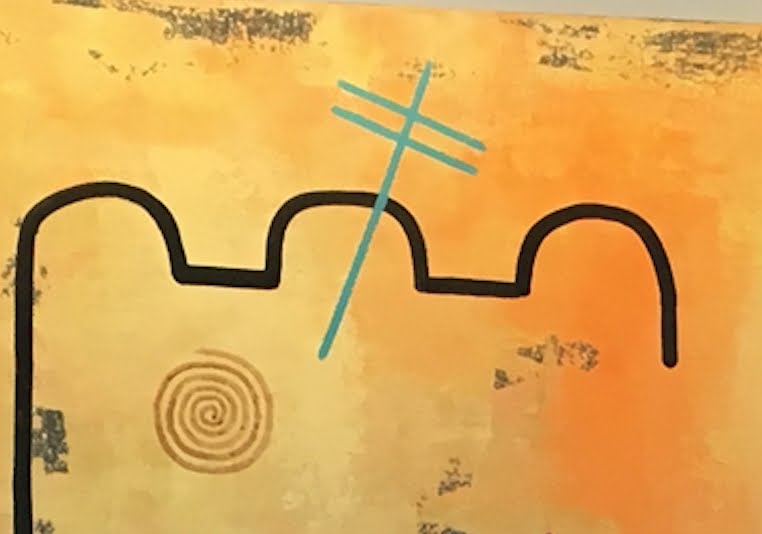
The lobbies are full of beautiful art work, including the following painting that caught my eye:


I love the various Native America motifs in the painting, and especially the three symbolic dragonflies.  The lower one is reminiscent of a Flame Skimmer, the middle one makes me think of a Red Rock Skimmer, and the top one could be a Western Pondhawk.  In any case, it was cool to see these dragonfly representations in the halls of power in Santa Fe.

The bluish dragonfly at the top is near a spiral symbol:


I've looked for the meaning of these spirals, which are quite common in Native American art, but no one really knows what they mean.  Some say they stand for water, others say they signify life, but no one knows for sure.

My thought – a bit biased I must admit – has always been that the spirals could represent the water spraying off a dragonfly as it performs a spin-dry after a series of splash-dunks.  What is particularly interesting in this painting is the association between the dragonfly symbol and the spiral symbol – there might be something to my spin-dry interpretation after all.

Tuesday, August 26, 2014

Pondhawks A-Plenty

Western Pondhawks are not that common in Anacortes.  Typically, we'll see maybe one a year, if that, and usually a female.  We saw a female on our field trip recently, and it was a bit of a surprise.

Yesterday, Betsy and I went to Heart Lake in Anacortes, which is near the road to the top of Mount Erie.  We've been there in the past, but hadn't seen a lot of activity.  That certainly wasn't the case yesterday – dragonflies were all over the place, and one of the most common was the Western Pondhawk.

The body of the adult male Western Pondhawk is solid blue, it's eyes are blue to green, and its face is green, with a nice Groucho Marx mustache.  Here are a couple pictures of adult males from yesterday:

Male Western Pondhawk.  Notice the Grouch Marx mustache.


Notice that these photos show the male perched on the ground.  That's where they prefer to perch, and in fact a good rule of thumb is "blue dragonfly on the ground = Western Pondhawk."  Our other blue dragonfly is the Blue Dasher.  It looks a lot like a Western Pondhawk, but I've never yet seen one of them land on the ground.

The female Western Pondhawks are all green.  In fact, Western Pondhawks are our only green dragonflies.  Here's a photo of one of the many females we saw at Heart Lake:

Female Western Pondhawk.

Male Western Pondhawks start off green, like females, not unlike many bird species where the young look like females.  As the male matures it turns blue from the tip of the abdomen forward, with everything becoming blue except the face, which retains its green color.  We saw many "transitional" males at Heart Lake, like the one shown below:

A "transitional" male Western Pondhawk about half way through its changeover from green to blue.

Look for more about our Heart Lake observations to come.

Saturday, May 19, 2012

Western Pondhawk: The Dragonfly With The Groucho Marx Moustache

Yesterday, Betsy and I visited Wild Horse Pass, a very nice birding and dragonflying area.  Here's what it looks like as you enter the area.


Notice the running water in the background on the right.  The whole Wild Horse Pass area consists of a stream with water sometimes running over rapids, and sometimes running so slow as to look stationary.

One of the most common dragonflies in the area yesterday were the Western Pondhawks, a beautiful blue dragonfly that looks a lot like a Blue Dasher.  Probably the most prominent difference is that the Western Pondhawk has a green face and the Blue Dasher has a white face.  Here's a look at a male Western Pondhawk.


Notice the dark blue eyes, and the green face.  When you get a better look at the face, you'll see that the Western Pondhawk has a nice black moustache.  Here it is:


Perhaps I shouldn't mention it, but the female – who is all green – also has a moustache.

Shortly before we left we noticed a Western Pondhawk eating a damselfly, probably a Familiar Bluet.  It was enjoying an obviously juicy meal.