Showing posts with label hamules. Show all posts

Tuesday, June 20, 2017

Species Spotlight: Four-spotted Skimmer

We saw our first Four-spotted Skimmers of the year a few days ago at Cranberry Lake. Curiously, we have never seen one at Heart Lake, even though it is only a few miles away and is very similar to Cranberry Lake. Eight-spotted Skimmers haven't been seen yet.

Heart Lake and Cranberry Lake are very similar, but have distinctly different dragonfly populations.

Here's a male Four-spotted Skimmer:

Four-spotted Skimmer, male.  Notice the dark spots at the nodus (center of leading edge) that give this dragonfly its name.  The dark spots near the wing tips (the stigma) don't count, since all dragonflies have them.  Also, note how the front two legs are folded up and tucked behind the head, just as they are in flight.

Males and females are practically identical in this species. The best way to distinguish them is by behavior—males patrol the shoreline looking for mates; females perch on vegetation when not dipping the tip of their abdomens in the water to lay eggs—and by the presence (males) or absence (females) of hamules under segment 2 of the abdomen.

Here's a female Four-spotted Skimmer, showing the lack of hamules, and the presence of a small egg scoop:


Here's a male Four-spotted Skimmer, clearly showing the hamules under segment 2 of the abdomen:

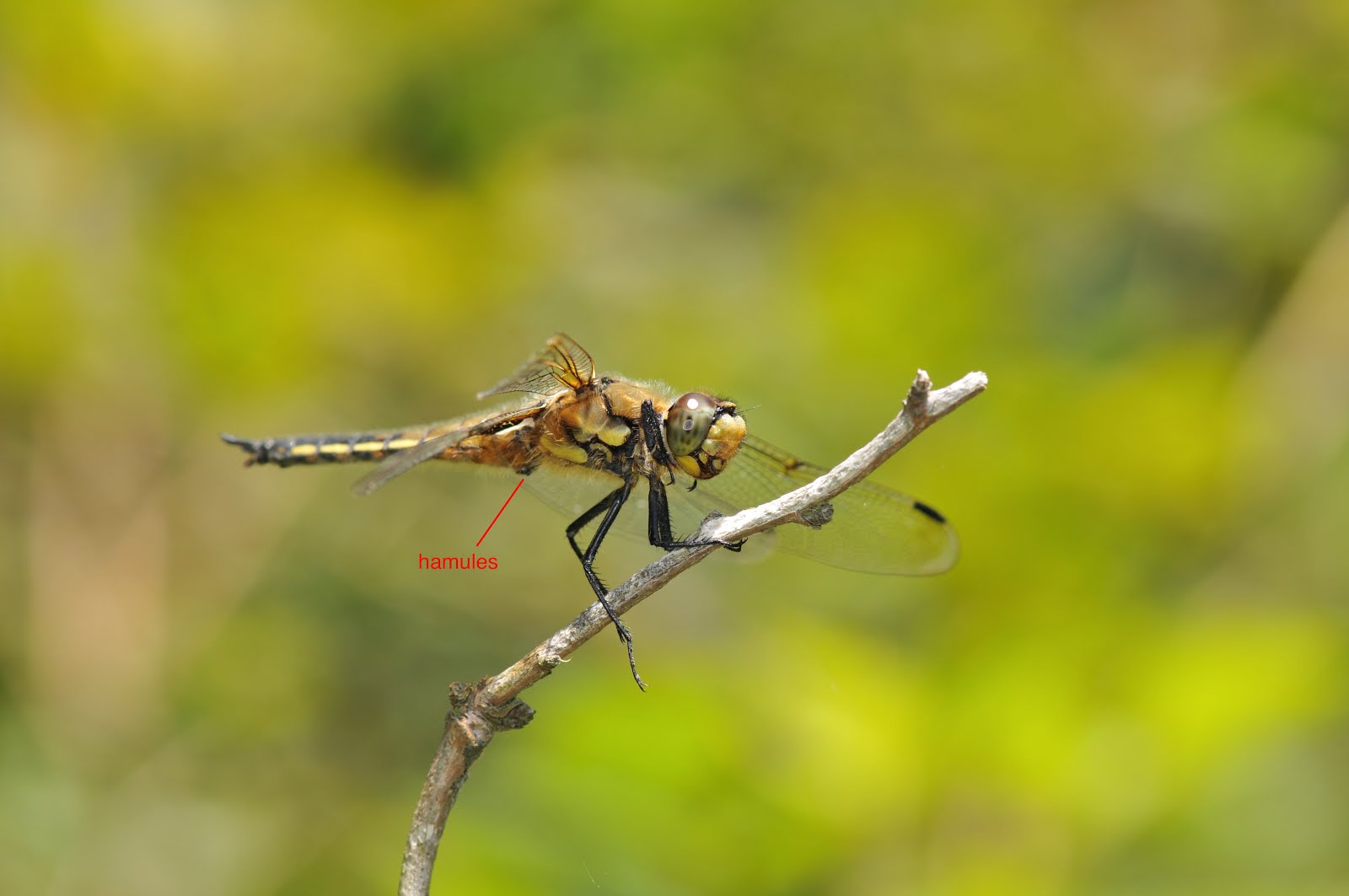


The hamules are like latches that hold the abdomen of the males and females together in the wheel position.

Four-spotted Skimmers have a high perching index (about 80 – 90%), and hence are easy to observe and photograph.  If you see a golden brown dragonfly in our area it's almost certainly a Four-spotted Skimmer, so the ID is fairly easy as well.

Mating is a rapid affair with these dragonflies.  Their short, pudgy abdomens aren't particularly flexible, and hence they stay in the wheel position for only about 10 to 15 seconds.  After mating, the female dips the tip of her abdomen repeatedly into the water to lay eggs while the male hovers above for protection.  They don't stay attached in tandem during egg laying, as do many meadowhawks, because their inflexible abdomens aren't well suited for that kind of maneuver.

Friday, October 2, 2015

Autumn Has Arrived!

Yes, autumn has arrived – both as reckoned by the calendar, and by nature.

In our backyard, we have lots of Dark-eyed Juncos, which ushered in the Fall season right on schedule on September 23.  The juncos leave our yard at the beginning of Spring – heading for the nearby forests – and return at the beginning of Fall.  They are really incredibly reliable in cueing us in to the changes of the seasons.

Another key indicator of Fall are the Autumn Meadowhawks.  Just a few days ago I had an Autumn Meadowhawk land on my shoulder at Cranberry Lake.  It reminded me of a wonderful dragonfly haiku:

Red dragonfly on my shoulder
calls me his friend.
Autumn has arrived.

In general, if a red dragonfly lands on you – especially in the Fall – you can be pretty sure it's an Autumn Meadowhawk.

Here's a female Autumn Meadowhawk that was seen at Beaver Pond in Winthrop just a few days ago:


She seems to be busy eating something she caught on the wing.  Also, note her yellow legs.  Formerly, this dragonfly was known as the Yellow-legged Meadowhawk, but the legs turn dark with age, and so the name was changed to Autumn Meadowhawk to recognize their late-flying proclivity.

That this individual is a female is clear by the lack of hamules on the underside of the second segment of the abdomen.  This is indicated in the photo below:


You can also see the prominent "egg scoop" near the tip of the abdomen.  The female dips the tip of her abdomen into the water, and collects a droplet of water that is held in place by the scoop – almost like a scoop of ice cream held in place by a cone.  She then lays eggs into the droplet, and finally slams into the shoreline vegetation to dislodge the droplet.  Another view of the egg scoop is shown below:


With Fall in full swing, it's good to see that the orbital changes of the Earth are reflected in the natural world.

Wednesday, April 29, 2015

Rambur's Forktail

One of the first odonates we see each year is the Rambur's Forktail.  In terms of coloration, it is similar to the Western Forktail that is common in Washington – green thorax with a blue tip to the abdomen – but the ranges are quite different.  Notice that the abdomen is black above and yellow below, with a nice straight line demarcating the two colors.  Here's a look at a male Rambur's Forktail:

A male Rambur's Forktail at the Gilbert Water Ranch.  Notice the hamules under segment 2 of the abdomen.

The eyes are similar to those of the Pacific Forktail – black above and greenish-blue below.

Female Rambur's Forktail can look a lot like a male, in which case they are said to be andromorphic (male form).  An example is shown below:

An andromorphic female Rambur's Forktail at the Gilbert Water Ranch.

Notice the flat bottom to segment 2 (S2) of the abdomen.  Thus, this individual lacks hamules, which indicates clearly that it is a female.  In the photo of the male above, the hamules are seen prominently on the bottom of S2.

Females can also look different from the males, and in this case are referred to as heteromorphic (different form).  Here's an example:

Heteromorphic female Rambur's Forktail.

Notice the orange thorax with the black front stripe, and the lack of hamules under S2.  As this individual matures it will become more greenish-brown.

Friday, April 4, 2014

Flame Skimmer at the Water Ranch

Betsy and I visited the Gilbert Water Ranch today.  Lots of activity, including some nice looks at Flame Skimmers, which are just getting started for the year.

Below is a female Flame Skimmer.  You can tell it's a female by the widened flanges near the tip of the abdomen, which is where the eggs come out.  The female uses the flanges to flip droplets of water as it lays its eggs.  Also, notice the lack of hamules.

Female Flame Skimmer at the Gilbert Water Ranch.

An important field mark for this species are the dark red markings near the base of the wings.  This is the best way to distinguish this skimmer from the similar Neon Skimmer, which lacks those dark marks.

Sunday, February 26, 2012

A Four-Star Teneral

A teneral is a dragonfly (or other insect) that has just undergone moulting.  In photo below, a dragonfly has just emerged from its last larval stage to become a winged adult.  It has given up the underwater existence it's known all its life to become an air-breathing, flying adult.  It doesn't moult again.


The teneral pictured above is a male Western Pondhawk.  You can tell it's a male by the presence of hamules, the bumpy structure that projects downward near the base of the abdomen.  The hamules are used to "latch" the male and female together during mating in the wheel position.  In a female, the underside of the abdomen near the base is smooth.  

It's always important to know which sex you're looking at when identifying dragonflies, but with this species it's particularly helpful because both sexes start off brilliant green.  Female pondhawks stay green as they mature, but the males turn from green to blue in stages starting at the tip of the abdomen and progressing toward the head.  The body and eyes of the adult male are solid blue, only the face remains green – in fact, the green face is a good distinguishing feature to separate male Western Pondhawks from male Blue Dashers, which have a white face.


Tenerals have a "fresh" look to them, with distinctively vivid colors.  The wings of a teneral look almost like cellophane.  In fact, the wings haven't completely hardened at this stage of a dragonfly's life, and as a result the flight of tenerals is usually quite weak and slow – almost like the fluttering flight of winged termites.  In fact, it's often possible to recognize a teneral from some distance because of its characteristic flight behavior.  When a dragonfly is fully mature, however, its flight becomes strong and fast, as you would expect for a top predator.