This year featured a number of dragonfly species that were flying well beyond their usual flight season. One example of this is the Variable Darner. We see this species only occasionally at Cranberry Lake, and so it was a particular surprise to see one on October 29, nine days after the previous late flight date.
Here's the flight season of the Variable Darner in our area, including this new extension:
Notice that they start pretty late in the year, and go almost until November.
The next graph shows the Observation Percentage for the Variable Darner – that is, the percentage of all our observations of the Variable Darner that occur in a given month:
Over 60% of our observations occur in August. As you can see, observations of this species are rather sporadic.
The Variable Darner is widely distributed in North America, as indicated in the following dot map:
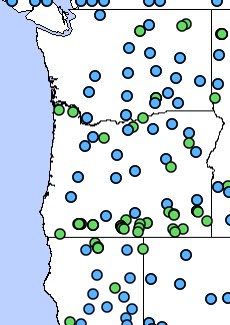
Here's its distribution in the Pacific Northwest, which is fairly uniform:
The male Variable Darner that visited up on October 29 is shown below. Notice the thin side stripes that actually break off into spots, the cream color on the 10th segment of the abdomen, and the simple appendages.
Another characteristic of this species is its propensity for perching on a wall or other flat vertical surface. In this case it landed on the vertical concrete wall of the dam at one end of Cranberry Lake. It's very common to see a Variable Darner perched in this way, but the other darners in our area generally land in bushes and trees.
Showing posts with label dot map. Show all posts
Thursday, December 19, 2013
Monday, November 11, 2013
A Late Meadowhawk
On October 6, Betsy and I went to Magnuson Park in Seattle for a little dragonflying. We weren't expecting too much that time of year, but it was a nice day, and we thought we might as well give it a try. We found quite a few darners and spreadwings, as we expected, so it was a fun outing.
To our surprise, we also found some Cardinal Meadowhawks out and about. They are one of our first meadowhawks to appear. In fact, they show up in early May, well before most of the other common meadowhawks in our area. We hadn't expected to see them this late in the season, and a check with the calendar of flight dates showed that the latest date previously reported for the Cardinal Meadowhawk was October 2. Here's a look at the flight season for Cardinal Meadowhawks, including our modest extension to October 6:
Another way to look at the flight season is shown below. In this graph, we plot the probability a Cardinal Meadowhawk will be seen in a given month. For example, notice that about 40% of the Cardinal Meadowhawk observations are made in the month of July. The data for this plot are taken from 3 successive years of observations.
Even though it was late in the season, the Cardinal Meadowhawks were in prime color – which means intense red. Here are a couple photos from October 6:
Cardinal Meadowhawks are primarily a west coast species, as you can see from the following dot map:
Even in our part of the country, they tend to be more common in the west:
When identifying meadowhawks, remember that Cardinal Meadowhawks are our only meadowhawk with a dark red concentration of color near the base of the wings. This field mark can be seen from virtually any angle, which is often not the case for the white spots on the side of the thorax, and is quite definitive for this species.
To our surprise, we also found some Cardinal Meadowhawks out and about. They are one of our first meadowhawks to appear. In fact, they show up in early May, well before most of the other common meadowhawks in our area. We hadn't expected to see them this late in the season, and a check with the calendar of flight dates showed that the latest date previously reported for the Cardinal Meadowhawk was October 2. Here's a look at the flight season for Cardinal Meadowhawks, including our modest extension to October 6:
Another way to look at the flight season is shown below. In this graph, we plot the probability a Cardinal Meadowhawk will be seen in a given month. For example, notice that about 40% of the Cardinal Meadowhawk observations are made in the month of July. The data for this plot are taken from 3 successive years of observations.
Even though it was late in the season, the Cardinal Meadowhawks were in prime color – which means intense red. Here are a couple photos from October 6:
| A male Cardinal Meadowhawk. Notice the dark red color at the base of the wings. |
| Brilliant red on a sparkling, sunny day. The dark red in the wings is nicely visible, but the wings make it difficult to see the white dots on the side of the thorax. |
Cardinal Meadowhawks are primarily a west coast species, as you can see from the following dot map:
Even in our part of the country, they tend to be more common in the west:
When identifying meadowhawks, remember that Cardinal Meadowhawks are our only meadowhawk with a dark red concentration of color near the base of the wings. This field mark can be seen from virtually any angle, which is often not the case for the white spots on the side of the thorax, and is quite definitive for this species.
Friday, September 6, 2013
Band-winged Meadowhawk
On a recent field trip to Burke Lake near Quincy, Washington, we saw a number of Band-winged Meadowhawks. Here's a young female that posed for its picture, happy to be a part of the Dragonfly Whisperer blog:
This meadowhawk is named for the band of amber color near the base of the wings. When I first started dragonflying, it was called the Western Meadowhawk, and there was a similar species in the eastern U. S. called the Band-winged Meadowhawk. These species have been merged due to the fact that intermediates were found. They all go by the name Band-winged Meadowhawk now.
Band-winged Meadowhawks seem very finicky about where to land. They often hover above a perch, and just when it looks like they're going to land they lift off again, only to come back for another try. This can happen numerous times before they finally "take the plunge" and settle down on the perch. Here's another view of this species from Burke Lake, showing the bands in the wings a little more clearly:
This is dragonfly is widespread across the northern part of North America, as can be seen in the following dot map from Odonata Central:
| Band-winged Meadowhawk (female). |
This meadowhawk is named for the band of amber color near the base of the wings. When I first started dragonflying, it was called the Western Meadowhawk, and there was a similar species in the eastern U. S. called the Band-winged Meadowhawk. These species have been merged due to the fact that intermediates were found. They all go by the name Band-winged Meadowhawk now.
Band-winged Meadowhawks seem very finicky about where to land. They often hover above a perch, and just when it looks like they're going to land they lift off again, only to come back for another try. This can happen numerous times before they finally "take the plunge" and settle down on the perch. Here's another view of this species from Burke Lake, showing the bands in the wings a little more clearly:
This is dragonfly is widespread across the northern part of North America, as can be seen in the following dot map from Odonata Central:
Here's a closer look at the dot map for the Pacific Northwest area:
Subscribe to:
Posts (Atom)