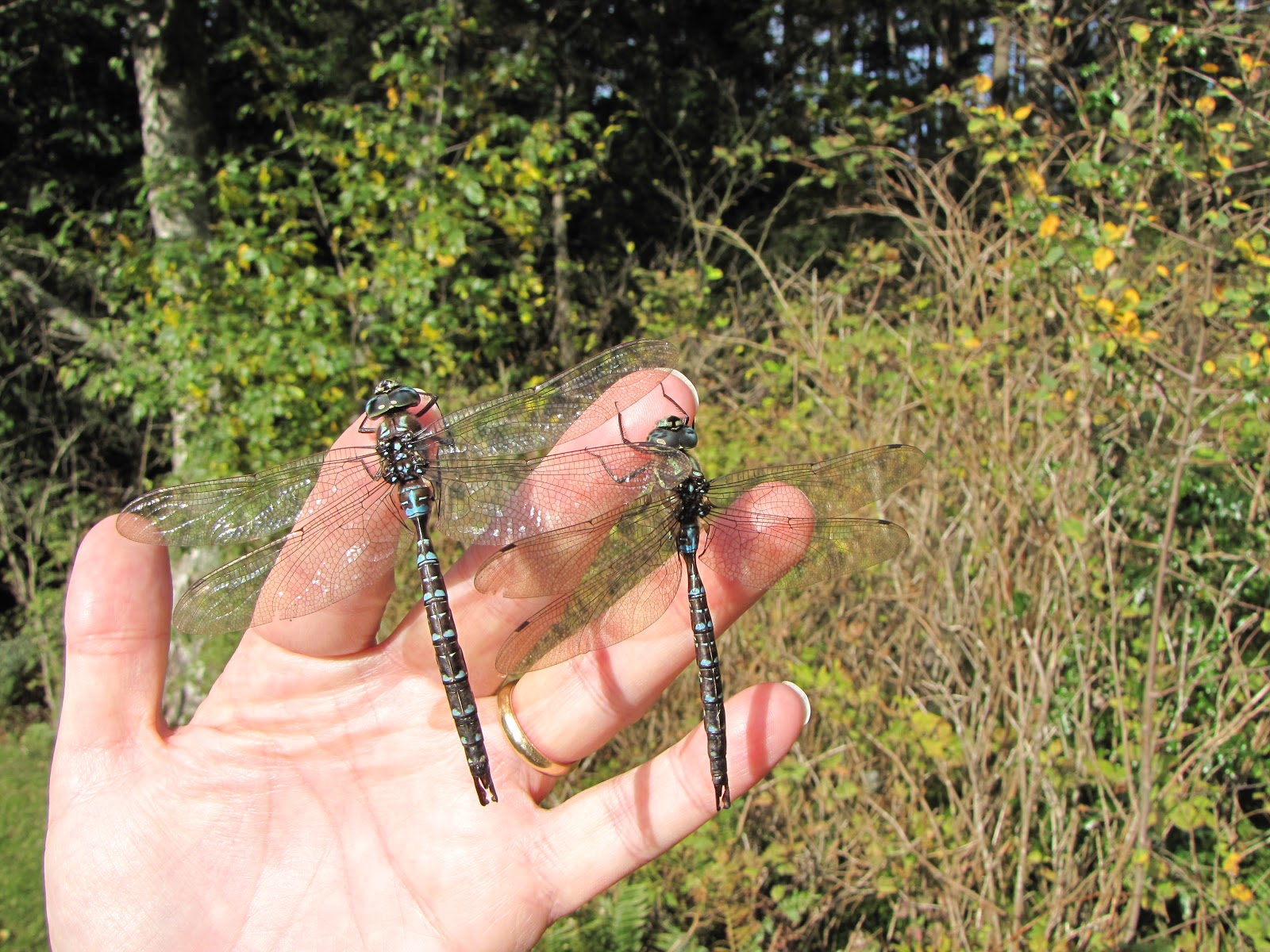
Edmund Murton Walker (1877-1969) was a Canadian entomologist, zoology professor at the University of Toronto, and an assistant director of the Royal Ontario Museum. His specialty was dragonflies, and it was for him that Walker's Darner was named.
I'm not related to Edmund Walker, as far as I know, but the fact that one of the mosaic darners carries the name Walker has always been a fun connection with my interests. This is especially true since Walker's Darner is a close relative of the Paddle-tailed Darner (Happy-face Darner), to which I have such a special connection. Thus, I've long looked forward to seeing a Walker's Darner.
The problem with seeing a Walker's Darner for me is that they had never been seen in Washington. Their range is mostly restricted to California, with just a few isolated observations in Oregon. In addition, they don't start flying until mid-summer, when I'm usually in Washington watching Happy-face Darners splash-dunking and spin-drying.
Last week, Betsy and I decided to take a short road trip to enjoy the good weather while it was still with us. Just minutes before we left I checked OdonataCentral to see if we might be going near any of the observation sites for Walker's Darner in Oregon. I knew there were a couple sites along the Columbia Gorge, and I thought we might visit one of them – even though it was too late in the season according to some of the field guides. I was surprised, then, when I saw a new dot on the Walker's Darner map in Washington State, on the Washington shore of the Columbia River! It was a state record for Walker's Darner, and it was observed just a few weeks before I checked, in the last half of September. We decided to give the location a try, even though we would be getting there in the second week of October.
OdonataCentral provided details of the location. It was near White Salmon, on Old Highway 8, about a mile north of the highway on Major Creek Road. There's a sharp bend in Major Creek Road where a small creek passes underneath, and that's where they were seen. We arrived there at about 2:00 pm, and just as I was getting out of the car a darner flew by. We followed its flight until it landed and, sure enough, it was a Walker's Darner. This was on October 9, 2012, a new late flight date for both Oregon and Washington.
So fun to finally see Walker's Darner, and in Washington to boot, where it had never been seen before. Below are a couple photos from Major Creek Road. The darner is perched high in a tree, making photography difficult, but the photos do show everything that's needed for a confirmed sighting. We've entered our observation with OdonataCentral – it's listed in their records as OC#382101.
 |
| Walker's Darner, male, perched high in a tree. Notice that the side stripes on the thorax are whitish, compared with yellowish stripes on the Paddle-tailed and Shadow Darners. |
 |
| Walker's Darner. Notice the paddle-shaped appendages and whitish side stripes on the thorax. In addition, the tenth segment of the abdomen (S10) is mostly black, but with a light-colored posterior edge. In the Paddle-tailed Darner, S10 is covered with blue, and in the Shadow Darner S10 is usually completely black. Notice also the blue dorsal stripe on S2; it is wide at the base and narrow at the top. In the Paddle-tailed Darner this stripe is uniform and narrow, and in the Shadow Darner it is broad and shaped somewhat like a vase. |
 |
| Walker's Darner. A good look at the whitish side stripes on the thorax. |
 |
| Betsy took a quick picture of me to document the time and place of our first sighting of a Walker's Darner. |