Saturday, April 23, 2016

Plateau Spreadwing at Bosque del Apache

One of the fun things about our recent visit to Bosque del Apache was seeing a new "life ode."

We were driving along the north loop road when we noticed a nice pond with lots of emergent vegetation.  It looked like a good spot to see some damselflies, so we stopped to check it out.  I saw some forktails there, and almost immediately saw some spreadwings as well.  Looking at them through my binoculars I could tell they were a species I wasn't familiar with, so I took some pics for later research.  It turns out they were Plateau Spreadwings, a new odonate for us.

Here's one of the first pics I got of this species.  This individual was some distance away, but my point-and-shoot camera did a pretty good job of getting a shot.


I like the iridescence in the wings.

Here's a closer shot, showing the distinctive thorax stripes – a light-colored stripe on the "shoulder", and a broad brown stripe below it.


As seen in this picture, spreadwings do sometimes perch with their wings held together, though the usual pose is with the wings spread, as in the first picture.

Tuesday, April 19, 2016

Capitol Building in Santa Fe

On a recent trip to New Mexico, we stopped at the state's capitol building in Santa Fe.  It's a very nice building, very inviting.  Here's the senate chamber:


The lobbies are full of beautiful art work, including the following painting that caught my eye:


I love the various Native America motifs in the painting, and especially the three symbolic dragonflies.  The lower one is reminiscent of a Flame Skimmer, the middle one makes me think of a Red Rock Skimmer, and the top one could be a Western Pondhawk.  In any case, it was cool to see these dragonfly representations in the halls of power in Santa Fe.

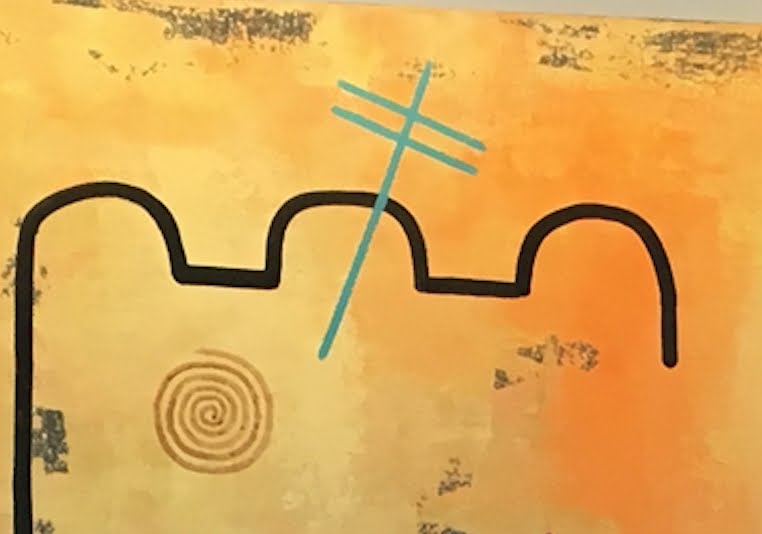
The bluish dragonfly at the top is near a spiral symbol:


I've looked for the meaning of these spirals, which are quite common in Native American art, but no one really knows what they mean.  Some say they stand for water, others say they signify life, but no one knows for sure.

My thought – a bit biased I must admit – has always been that the spirals could represent the water spraying off a dragonfly as it performs a spin-dry after a series of splash-dunks.  What is particularly interesting in this painting is the association between the dragonfly symbol and the spiral symbol – there might be something to my spin-dry interpretation after all.

Monday, April 18, 2016

Variegated Meadowhawks at Bosque Del Apache

Last week, my wife and I visited Bosque del Apache for the first time.  It's quite a delightful place, especially for birdwatchers.  There were a few dragonflies there, as well, including Common Green Darners and Blue-eyed Darners.

We also saw a number of Variegated Meadowhawks, which are wonderfully photogenic.  Here are a few pictures from April 5 this year.


This was the first Variegated Meadowhawk we saw at Bosque.  It perched nicely for us on its favorite perch over the water.

After a while it moved to a closer perch.  Here it is coming in for a landing:


The next shot shows it after its pinpoint landing:


Later we saw another individual, this one much younger:


Notice that the side of the thorax has white stripes, ending in yellow dots at the bottom.  As the meadowhawk matures, the white stripes fade away, leaving just the yellow dots.  This is the case with the first individual, show above, where we see just a faint remnant of the white stripes.

Saturday, April 2, 2016

The Unexpected Pleasures of Dragonflying

You never know what you're going to find when you're out in the field looking for dragonflies.  I went out yesterday to check on the local odes, but didn't find any.  What I did find was well worth the effort, however, and I'm glad I went.

First, I noticed that our saguaro cactus is doing quite well in our front yard.  Here's a look at it:


It has interesting needles, with one spike much larger than the rest:


Also present in the garden were roses and a type of daisy:


As I admired the flowers, I heard a pigeon cooing and strutting to woo its mate:


The really big surprise, however, awaited me when I got down to the pond.  Standing there on the shore was a Black-bellied Whistling-Duck, a species we've never seen at this location before.


That was quite a treat – just one of those unexpected pleasures!  It's especially unexpected when you consider the range of the Black-bellied Whistling-Duck:

Wednesday, March 30, 2016

First Damselfly of the Year, 2016

We saw our first damselfly of the year, Rambur's Forktail, the same day we saw the first dragonfly.  It flew on by us, however – surprisingly quickly for such a small insect – never to be seen again.

It was immediately recognizable by its green thorax and blue-tipped abdomen.  There's another forktail that's similar, the Desert Forktail, but it has yellow on the sides of the abdomen that extends up onto the top of the abdomen.  In Rambur's Forktail the yellow on the abdomen terminates in a nice, clean straight line about halfway up.  We haven't seen a Desert Forktail at our backyard pond, so we were pretty sure we were seeing a Rambur's Forktail.

A week or so later we went to Wild Horse Pass, and there we saw several Rambur's Forktails that were perching for us.  Here's a view of a male Rambur's Forktail at Wild Horse Pass:


Notice the green on the head and thorax, the blue tip to the abdomen, and the lack of yellow on the top of the abdomen.

Here's another male seen later the same day:


Heteromorphic females (those that don't look like males) start off bright orange when young, but with age turn more brownish and greenish.  Here's an immature heteromorphic female seen the same day at Wild Horse Pass:


Notice the nice straight line between the light color on the bottom of the abdomen, and the black on top – similar to the line of demarcation in the male.  We saw the female interact with a male, but she fended it off and they went their separate ways without mating.

Wednesday, March 23, 2016

First Dragonfly of the Year, 2016

We saw our first dragonfly of the year a few days ago flying around the lake in our backyard.  It was a male Red Saddlebags – the species that we observed laying eggs in the lake last year.  So far this year we've only seen the one individual at our lake, and we've only had fleeting glimpses of it.  Our first sighting last year was even earlier, by a few days.

A few days later we went to the Gilbert Water Ranch, where we saw several Red Saddlebags.  One, a female, perched for its picture:


This individual perched on a bush several feet back from the shore at Roseate Bay.  Notice how it folds its front two legs up and tucks them behind its head.  It generally flies in this configuration, as well.

Here's another look from a slightly different angle:


Both photos show a bulge extending below segments 8 and 9 of the abdomen.  This is the female's egg laying mechanism.

When saddlebags (both red and black) lay eggs they have a unique way of doing it.  It's a bit like the lunar landing, where the command module remained in orbit as the lunar lander descended to the surface, the astronauts got out to explore, and then the lunar lander returned to orbit where it re-attached to the command module.  In the case of saddlebags, the male hovers above the water as the female descends, taps the water to lay eggs, then rises to re-join the male.  It's a fascinating procedure to watch.

Here's a link to a slow-motion video showing the egg-laying process in the Red Saddlebags:

https://www.youtube.com/watch?v=CSvPZzgNCbU

In this next video, you can see the process in real time.  Don't blink!

https://www.youtube.com/watch?v=pQp4M_0zJKU

Finally, here's a video where a pair of Red Saddlebags is laying eggs, and another male zooms in and crashes into the pair in an attempt to break them up so he can have the female for himself.  The pair eventually re-attached, however, and continued to lay eggs:

https://www.youtube.com/watch?v=AS6sWAbzRCo

Thursday, February 25, 2016

Splash-Dunk and Two-Spin-Dry Analysis For 2011-2015

This is an article I've submitted to Argia, the journal of the Dragonfly Society of the Americas.

My wife Betsy and I enjoy dragonflying whenever we can, and when we do we’re always on the lookout for interesting behavior.  When a splash-dunk event starts up, for example, we point to the dragonfly as it goes from one splash-dunk to the next, and keep track of the total number of splash-dunks in the event.  We also watch it rise from the water after the last splash-dunk, and keep watching until it performs the spin-dry – that dramatic burst of water spraying in all directions as the dragonfly spins head-over-heels at 1,000 rpm (Walker, 2011, 2014b).  Sometimes they even do two spin-drys back-to-back.
As the summers roll by, we continue to amass interesting data and observations.  The purpose of this article is to present some of the key features of our results, both for this year, and for the period from 2011 to 2015.  This updates the results previously published for 2011-2014 (Walker, 2014a).

Splash-Dunk Distribution for 2015
The 2015 season of splash-dunk events was exceptional in a number of ways.  First, we saw 124 events during the year, which is a record in itself.  The average number of splash-dunks per event was 2.45, which is a bit higher than our cumulative average of 2.31 over the period from 2011-2015.  The reason for this higher average value can be seen in Figure 1, where we show the splash-dunk distribution for 2015.  Notice the small, “secondary peak” at 3 splash-dunks.


Figure 1  Data for the 124 splash-dunk events observed during the 2015 season.

The 3-splash-dunk peak is a feature we haven’t seen before in our data.  It is consistent, however, with the “shoulder” or “plateau” in the data at 3 splash-dunks that has been observed to persist over the years.  There clearly seems to be an unexpected preference for 3 splash-dunks in the dragonfly world.

The second notable aspect of the 2015 season was the “swarm” of events at the Beaver Pond, which we refer to as the “Splash-Dunk Derby” (Walker, 2015).  During this episode, in which 33 events were seen in a short period of time, the average number of splash-dunks per event was 3.18.  This accounts for the higher than usual average value for the year, and the peak at 3 splash-dunks.

Splash-Dunk Distribution for 2011-2015
Over the years since 2011, we’ve observed and recorded data for 576 splash-dunk events.  A plot of the resulting distribution for the number of splash-dunks per event is shown in Figure 2.  As in past years, there is a clear shoulder at 3 splash-dunks.  In addition, the maximum number of splash-dunks for a given event is 8, as it has been for the last several years.  The average number of splash-dunks per event is 2.31, as mentioned above.


Figure 2  Cumulative splash-dunk data for 2011-2015.  The data encompasses 576 distinct events.

With such a large number of observations, the statistical value of these results is significant.  In particular, we see a drop-off by almost a factor of 2 from n splash-dunks to n + 1 splash-dunks – with the notable exception of n = 2 to n = 3, of course.  In addition, more events have only a single splash-dunk than any other number, and roughly 82% of all events have 1, 2, or 3 splash-dunks.

Temporal Distribution of Splash-Dunk Events
In addition to the number of splash-dunks in an event, we also record the date.  This allows us to plot the temporal distribution of splash-dunk activity.  The result, shown in Figure 3, shows a striking peak at the month of September.  In fact, more than half of all the 576 splash-dunk events observed from 2011 to 2015 were seen in that month.

Figure 3  Temporal distribution of splash-dunk events  observed from 2011 to 2015.

In past years, we’ve seen a number of dragonflies get stuck in the water as they perform a splash-dunk.  This generally occurs late in the season, when the air temperatures dip near the lowest value possible for sustained flight (Walker, 2012).  They always get stuck on the first splash-dunk they attempt, and once they fail to exit the water immediately they are condemned to remain stuck.  At times, we’ve seen as many as 8 or 10 dragonflies stuck and struggling at one time.  No dragonflies were observed stuck in the water in 2014, and none were seen again in 2015.  The reason for this isn’t clear, but it’s nice not to have to watch the poor fellows struggling mightily to no avail.

Splash-Dunk Species
Most of the splash-dunks we observe are performed by darners.  In particular, the Paddle-tailed Darner (Aeshna palmata) seems to be the champion of the splash-dunkers.  A pair of male Paddle-tailed Darners are shown resting on my fingers in Figure 4 – I lifted them up from their perches one at a time.  The photo was taken at Cranberry Lake in Anacortes, WA, a prime location for splash-dunks and spin-drys.  


Figure 4  A pair of Paddle-tailed Darners taking a rest between bouts of splash-dunking and spin-drying.

Paddle-tailed Darners are strong fliers, and they plow headfirst into the water at considerable speed when they splash-dunk, creating a sizable splash in the process.  I refer to the splash as a “dragon splash,” because it resembles a typical winged dragon, with a large central splash produced by the body of the dragonfly, and smaller side splashes produced by the wings.

Other darners have also been observed to splash-dunk.  They are as follows:

California Darner (Rhionaeschna californica)
Blue-eyed Darner (Rhionaeschna multicolor)
Common Green Darner (Anax junius)
Shadow Darner (Aeshna umbrosa)

We occasionally see dragonfly species other than darners engaging in splash-dunking, though usually in isolated incidents.  The following species have been observed to splash-dunk:

Four-spotted Skimmer (Libellula quadrimaculata)
Eight-spotted Skimmer (Libellula forensis)
Western Pondhawk (Erythemis collocata)
Cardinal Meadowhawk (Sympetrum illotum)
Autumn Meadowhawk (Sympetrum vicinum)
Blue Dasher (Pachydiplax longipennis)

The new addition to the list this year is the Cardinal Meadowhawk.

Distribution of Two-Spin-Dry Events
When a dragonfly rises from the water after a series of splash-dunks, we always watch with interest to see the spectacular spin-dry.  Sometimes we can even see the body of the dragonfly curled up in a loop as it spins like a bicycle wheel.  When the lighting is just right – especially when the dragonfly is backlit – we can often see droplets of water shooting off in all directions.  Even in cases where we can’t see the spinning and water droplets directly, we can see the slight “zigzag” in the flight path as the dragonfly drops downward during the spin.

What is particularly interesting is that we sometimes see two spin-drys, one right after the other.  Apparently the dragonfly just doesn’t feel dry enough after one spin-dry, so it promptly does another.  This occurs in only about 5% of splash-dunk events that we’ve observed since 2013, when we began collecting this data.  Our results for 2013 to 2015 are presented in Figure 5.


Figure 5  Temporal distribution of two-spin-dry events from 2013 to 2015.

So far, only 17 two-spin-dry events have been recorded, so the data in Figure 5 should be taken with a grain of salt.  As the years go on, we will be able to improve the statistical significance of these results.  At the moment, however, it appears that two-spin-dry events are more likely later in the season.  It will be interesting to see if this trend persists with additional observations.

Acknowledgements

I would like to thank Betsy Walker for help collecting the data presented here, and for co-leading our splash-dunk/spin-dry dragonfly field trips.

Literature Cited

Walker, J. S. 2011.  Spin-Dry Dragonflies.  Argia 23(3): 29-31.

Walker, J. S. 2012.  Splash-Dunking Gone Bad: The Sticking Frequency.  Argia 24(1): 19-22.

Walker, J. S. 2014a.  Life at 1,000 RPM.  Argia 26(2): 11-13.

Walker, J. S. 2014b.  Splash-dunk Analysis For 2011-2014.  Argia 26(4): 32-33.

Walker, J. S. 2015.  Splash-Dunk Derby at Beaver Pond.  Argia 27(4): 22-24.