Friday, April 13, 2018

Roseate Skimmer at Roseate Bay

There's one spot at the Gilbert Water Ranch that we refer to as "Roseate Bay" because we often see Roseate Skimmers there. Today we saw our first of the year, a young male. Here it is:


The roseate colors haven't developed yet, but they will soon.

Why is this a male? Well, first, the hamules are visible under segment 2 of the abdomen; second, the appendages are fairly large; third, the tip of the abdomen lacks the flanges associated with the egg scoop of the female of this species. Here's a look at two females from last season—the top two in the photo below—showing the flanges near the tip of the abdomen:


It's also clear from the above photo why this area is called Roseate Bay.

Here's another view of today's male:


You can just see a hint of the roseate color to come. Dragonfly season is getting started!

Thursday, April 12, 2018

Species Spotlight: Desert Firetail

The Desert Firetail is a small delicate damselfly that likes to lay eggs on floating vegetation, like lily pads or algae. The male's abdomen is a fire red color—hence the common name.

Here are a couple males resting near a pond:


The red abdomen and short wings make this an easy damselfly to identify. Here's a photo that shows just how short the wings are in this species:


This is a male—as can be seen from the protrusion under segment 2 of the abdomen (the hamules) and the lack of an ovipositor at the tip of the abdomen. It is a young male, as evidenced by the light red color on the abdomen.

Pairs lay eggs with the male attached to the female. Males stand upright when attached, and if a group is laying eggs together the males can look like red blades of grass. Here's a pair in which the female is laying eggs on the underside of a lily pad:


A closer look at the female shows how the male is attached to the front of the female's thorax—not to the back of her head, as in dragonflies:


You may observe adults emerging from their larval (naiad) skins in the same general area where the eggs are being laid. Here's a larva that was swimming a few moments before the photo was taken, but who is now drying out on a lily pad, getting ready for the adult to emerge.


In a matter of minutes, the adult makes its appearance:


Soon thereafter the adult is fully emerged from its larval skin, and it now begins to pump up its abdomen and wings to their final size.


Ah, such is the life of an odonate!

Tuesday, April 3, 2018

Dragonfly Alley

A few days ago we visited an area that was new to us, referred to locally as "Dragonfly Alley." On the map its proper name is Queen Valley, and it lies about midway between Gold Canyon and the Boyce Thompson Arboretum. Here's a map of the general area:


Here's a close-up view of the community itself:


Queen Valley is a small little town, centered around a source of water and a golf course. There's nothing else near it—just wild desert.

It also happens to be a great place for dragonflies and damselflies. Over the year, a total of 59 species have been seen in Queen Valley. We went early in the season, so our species list was more like 15 or so. And since this is an early-season population, it consisted of about twice as many damselflies as dragonflies—more or less the reverse of what is typically seen in mid season.

The first odonate we saw as we got out of the car was the Aztec Dancer.


What lovely, intense blue colors it has on both the body and the eyes. Here it is taking off:


This species preferred the shoreline of one of the ponds on the edge of the golf course. Also prominent in the same area was the Familiar Bluet:


Notice how the bluet folds its wing along the abdomen—almost forming a "tent" over the abdomen. In contrast, the wings of dancers are held high above the abdomen.

At a nearby stream, we found the Springwater Dancer.


We were looking for an American Rubyspot here as well, since this is their preferred habitat. After a few minutes one indeed showed up:


One of the most interesting odonates we saw that day was a female Filigree Skimmer. Here she is perched in the sun:


She blends in to the surroundings so well with her wings that look like dried-up leaves and her abdomen that looks like a twig. Notice also her boldly-striped eyes and prominent egg scoop under the abdomen near the tip. Quite the dragonfly.

Queen Valley was a fun place to explore. It's just a small valley in the middle of the desert, hot as blazes, but a great spot for dragonfly watching.

Thursday, March 29, 2018

Species Spotlight: Common Whitetail

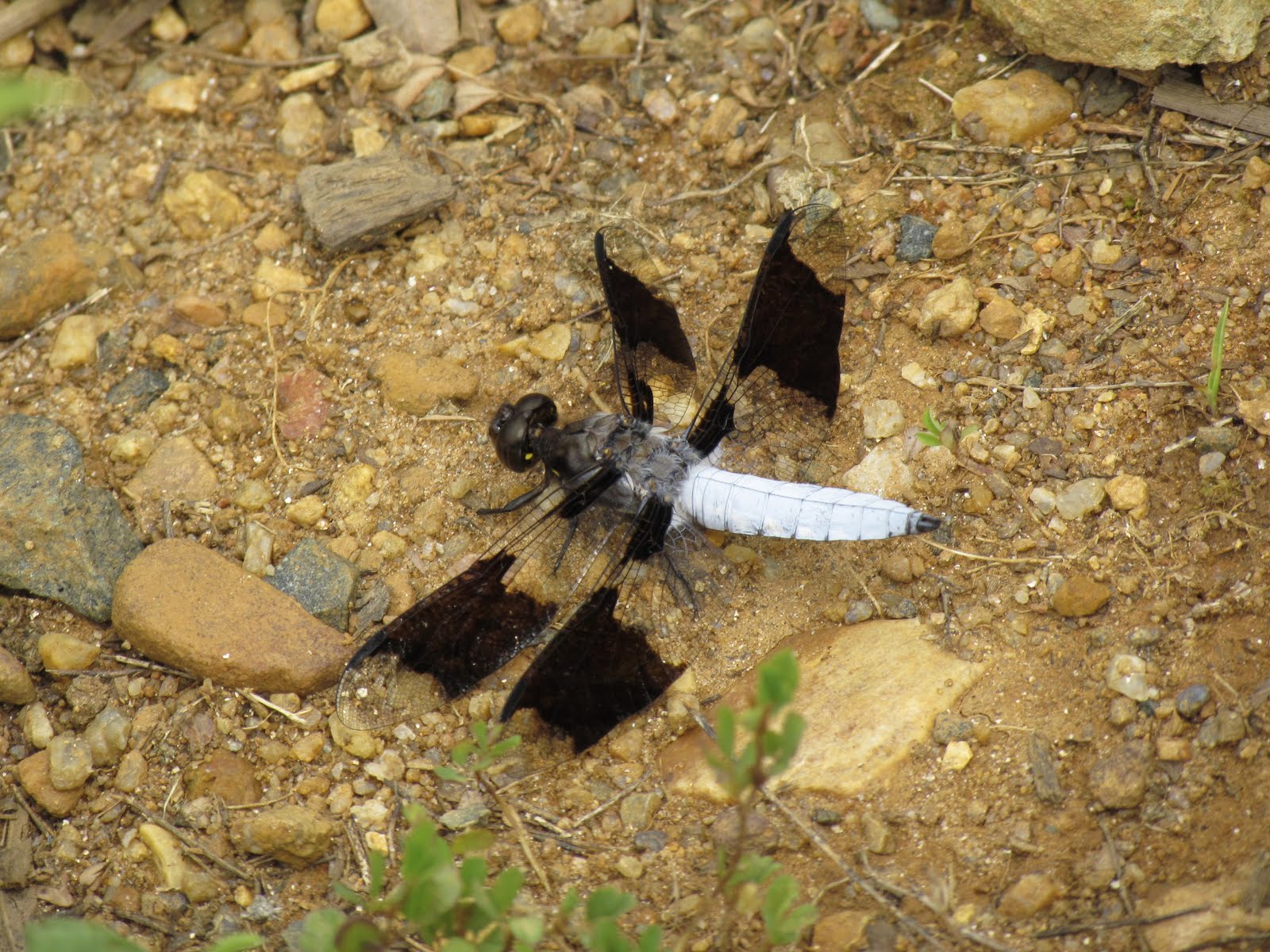
The next species in the spotlight is another "common" species—the Common Whitetail. Here's a look at the male of the species:


Notice the brilliant white abdomen—the origin of its common name. The abdomen is wider and flatter than in other species, to show it off to best effect; the underside of the abdomen is black. The white color is the result of pruinosity, which is also visible near the base of the wings. Speaking of the wings, the large black patches are another prominent field mark for this species—as if any additional field marks were needed.

This species generally perches on the ground, when bare areas are available. Here's another example:


Males chase one another back and forth along the shoreline incessantly, and in a very particular way. The pursued male depresses his abdomen to shows its white surface to the pursuer; the pursuer raises its abdomen to show the white surface to the male it's chasing.

Females of this species have small dark spots in the wings, similar to those in female Eight-spotted Skimmers and female Twelve-spotted Skimmers. A key difference, besides the number of black spots in the wings, is that the side stripes along the edge of the abdomen are straight and yellow in the Eight-spotted and Twelve-spotted Skimmers, whereas all but one are white and curve inward at the forward end in the Common Whitetail. This can be seen clearly in the photo of a female Common Whitetail below.


For comparison, here's a female Eight-spotted Skimmer, with her straight, yellow side stripes:


The abdomens of Common Whitetails are so stout and thick that it is difficult for them to maintain the wheel position; therefore, mating is very brief. In addition, it's hard for them to remain attached in tandem, and hence the female lays eggs by herself as the male hovers above her to ward off any intruders.

All in all, the Common Whitetail is a beautiful dragonfly species with lots of interesting behavior to observe. Read more about this and other species in my new field guide, Common Dragonflies and Damselflies of the Pacific Coast.

Monday, March 26, 2018

Vitruvian Tattoo

I just had a request from a da Vinci/dragonfly enthusiast to use the Vitruvian Dragonfly, shown below, for a tattoo.


That should be interesting. I'm curious to see the final result.

The above is a polished piece of art by Sabine Deviche from my original concept shown below:


She also made the following full color version:


I think they're both fantastic.

You can find more of Sabine's wonderful artwork at her website:

http://devichedesigns.com/home

Tuesday, March 20, 2018

Common Dragonflies and Damselflies of the Pacific Coast

Here's the cover of my new dragonfly field guide.


The guide has a nice feel to it, due in part to the high quality paper that we used, but also to the size and shape of the book that allows it to fit nicely in the hand or pocket.

Here's a peek inside the guide, at the spread for the Comm Green Darner, the subject of the previous post.


Each species has its own spread, and each has a number of helpful features:

• Life Size Photo
• Range Map
• Flight-Season Chart
• Annotated Photos
• Colored Margins

Here's a brief description of each feature:

Life Size Photo (A unique feature in this guide) Dragonfly field guides generally give a numerical value for the size of a dragonfly species. This is fine, as far as it goes, but what's even better is to show the dragonfly at life size right there in the guide. The photo on the left side of the Common Green Darner spread shows the dragonfly at life size—as if it had actually landed on the page. Now you know exactly how big it is.

Range Map The range maps in this field guide are derived from dots maps produced by the Dragonfly Society of the Americas (DSA). The observations in the maps are vetted by dragonfly experts, and provide the current state-of-the-art in our knowledge of dragonfly ranges.

Flight-Season Chart (A unique feature in this guide) The DSA dot maps have dates associated with each observation. I have "data-mined" this information to produce charts that show the percentage of observations for each month of the year. The charts give not only the beginning and ending months of the flight season, as in many guides, but also the distribution of sightings within the season.

Annotated Photos (A unique feature in this guide) It can be hard when you start to do some dragonflying to know just where to find the relevant field marks of a particular species. In this guide, each species has annotated photos that point out exactly where the key field marks are and how to interpret them.

Colored Margins The margins of each spread have a color that is most characteristic of that particular species. Thus, the margins on the Common Green Darner spread are green. By looking for the appropriate color on the margins of the pages you can quickly locate the section where the dragonfly you want to identify is located.

The guide also includes detailed information on dragonfly behavior, and I'll describe some of those features in future posts.

Here's a link to the Amazon page for the book:

Link To Amazon

It's been a lot of fun writing this book, including as it does so many of my favorite photos and new observations of dragonfly behavior. I sincerely hope it will be helpful in introducing others to the pleasures of dragonflying!

Monday, March 19, 2018

Species Spotlight: Common Green Darner

The next species in the spotlight, the Common Green Darner (Anax junius)—which is closely related to the previous species, the Comet Darner (Anax longipes)—has the distinction of being the official state insect of Washington state. It is a large, vigorous dragonfly that is widespread across North America, and is one of the species of dragonfly known to migrate. Its scientific name means "King or Ruler of June" referring to the peak of its flight season; the scientific name for the Comet Darner means "Ruler with long legs" which is certainly an apt name as can be seen in the photos for that species below.

You can judge the size of this species from the following photo, showing a mating pair that I whispered onto my finger.


One day we saw a male Common Green Darner catch and consume a female Eight-spotted Skimmer—which is a good-sized dragonfly in its own right.

Here's a pair of Common Green Darners in tandem, as the female lays eggs in a floating log. Sometimes the female will go partly underwater—up to her thorax at least—as she probes for a suitable deposition site. Notice also the yellow veins on the leading edge of the wings.


The following shot shows a freshly emerged teneral female Common Green Darner. The colors are bright and fresh, and her body is partially translucent.


Common Green Darners are always a delight to see as they whiz by at high speed. Seeing one perched so you can get a close up look is an added bonus.