Here's sort of an engraved invitation to tomorrow's dragonfly talk, by way of the Vitruvian Darner:
This dragonfly (the Happy-face Dragonfly) shows the nice proportions of da Vinci's Vitruvian Man.
I was curious how these proportions would compare with other dragonflies, so I tried a Vitruvian Glider, based on a Wandering Glider:
Not surprisingly, the broad, wide wings of the glider give it distinctly different proportions.
Both of these sketches were taken from photographs, so the proportions are true to life.
Off to Prescott tomorrow.
Wednesday, May 21, 2014
Monday, May 19, 2014
The Whisperer Speaks: Dragonfly 101 Handout
I've prepared a handout to go along with my upcoming talk for Prescott Audubon. Unfortunately, I don't know how many to expect at the meeting, so it's probably best to post the handout here where everyone can have a copy if they like.
This should make the handout available to a wider audience, and also provide a color version suitable for printing at home. Please feel free to print out a copy. No need to bring it with you, unless you want to use it to take notes.
See you there, Thursday.
This should make the handout available to a wider audience, and also provide a color version suitable for printing at home. Please feel free to print out a copy. No need to bring it with you, unless you want to use it to take notes.
See you there, Thursday.
Thursday, May 15, 2014
The Whisperer Speaks in One Week!
In just one week, on Thursday, May 22, 2014, The Dragonfly Whisperer speaks at the general meeting of the Prescott Audubon Society. They've been kind enough to invite me, and I'm looking forward to a fun evening. We also plan to conduct a dragonfly walk the following day.
They have a very active organization, with lots of different programs, and they've produced some excellent promotional materials to advertise the talk. Here's an example:
That should attract some attention. Even the Vitruvian Dragonfly is getting into the act:
Prescott Audubon's website contains more specific information:
Be sure to say "Hi" if you can make it to the presentation. Betsy and I will be looking onward to seeing you..
You can find more information about Prescott Audubon at their website:
http://prescottaudubon.org
They have a very active organization, with lots of different programs, and they've produced some excellent promotional materials to advertise the talk. Here's an example:
That should attract some attention. Even the Vitruvian Dragonfly is getting into the act:
Be sure to say "Hi" if you can make it to the presentation. Betsy and I will be looking onward to seeing you..
You can find more information about Prescott Audubon at their website:
http://prescottaudubon.org
Wednesday, April 23, 2014
The Unexpected Pleasures of Dragonflying: A Rattler and a Monster
One of the great things about dragonflying is that it gets you out in the field where you're likely to see many wonders of nature. A couple weeks ago we went to the Boyce Thompson Arboretum, and though we saw only a couple Blue-eyed Darners and one Flame Skimmer at Ayer Lake, we saw lots of other delights.
One was a beautiful male Broad-billed Hummingbird that perched for us in the sunlight. This was in the Cactus Garden area, near the boojum tree. Such a nice contrast between his flame red bill and the iridescent blues and greens in his body.
| A Broad-billed Hummingbird at the Boyce Thompson Arboretum. |
A little later, on the shady path near the Herb Garden, we saw two baby Anna's Hummingbirds almost spilling out of their tiny nest. Good thing it's so elastic. Here are the babies:
| Baby Anna's Hummingbirds overflowing their nest. |
As we watched, they decided to take a little nap:
| Nap time for the babies. |
Hummingbirds are a common part of a visit to the arboretum, even babies in the nest. What was a bit more exciting, however, was the next unexpected pleasure – a Western Diamonback Rattlesnake. We were heading back toward the picnic area for lunch when we spotted a good-sized rattler under a bush. I would say it was around 5 feet long. Here are a couple photos of it:
| Western Diamondback Rattlesnake. Clearly a member of the pit viper family. |
He was getting a good look at us. As he moved on I was able to get a couple shots of his rattles, and also the black and white bands of roughly equal width:
It was interesting having lunch, knowing this guy was just a few feet away. Oh well, he was staying well under the bush, so we weren't concerned.
After lunch we took a walk through the Demonstration Garden. We checked out the hummingbird nest on top a pine cone, but discovered that the babies had left. Just then we stopped dead in our tracks as we saw the guy below lumbering out of the meadow onto the walking path:
| A Gila Monster strolling across the walking path. |
What a treat to see the Gila Monster. We've seen them before at the arboretum, but always in the desert area, near the Cactus Garden. This was the first we'd even heard of one being in the Demonstration Garden.
He sauntered across the path, then disappeared into the brush on the other side. A nice treat to top off our day of unexpected pleasures.
Tuesday, April 22, 2014
The Whisperer Speaks! Prescott Audubon, May 22
In just one month, on May 22, 2014, The Dragonfly Whisperer speaks at the general meeting of the Prescott Audubon Society. They've been kind enough to invite me, and I'm looking forward to a fun evening.
They have a very active organization, with lots of different programs, and they've produced some excellent promotional materials to advertise the talk. As an example, here's an ad they'll be distributing soon:
That should attract some attention.
Their website contains more specific information:
Betsy and I will be there – be sure to say "Hi" if you can make it, too.
You can find more information about Prescott Audubon at their website:
http://prescottaudubon.org
Thursday, April 10, 2014
Roseate Bay at the Gilbert Water Ranch
Another place we like at the Gilbert Water Ranch is what we call Roseate Bay, so named because Roseate Skimmers are so abundant there. It's located at the northern end of Pond #5 in an area that stays wet all the time, while most of the pond dries up. Its location is indicated on the map below:
There's also a nice shaded viewing blind at Roseate Bay. It's a great place to see 3 or 4 Roseate Skimmers perched at a time, while in the background all sorts of ducks and shorebirds are feeding.
Here are a couple shots of a Roseate Skimmer at Roseate Bay. They're very active right now, and often just perch for a few seconds before taking off again, but every now and then one rests for long enough to get some good shots.
| Roseate Skimmer, at Roseate Bay, Gilbert Water Ranch. |
The same individual. Notice how the front two legs are tucked up nicely behind its head. This is where they hold the front legs during flight as well. Once the rear four legs capture an insect, the front two legs come into play as they manipulate the prey item for processing.
Also observed at Roseate Bay were a couple Variegated Meadowhawks. Here's one on a stem, watching for something to take off and chase.
| Variegated Meadowhawk, Roseate Bay, Gilbert Water Ranch. |
The same individual from a different angle. Notice the two yellow spots on the thorax. When it was younger, there would have been two white stripes on the thorax, with yellow spots at the bottom. With age, the white fades away, leaving just the yellow spots. Notice also the intricate pattern on the abdomen, the reason for its name.
Monday, April 7, 2014
A Day At The Boyce Thompson Arboretum
Betsy and I went to the Boyce Thompson Arboretum yesterday. It's one of our favorite places, and we always have a great time there. Below is where we have our lunch after a full morning hiking the trails.
One of the fun things about the arboretum are the many hummingbird nests you can find there. Yesterday, we found four nests, and weren't even looking for them. Below is one where we could watch the mother feeding her young, and at the same time admire the construction of her nest.
Another nest with feeding going on was built right on top a pine cone. You can see the location in the photo below. The lowest pine cone in the tree, the one against blue sky just above a distant mountain peak, is the one with the nest. Betsy and I found it a week or so ago by "looking for it," and we were just checking up to see how things were going.
The mother using this nest was quite attentive. In the sequence of photos below you can see her feeding one baby, taking a breather, then feeding the other baby.
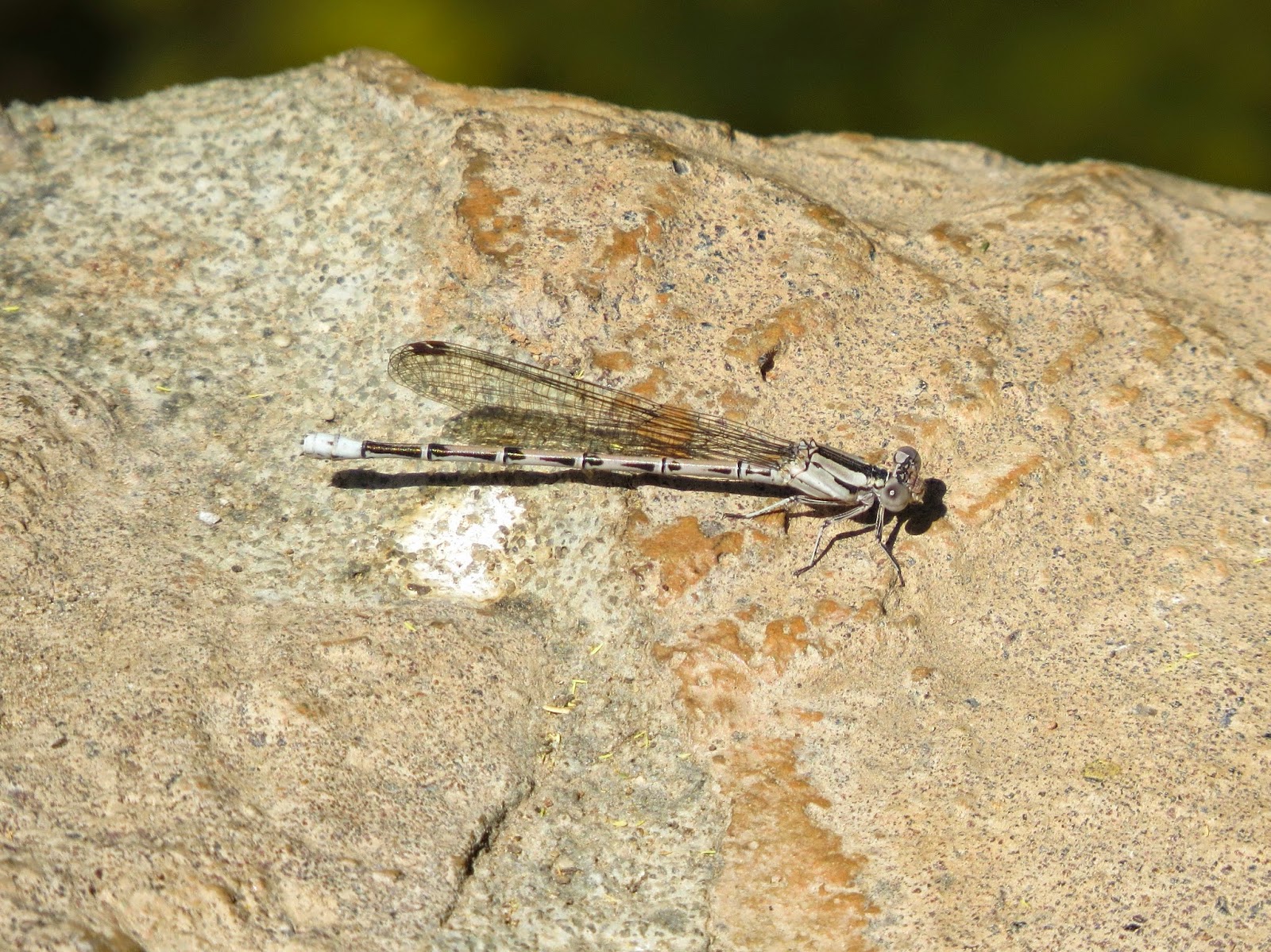
There weren't many odonates at the arboretum, but we went primarily for the birding in any case. We did find a few, though. The first one was a female Springwater Dancer at the mini-oasis. In the past we saw numerous Desert Firetails at this location, but after they cleaned out the pool only a few have been seen. We usually encounter the Springwater Dancer on Queen Creek, so we were a bit surprised to find it here.
It's clear right away that this damselfly is a dancer, by the way it holds its wings high above the abdomen. This is a characteristic pose for dancers. Bluets use their wings to make a "tent" enclosing the abdomen. Notice, in addition, the "arrowhead"-shaped dark markings on the side of the abdomen. This is a good field mark for the Springwater Dancer in this part of the country. Back in the northwest, though, markings like that indicate a Vivid Dancer.
The next odonate we encountered was a Filigree Skimmer on Queen Creek. It was perched on the ground, as is usual for this species. The filigree name comes from the intricate pattern in the wings, but there are intricate patterns all over this dragonfly. The abdomen, for example, has fine markings for most of its length. In addition, the eyes are covered with alternating light and dark lines. One has to wonder what the world looks like to the Filigree Skimmer.
As we continued on the trail, we soon came to Ayer Lake, shown below. Here we saw three male Blue-eyed Darners actively searching the shoreline for females. Betsy also saw one perch in the bushes.
In addition to the darners, there were a couple birds of note on the lake. You can probably just make them out below, near the center of the picture. They are a pair of Hooded Mergansers, enjoying the day.
When I got home I posted a checklist to eBird, and to my surprise the Hooded Mergansers were questioned – in fact, I had to add them to the checklist by hand. I knew they were unusual there, but didn't think of them as being rare. I was more intrigued by our observation – with a tip from naturalist Paul Wolterbeek – of a Common Ground-Dove.
In any case, I described the mergansers for eBird, and included the photo below.
I'm glad they posed for a nice shot to verify the identification.
All in all, a wonderful day at the Arboretum.
| A female hummingbird with some sort of a small bug, which she fed to her young. |
Another nest with feeding going on was built right on top a pine cone. You can see the location in the photo below. The lowest pine cone in the tree, the one against blue sky just above a distant mountain peak, is the one with the nest. Betsy and I found it a week or so ago by "looking for it," and we were just checking up to see how things were going.
| A hummingbird built its nest on top the lowest pine cone visible here, the one just above a distant mountain peak. |
The mother using this nest was quite attentive. In the sequence of photos below you can see her feeding one baby, taking a breather, then feeding the other baby.
There weren't many odonates at the arboretum, but we went primarily for the birding in any case. We did find a few, though. The first one was a female Springwater Dancer at the mini-oasis. In the past we saw numerous Desert Firetails at this location, but after they cleaned out the pool only a few have been seen. We usually encounter the Springwater Dancer on Queen Creek, so we were a bit surprised to find it here.
It's clear right away that this damselfly is a dancer, by the way it holds its wings high above the abdomen. This is a characteristic pose for dancers. Bluets use their wings to make a "tent" enclosing the abdomen. Notice, in addition, the "arrowhead"-shaped dark markings on the side of the abdomen. This is a good field mark for the Springwater Dancer in this part of the country. Back in the northwest, though, markings like that indicate a Vivid Dancer.
| A female Springwater Dancer at the mini-oasis. |
The next odonate we encountered was a Filigree Skimmer on Queen Creek. It was perched on the ground, as is usual for this species. The filigree name comes from the intricate pattern in the wings, but there are intricate patterns all over this dragonfly. The abdomen, for example, has fine markings for most of its length. In addition, the eyes are covered with alternating light and dark lines. One has to wonder what the world looks like to the Filigree Skimmer.
| A Filigree Skimmer on a gravel bar in Queen Creek, near the pump house. |
As we continued on the trail, we soon came to Ayer Lake, shown below. Here we saw three male Blue-eyed Darners actively searching the shoreline for females. Betsy also saw one perch in the bushes.
In addition to the darners, there were a couple birds of note on the lake. You can probably just make them out below, near the center of the picture. They are a pair of Hooded Mergansers, enjoying the day.
| Ayer Lake, at the Boyce Thompson Arboretum. Notice a pair of birds near the center of the picture. |
When I got home I posted a checklist to eBird, and to my surprise the Hooded Mergansers were questioned – in fact, I had to add them to the checklist by hand. I knew they were unusual there, but didn't think of them as being rare. I was more intrigued by our observation – with a tip from naturalist Paul Wolterbeek – of a Common Ground-Dove.
In any case, I described the mergansers for eBird, and included the photo below.
| A pair of Hooded Mergansers on Ayer Lake. eBird regarded them as rare for that location. |
I'm glad they posed for a nice shot to verify the identification.
All in all, a wonderful day at the Arboretum.
Subscribe to:
Posts (Atom)


